
- Home
- Live Blog
- Breaking News
- Top Headlines
- Cities
- NE News
- Sentinel Media
- Sports
- Education
- Jobs
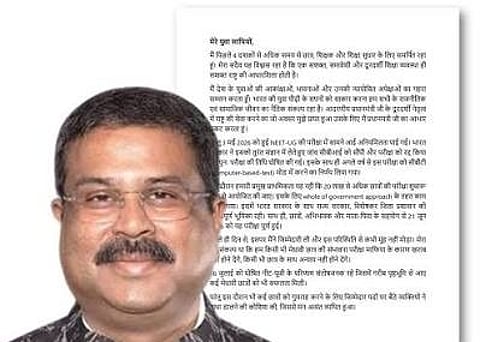
The resignation of Union Education Minister Dharmendra Pradhan on Saturday, following a massive nationwide protest against the leak of the NEET question paper, has signalled several issues. First and foremost, Pradhan - and for that matter, the government - has admitted that irregularities did occur in the NEET-UG examination held on May 3, 2026. Even as the agitation gathered momentum, the government had removed as many as 47 officers of the National Testing Agency. Prime Minister Narendra Modi has, in the meantime, announced major steps like fast-track courts to try paper leak cases to set things right. The government has also approved a draft bill to ensure stricter punishments for paper leaks. Mention must also be made that the agitationists were given a bit longer time because of the government's initial reluctance to reach out to their leaders. What, however, must be appreciated is that, sensing trouble, the prime minister finally dispatched two senior ministers to meet Sonam Wangchuk and end his hunger strike. Following this meeting, the government held talks with the agitation leaders on Saturday. While it is not clear whether Pradhan resigned on the prime minister's advice, his resignation has prompted the group to call off the agitation. Dharmendra Pradhan, who has spent nearly four decades rising through the ranks of the Akhil Bharatiya Vidyarthi Parishad (ABVP), RSS, and the BJP, is the first Union minister to resign since Narendra Modi became prime minister. What we must also remember is that Dharmendra Pradhan's resignation has demonstrated that India's youth can compel political concessions. Dharmendra Pradhan's resignation has demonstrated that India's youth can compel political concessions. Additionally, the resignation, which came in the wake of the youth-led protests, signals a significant shift in the political landscape of the country. The series of incidents, starting with the question paper leak, the rescheduling of the NEET, the suicide of numerous candidates, the nationwide protest, and Sonam Wangchuk's hunger strike leading to the education minister's resignation, clearly highlights the urgent need to address the concerns of the youth, particularly at a critical moment when the prime minister has placed his hopes on them to guide the country through to 2047.
