
- Home
- Live Blog
- Breaking News
- Top Headlines
- Cities
- NE News
- Sentinel Media
- Sports
- Education
- Jobs
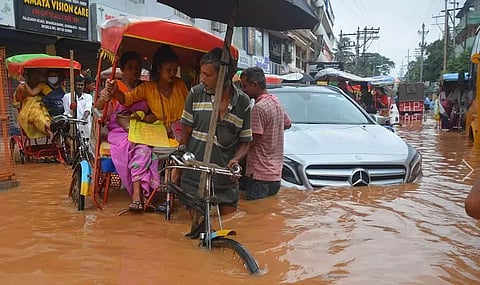
The harrowing time that Guwahati passed through in the past four or five days is a clarion call for the Himanta Biswa Sarma government to take a fresh look at the city's drainage system. Guwahati's environmental sufferings began the day a decision was taken by Sarat Chandra Sinha's Congress government to shift Assam's capital "temporarily" from Shillong to Dispur in the early 1970s. Shifting the capital was inevitable. But then, the manner in which it was shifted, and the way Guwahati was subjected to rapid and haphazard growth were totally uncalled for. Guwahati's suffering is also the result of lack of vision and perspective in planning and failure in understanding the city's topography and environment. It is interesting to note that these things have been very clearly acknowledged by the Guwahati Development Department in its mission statement titled 'Mission Flood-Free Guwahati'. The department must be congratulated for putting on record that unplanned expansion of the city and increasing population have led to severe encroachment in the wetlands, low-lying areas, hills and shrinkage of forest cover. Given the experience that Guwahati had undergone last week, what the government at its highest level probably needs to do is to take up a widening project for all the rivers, streams, rivulets and other water-channels and wetlands within the city. If land can be acquired by awarding adequate compensation and encroachers can be removed with an iron fist in case of widening of highways, the same approach can also be taken to widen the natural drainage network of Guwahati. Large tracts of land actually belonging to the Bharalu and all other rivers, streams and rivulets of the city have been anyway occupied by a section of people by one means or the other. If one section of these people is illegally sitting on such land, another section – the influential, powerful and well-connected section – has managed to convert such land to patta land. The list of the second category includes politicians, former government officers, and private institutions owned by such people. There are also a few government institutions. This is the most appropriate time to demarcate five to ten feet on both sides of every river, stream and rivulet within Guwahati and remove all structures from them. This is also the right time for the government to revisit the Guwahati Waterbodies (Preservation and Conservation) Act of 2008 and return to Silsako, Borsola, Sarusola, Bondajan, Deepor Beel and all other wetlands and waterbodies within Guwahati metropolitan area all the land that have been encroached by and/or allotted to various individuals in the past two or three decades. After all, Guwahati has to last forever, and it has to be converted into one of the best liveable cities of the country.
