
- Home
- Live Blog
- Breaking News
- Top Headlines
- Cities
- NE News
- Sentinel Media
- Sports
- Education
- Jobs
Karun Lama
(The writer can be reached at karunlamascholar@gmail.com)
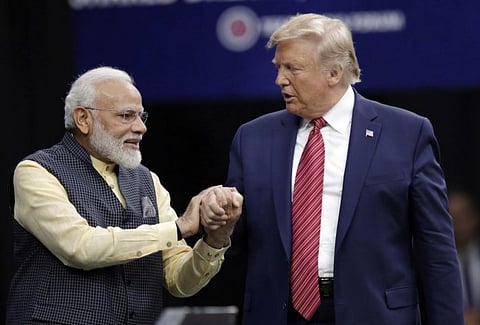
India and the United States of America, being the two largest democracies of the world, time and again, have undergone different statures of bond ever since colonial India had been on her struggle for independence. As such, though India emerged to be a successful democracy much later than the already democratic and powerful US, yet in the contemporary times, the geopolitics has evolved in such a way that none of the two nations can overlook one another, which certainly can be reckoned by the recent visits of Modi followed by Trump, engaged in extending friendship between the two nations like never before if one keenly observes the ‘Howdy Modi’ event followed by ‘Namaste Trump’ extravaganzas. Well, as of now, how long this warm cordial friendship between the two nations would continue to prevail would soon be revealed in a couple of months from now. However, if one retrospects this relationship, it can be count in different phases of both ups and downs in the past.
To begin with the pre-independence era, India’s struggle for independence had indeed caught America’s attention as the latter also didn’t favour colonialism since America herself had been a British colony once. Franklin D Roosevelt the then President of the USA had full support for India’s independence albeit on moral and strategic grounds. However, after the outbreak of the Second World War and Japan’s growing imperialism in Asia, America’s position remained unclear with its subscribing to the British view. However, the initial years of India’s independence saw great heights of support from the US when India was at a need due to famine wherein the Truman’s India Emergency Food Assistance Act 1951 came out as a helping hand to the needy India. Not just this, India’s Green Revolution having inspired by Norman Borlaug changed the entire scenario which prevailed then into an affluent India.
However, in bi-polar politics, India refrained herself from making direct involvement. But India seemed slightly inclined towards the socialist ideology, no doubt, there stood genuine reasons as America’s freestyle market capitalism created suspicion in many of the Indian elites, including Prime Minister Nehru. Knowing that imperialism or colonialism was nothing but the cause & effect of Capitalist ideology, hence nations like India had the fear of the powerful colonialist countries such as the USA that they might recolonize the newly independent countries.
The US continued to support India during the Sino-India war in 1962. It was also because China was a closer ally of the Soviet Union carrying similar ideology of Communism. But, Nehru’s Non-Aligned policy in search of strategic autonomy unfavoured America’s scheme of geo-strategic balancing in Asia. No doubt, in retrospection for India, it’s worth mentioning that NAM indeed played a significant role in sustaining India’s sovereign democracy though then India’s economic and strategic insignificance followed a new gap in the relation of the duo.
Thereafter, the relationship post-1962 didn’t go well with the emerging bond amongst US-Pakistan-China. Also, the USA had always been vocal of the Kashmir issue against India. Henceforth, India signed the Indo-Soviet Peace, Friendship & Co-operation Treaty in 1971. Notwithstanding, India was never critical against Soviet’s invasions in Hungary, Czechoslovakia and later Afghanistan in 1979. Such instances certainly added impediments in the already deteriorating relation.
Following this, America turned her support for Pakistan in the Bangladesh liberation India-Pakistan war of 1971. Nixon the then President of the USA even dispatched aircraft against India. Moreover, taking the advantage of ideological rift between the two great communist nations – USSR and China, the USA in 1972 tied hands with China. Thus as seen so far, for the USA, dictatorial-ship of Pakistan and the Communist China was more acceptable than the democratic India. This certainly proves Henry Kissinger’s saying – “America has no permanent friends or enemies, only interests”. The major setback in India-US relations happened to be because of India testing her first-ever nuclear power which was against the nuclear treaties formulated by the US. Eventually, India signed the Non-Proliferation Treaty in 1978.
The entire global geo-politics changed after the collapse of the USSR; the cold war ended and the world order moved towards unipolar where the USA stood as the only superpower. Both India and Russia had no much of choice rather than to have better relation with the USA. India’s policy began to favour US so as to have a close alliance. Thus in one hand, where both India & Russia were trying to get closer to the USA while on the other hand there emerged a rift between India and Russia.
Thus, in the early 1990s, India on one hand lost her Soviet ally while on the other hand it was undergoing a serious economic crisis. This was the period when Dr. Manmohan Singh serving the portfolio of Finance Ministry initiated the Structural Adjustment Programme (SAP) to reform India’s economy which was successfully followed by gradual economic reforms on the liberal lines. With this, America’s growing interest was obvious as India opened a huge middle class market. And needless to say, geopolitical and strategic purposes, and economic reasons are the two major factors guiding the US policies.
Another series of intensive engagements took place between India and US in 1998 when India again tested her nuclear program but this time, sanctions were put by the US. No matter, it was later justified as a measure of deterrence by India against the already nuclear power China. The very next year followed the Kargil War when it was thought that US and China would take sides for Pakistan, but fortunately it didn’t happened so, instead Pakistan was asked to withdraw her army by US. Henceforth, with the beginning of the new century, Clinton’s India visit in 2000 marked the beginning of a new era in Indo-US relations which was followed by the historic Bush-Manmohan Civil Nuclear Deal signed in 2008. Along with this, the growing bilateral trade between both the nations has also ushered in extending their friendship and ties.
However, only bilateral terms aren’t sufficient to understand the relationship as both the nations have also been negotiating in various multilateral forums, be it in WTO, Climate negotiations and so on. Moreover, there are various other international issues and security concerns, for instance – the USA-Taliban truce followed by the withdrawal of American soldiers from Afghanistan brings a lot of concern to India, the US-Iran conflict has affected India’s bilateral trade with Iran, et el. However, the decade marked several instances when the world witnessed euphoric events, be it – Modi and Obama – both exchanging visits in each other’s country or the very recent visits of Modi and Trump, all these have indeed created positive sentiments among the masses of both the nations and strengthened the ties. Well, the decade as it now ends soon with this friendship reaching at a peak and also the US presidential election just a few months away whether the India-US relation will continue remains under deep reckoning!