
- Home
- Live Blog
- Breaking News
- Top Headlines
- Cities
- NE News
- Sentinel Media
- Sports
- Education
- Jobs
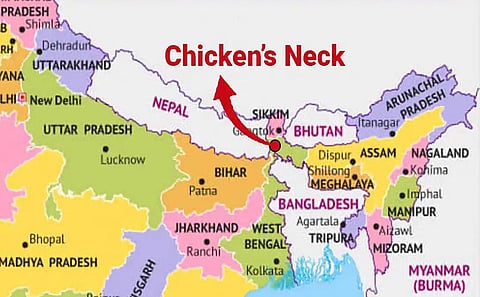
The newly elected Bharatiya Janata Party (BJP)-led West Bengal government has started handing over land to the Border Security Force (BSF) in the strategic Chicken Neck Corridor for constructing a border fence, which is good news for Assam and other Northeastern states. The previous Mamata Banerjee-led Trinamool Congress government stalled the sealing of the border by delaying the handing over of the required land to the BSF, which left a vast stretch of the international border porous, allowing infiltrators to cross over into West Bengal and then enter Assam to settle. Expeditious erection of the border fence, after the land is handed over to BSF, will be critical to strengthening border security to curb infiltration from Bangladesh. Strengthening border surveillance along riverine areas along the India-Bangladesh border in Assam, in which fencing is not feasible, also remains vital for securing the entire international border against illegal border crossing, smuggling, trafficking and movement of terrorists and criminals. India and Bangladesh share the world’s fifth longest border, with a total length of 4096 km, of which 3232 km has been fenced so far, while in about a 175 km stretch, mostly comprising riverine areas, fencing is not possible, but about 689 km of the border where it is feasible remains unfenced, making it vulnerable to illegal border crossing and other criminal activities. The previous TMC government delayed handing over even those areas of land along the unfenced stretch, against which the central government had already paid compensation for land acquired by the state government and despite repeated reminders. For the remaining stretch of land, the TMC government adopted the policy of purchasing land under a policy called the direct purchase policy instead of acquiring land under the Land Acquisition Act, 1894, or the Right to Fair Compensation and Transparency in Land Acquisition, Rehabilitation and Resettlement Act, 2013. As the acquisition/purchase proceedings have been commenced under the direct purchase policy, they were stuck up at different stages and pending approval before the state government, the purchase proceedings in respect of a major portion of borderland were inordinately delayed, while for some stretches the purchase proceedings were not even started, jeopardising the entire plan of the central government to fence the strategic border stretches. The Calcutta High Court issued a directive to the West Bengal government in January to hand over land already acquired with funds provided by the central government in nine border districts to the BSF by March 31 for the erection of the barbed wire fence. The need for court involvement showed a troubling situation caused by unnecessary delays from the TMC government, which worsened the risk of demographic changes in West Bengal and Assam due to its focus on narrow vote-bank politics. This created obstacles in securing the border, allowing infiltrators to cross the weak border, settle in both states, and eventually become voters. Assam Chief Minister Himanta Biswa Sarma brought the underlying issue into sharp focus by emphasising the mere sealing of the Assam-Bangladesh border cannot protect Assam from the existential demographic invasion by Bangladeshis if the India-Bangladesh border remains porous in West Bengal and Tripura. The Ministry of External Affairs, while apprising the Parliamentary Standing Committee on the issues of border security in March 2025, explained that India felt an increasing need for bolstering the security of the shared border in view of the deteriorating internal security situation in the neighbouring country (during the interim Yunus regime) and that border fencing has become an even more important area for India and, therefore, committed to completing the border fencing with Bangladesh. Growing Chinese presence in Bangladesh, especially through infrastructure and military cooperation, has precipitated India’s concern over security along the narrow Chicken Neck Corridor that connects India’s northeast region to the rest of the country. Even though Bangladesh officials clarified that there are currently no plans to upgrade the Lalmonirhat airbase with Chinese assistance to upgrade the World War II-era airstrip close to the Chicken Neck corridor, India maintaining a constant vigil on the developments around the strategic corridor is critical to safeguarding its strategic interests. Complete sealing of the India-Bangladesh border, therefore, has assumed greater urgency to ensure that no elements inimical to India’s strategic interests are able to exploit the existing gaps. Securing the international border against illegal crossings and cross-border crime is in the interest of both neighbouring countries, as it aids the border-guarding forces to effectively manage border vigil. Neutralising criminal networks through strengthening of border security helps secure cross-border supply chains, curb smuggling and trafficking and facilitate the creation of infrastructure like integrated checkpoints for a smooth flow of goods. Bangladesh extending cooperation in the expeditious completion of the installation of a barbed-wire fence along the shared border is also crucial for strengthening mutual security. For Assam and the rest of the northeast, securing the entire border is critical to stave off the demographic threat which has precipitated the anxiety of indigenous communities.
