
- Home
- Live Blog
- Breaking News
- Top Headlines
- Cities
- NE News
- Sentinel Media
- Sports
- Education
- Jobs
Dr. Samir Sarkar
&
Prof. Pradeep Kumar Jain
At a time when Donald Trump has publicly expressed his desire for a
Nobel Peace Prize, the world is being offered a curious lesson in how peace is now defined. Bombs falling on sovereign territory and the forcible capture of another country’s president are presented not as acts of aggression, but as moral necessities. If this is the new route to peace, then diplomacy, courts, and international institutions appear increasingly redundant, replaced by missiles, commandos, and carefully worded press briefings about justice delivered at gunpoint.
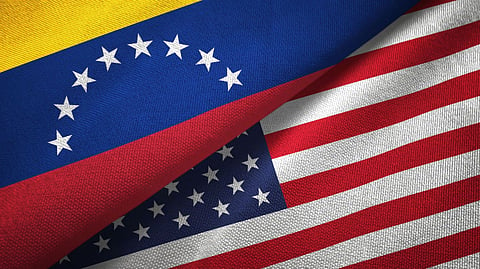
What has reportedly unfolded in Venezuela is therefore not merely a regional crisis or a bilateral confrontation between Washington and Caracas. It raises a far more consequential question: can a powerful country openly violate another nation’s sovereignty, arrest its leader by force, and still claim to be the custodian of international law? The method adopted—unilateral military action without multilateral sanction—crosses a line that should alarm every nation, regardless of one’s assessment of Venezuela’s internal politics or President Nicolás Maduro. It undermines the principles that protect all states, particularly weaker ones, from arbitrary power.
A Familiar Script, Not
a Singular Event
Venezuela does not stand alone. It fits into a long and well-documented pattern of U.S. interventionism that stretches across decades and continents. From Iraq and Afghanistan to Libya and Syria, military force has repeatedly been justified through the language of democracy, security, and humanitarian rescue. The rhetoric has remained consistent; the outcomes have not.
Iraq was invaded in 2003 on the claim that it possessed weapons of mass destruction, claims later proven false. The consequences were catastrophic: state collapse, hundreds of thousands of civilian deaths, sectarian violence, and the rise of extremist groups that destabilized the entire Middle East. While Iraq struggled to rebuild, American corporations secured lucrative reconstruction and energy contracts. Two decades later, the country remains politically fragile and socially fractured.
Afghanistan endured twenty years of war, trillions of dollars in expenditure, and the loss of tens of thousands of civilian lives. When U.S. forces finally withdrew, the exit was abrupt and chaotic. The Taliban returned to power within weeks. Washington moved on; Afghans were left with frozen assets, a humanitarian crisis, and a future once again shaped by uncertainty.
Libya offers an equally sobering lesson. NATO’s intervention removed Muammar Gaddafi in the name of protecting civilians. What followed was not democracy, but disintegration. Libya descended into civil war, armed militias proliferated, and the country became a major hub for arms trafficking and human smuggling across Africa. The intervening powers exited. Libya did not recover.
In each case, the pattern is unmistakable: military intervention reshapes regimes but not societies; it destroys institutions faster than it builds them. Once strategic objectives are met, responsibility ends.
A World Reacts with Alarm
The Venezuela episode has drawn unusually blunt reactions from across the Global South. Brazil’s President Luiz Inácio Lula da Silva warned that bombing Venezuelan territory and capturing its president “cross an unacceptable line,” calling it a direct assault on sovereignty and a dangerous threat to the international community. Leaders in Latin America and beyond have echoed similar concerns, demanding urgent multilateral engagement. Russia, China, and other major powers have also criticized the use of force, stressing that it violates international law and risks regional destabilization.
Selective Morality,
Strategic Silence
If Washington insists that its actions are driven by human rights and justice, an uncomfortable question follows: why does this urgency appear so selective?
Bangladesh, India’s immediate neighbor, has experienced serious political turmoil since 2024, alongside disturbing incidents of mob violence, including lynchings linked to blasphemy allegations that have disproportionately affected religious minorities. Local media and human rights organizations have reported these incidents, causing deep concern across South Asia. Yet here, the American response has been restrained and diplomatic. There have been statements, not sanctions; concern, not commandos. Where strategic or economic stakes are limited, restraint prevails. Where resources, influence, or geopolitical leverage are involved, force becomes an option.
Who really gains, and
why Venezuela?
There is a deeper context to America’s assertiveness that cannot be ignored: the growing fragility of its own economic foundations. The United States today carries a public debt exceeding $34 trillion, runs chronic fiscal and trade deficits, and relies heavily on the global dominance of the dollar to finance both consumption and military reach. Rising interest costs, inflationary pressures, and political paralysis at home have exposed structural vulnerabilities long masked by economic supremacy.
History suggests that great powers facing internal strain often turn outward. Military assertiveness becomes a substitute for economic confidence. Control over energy flows, sanctions leverage, and geopolitical dominance help preserve the dollar’s central role in global trade, an advantage that allows the U.S. to borrow cheaply and sustain its global footprint.
Venezuela’s significance lies precisely here. It holds some of the world’s largest proven oil reserves at a time when alternative trading arrangements and non-dollar energy deals are slowly gaining ground. For a debt-burdened superpower, maintaining geopolitical control is not merely strategic; it is economic insurance.
Militarism as Economic
Insurance
American military dominance has long acted as an invisible guarantor of its economic privileges. Sanctions work because the dollar dominates. The dollar dominates because U.S. power enforces the system. When that dominance is challenged by rising multipolar trade, alternative payment systems, or energy deals outside the dollar framework, the instinctive response is not reform but force.
This is why unilateral interventions persist even when they fail politically or morally. They are not only acts of foreign policy; they are acts of economic preservation. The tragedy is that while this strategy may buy time for the United States, it extracts a devastating price from the rest of the world.
Force Becomes Habit
What deepens global unease is the normalization of force. Over recent years, U.S. military actions, airstrikes, drone operations, and targeted missions have occurred across multiple countries, justified individually as counter-terrorism or national security measures. Viewed collectively, they reveal a troubling trend: the routine use of force as a policy instrument rather than a last resort.
Law without Enforcement
International law is clear. Under the United Nations Charter, force may be used only in self-defense after an armed attack or with explicit Security Council authorization. Unilateral military arrests of foreign leaders meet neither condition. Domestic indictments, however serious, do not grant any country the right to enforce its laws through military action on another state’s territory. There was no international court mandate, no multilateral approval, and no recognized due process. The deeper problem lies in enforcement. When major powers face no consequences, law becomes optional. And when law becomes optional, global order begins to unravel.
Why This Situation Matters
to India and the World
Opposing unilateral U.S. action does not mean defending authoritarianism. It means defending a principle essential to global stability: no country should act as judge, jury, and enforcer over another without law, courts, and international consent.
For India, with its long commitment to sovereignty, strategic autonomy, and restraint, this debate is not distant. Today’s violations elsewhere weaken the protections all nations rely on. If power alone decides what is legal, then no country is truly secure. The choice before the international community is stark: accept a system ruled by unilateral force, or rebuild one anchored in law, balance, and collective responsibility. Delay will only make the cost higher for everyone.