
- Home
- Live Blog
- Breaking News
- Top Headlines
- Cities
- NE News
- Sentinel Media
- Sports
- Education
- Jobs
Himangshu Ranjan Bhuyan
(himangshur1989@gmail.com)
The legacy of Mahapurush Srimanta Sankardeva is often discussed
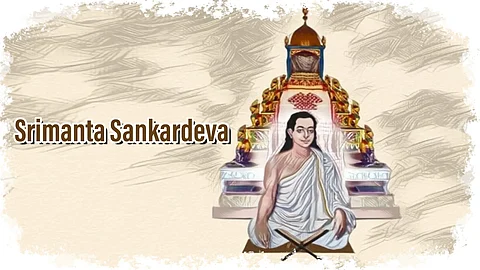
through the lenses of religion, literature, music, and culture. Such recognition is fully deserved, yet it captures only one dimension of his extraordinary contribution to Assamese society. Beneath the spiritual movement he founded lay a broader intellectual vision shaped by reason, observation, and a practical understanding of human needs. Although he lived in the fifteenth and sixteenth centuries, long before the emergence of modern scientific institutions, many of his ideas reflected qualities that today are associated with scientific thinking. Scientific vision is not confined to laboratories, formulas, or technological inventions. At its core, it involves the ability to examine reality objectively, challenge harmful conventions, and seek solutions that improve human life. This was precisely the approach Sankardeva adopted while confronting the social realities of his time. Mediaeval Assam was characterised by rigid caste distinctions, costly religious rituals, social fragmentation, and widespread superstition. These conditions weakened social cohesion and prevented large sections of society from participating fully in cultural and spiritual life. Sankardeva recognized that such divisions were neither natural nor beneficial. Instead of accepting inherited customs unquestioningly, he sought to reform them through a philosophy grounded in human dignity and social inclusion. His doctrine of Ekasarana Nam Dharma represented more than a religious movement; it was a deliberate attempt to create a shared social identity capable of transcending caste and community barriers. By opening the doors of spiritual participation to people from different social backgrounds, he challenged one of the most entrenched structures of inequality in mediaeval society. This was not a revolutionary act in the political sense, but it was revolutionary in its social consequences. His rejection of elaborate rituals and sacrificial practices revealed a similarly practical mindset. He understood that religion had become inaccessible to many because of the financial and social burdens attached to ceremonial observances. By emphasising devotion through prayer, congregational singing, and moral conduct, he simplified spiritual practice and made it available to ordinary people. Such reforms demonstrate a clear awareness of cause and effect. Social division produced weakness; inclusion produced strength. Economic exploitation created hardship; simplicity promoted participation. These conclusions were not derived from abstract speculation but from close observation of society. That capacity to diagnose social problems and propose workable alternatives forms the essence of Sankardeva's scientific vision. His objective was not merely to alter religious practices but to create conditions under which human beings could live with greater dignity, confidence, and mutual respect.
The scientific quality of Sankardeva's thought becomes even more evident when one examines the institutions and cultural mechanisms through which he implemented his ideas. Great thinkers are often distinguished not only by the principles they advocate but also by their ability to translate those principles into durable social structures. Sankardeva achieved precisely this through the creation of the Namghar. Frequently described as a religious institution, the Namghar was in reality a multifunctional social centre that served educational, cultural, and administrative purposes. It became a space where communities could gather, discuss collective concerns, resolve disputes, and participate in cultural activities. In many respects, it anticipated the principles of participatory governance. Decisions emerged through dialogue and consensus rather than coercion. Such a model reflected a sophisticated understanding of human society. Sankardeva realised that stable communities depend upon cooperation and communication rather than hierarchy alone. His emphasis on collective participation demonstrated an appreciation for the social value of shared responsibility. Equally important was his approach to knowledge dissemination. During a period when sacred texts and intellectual resources remained largely inaccessible to common people, he translated religious ideas into languages that ordinary individuals could understand. This act represented more than literary creativity; it was an effort to democratise knowledge. Scientific progress depends upon the circulation of ideas, and Sankardeva instinctively understood that knowledge loses much of its value when confined to privileged groups. His innovations in theatre, music, and literature reveal the same insight. Through Bhaona, Chihna-Yatra, and Borgeet, he transformed artistic expression into a medium of education and social communication. These cultural forms enabled complex ethical and philosophical concepts to reach audiences regardless of literacy levels. Modern educational theories emphasize experiential learning, visual communication, and emotional engagement. Sankardeva employed all these methods centuries before they became formal subjects of academic study. His concern for public health further highlights his practical wisdom. The stress he placed on cleanliness, discipline, personal hygiene, and moderation in daily life carried significant social benefits. At a time when scientific medicine was limited, such habits contributed to disease prevention and healthier communities. His opposition to intoxicants reflected a similar awareness of their destructive effects on individuals and society. These initiatives demonstrate that his vision extended beyond spiritual salvation to encompass physical well-being and social welfare. Rather than separating religion from everyday life, he used religious frameworks to promote habits and institutions that strengthened society. Such an approach reflects a remarkably pragmatic understanding of human development.
Another defining feature of Sankardeva's scientific vision was his openness to learning and his capacity for adaptation. Throughout history, societies have advanced not by isolating themselves from new ideas but by engaging with them critically and creatively. Sankardeva embodied this principle. His extensive travels across the Indian subcontinent exposed him to a wide range of cultural traditions, philosophical systems, artistic practices, and social institutions. What makes these journeys significant is not merely the fact that he travelled but the manner in which he processed the experiences he encountered. He did not imitate external influences blindly, nor did he reject them out of attachment to local customs. Instead, he observed, analysed, selected, and adapted. This method closely resembles the process of inquiry that underlies scientific advancement. Knowledge grows through observation and evaluation, not through unquestioning acceptance. The cultural forms he developed illustrate this capacity for synthesis. Borgeet, for example, drew inspiration from broader Indian musical traditions while incorporating regional elements that resonated with Assamese society. The result was neither imitation nor isolation but innovation. Similar creativity can be seen in his literary works and theatrical productions. His understanding of economic life was equally practical. Sankardeva recognized that spiritual ideals could not flourish in a society burdened by economic insecurity. Consequently, the institutions associated with his movement encouraged productive labour, agriculture, craftsmanship, weaving, and artistic production. He upheld the dignity of work and rejected notions that spiritual life required withdrawal from worldly responsibilities. This emphasis on self-reliance and productivity reflected a realistic assessment of social needs. His views regarding nature reveal another dimension of his foresight. Long before environmental conservation became a global concern, he advocated compassion toward all living beings and discouraged practices involving unnecessary violence. His writings frequently celebrate the beauty and interconnectedness of the natural world, conveying an awareness that humanity exists within a larger ecological framework. Similarly, his approach to women displayed a degree of inclusiveness uncommon for his era. While the limitations of mediaeval society remained, his philosophy acknowledged women's spiritual significance and allowed greater participation in religious and cultural life than many contemporary traditions permitted. Such positions emerged from a broader commitment to human dignity rather than rigid social conventions. In each of these areas-culture, economy, environment, and social relations-Sankardeva demonstrated an ability to examine reality pragmatically and formulate responses suited to the needs of society.
The enduring relevance of Sankardeva's scientific vision lies in its capacity to address challenges that remain strikingly familiar in the twenty-first century. Modern societies possess advanced technologies and unprecedented access to information, yet they continue to struggle with social polarisation, misinformation, prejudice, environmental degradation, and the persistence of irrational beliefs. Technological progress alone has not eliminated these problems because they are fundamentally human and social in nature. Sankardeva's philosophy offers valuable insights precisely because it combined rational thinking with ethical responsibility. He understood that knowledge without compassion can become destructive, while faith without reason can descend into dogmatism. His life demonstrates that intellectual inquiry and moral commitment are not opposing forces but complementary dimensions of human progress. The scientific vision he embodied encouraged people to question harmful customs, but it also encouraged them to build stronger communities. It promoted learning, yet it remained grounded in practical realities. It valued individuality while emphasising collective welfare. These qualities make his philosophy particularly relevant at a time when public discourse is often characterised by division and extremism. The contemporary tendency to view tradition and modernity as mutually exclusive categories would have been alien to Sankardeva's approach. He showed that societies can preserve cultural identity while embracing reform and innovation. His willingness to evaluate customs according to their social consequences rather than their antiquity remains a powerful lesson. The institutions he established, the literature he created, and the values he promoted were all directed toward a single objective: the creation of a humane and harmonious society. For this reason, Sankardeva should not be remembered solely as a religious reformer or cultural icon. He deserves recognition as one of the most insightful social thinkers in Indian history, a figure whose understanding of human behaviour anticipated many principles associated with modern democratic, educational, and scientific thought. His scientific vision was not expressed through equations or experiments but through the transformation of society itself. More than five centuries later, that vision continues to offer guidance for those seeking a future founded upon reason, inclusion, dignity, and collective progress. In an age searching for balance between technological advancement and human values, the example of Srimanta Sankardeva remains both relevant and inspiring.
