
- Home
- Live Blog
- Breaking News
- Top Headlines
- Cities
- NE News
- Sentinel Media
- Sports
- Education
- Jobs
Amitava Mukherjee
(The author is a senior journalist and a commentator on current affairs.)
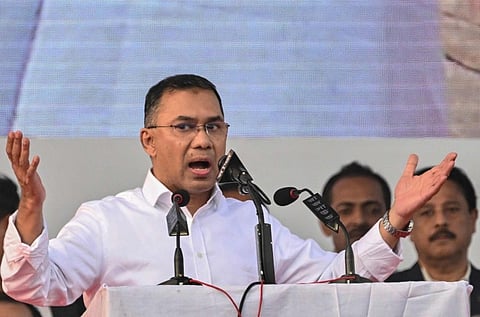
The victory of the BNP-led alliance in the Bangladesh election has opened up several possibilities in Indo-Bangladesh relations. The most contentious issue will no doubt be the presence of Hasina Wazed in India. She has already been sentenced to the death penalty in absentia in Bangladesh, and the Mohammed Yunus-led interim government has officially asked for Hasina’s extradition. Will Tarique Rahman and his BNP follow the same policy? A big question mark hangs over here. Tariq Rahaman has said that he does not favour the proscription of any political party. That signifies a reasonably soft attitude towards the Awami League. But will he extend it to Hasina Wazed as a person too?
Secondly, Tariq has said during electioneering that he will be neither pro-Delhi nor pro-Pindi (meaning Rawalpindi) but pro-Bangladesh. This is fine, and this should be the foreign policy of any country. In the same breath he had expressed that he wants good relations with India. If that is the case, then two knotty issues await his reaction – the Teesta water sharing controversy and the Ganges water sharing treaty, whose expiry is not far off. The Mohammed Yunus-led government had moved ahead to accommodate China in the Teesta River water augmentation and development plan. This is at present the most intricate issue between India and Bangladesh. If Tariq continues to involve China in the project implementation, then his relation with New Delhi is bound to turn sour. On the other hand, it is difficult for India to give the quantum of water as demanded by Bangladesh, as that would starve North Bengal of the much-needed water. A compromise formula has to be worked out. It is there. Will Tariq Rahaman be bold enough to adopt it?
Tariq Rahaman’s public statements indicate that he will follow his father Ziaur Rahaman’s preferred theory of Bangladeshi nationalism, which is opposed to the Awami League’s idea of Bengali nationalism. Although the Awami League was absent in this election, the large number of seats captured by the Jamaat-i-Islami-led alliance indicates that Bangladeshi society has gone through a serious metamorphosis, one that has to be understood and deeply analysed by policymakers in New Delhi.
What is now really expected from Tariq Rahaman? The most important task before him is to contain mob culture in his country, which is a typical phenomenon of Bangladeshi society. Tariq must strive to return to the civic society the position which it should enjoy. But there will be plenty of impediments before him in this task, as the lower rungs of his own party’s hierarchy are often accused of loot, plunder and extortion. This is a deep-rooted malaise in Bangladesh. The loot of Gana Bhavan, the official residence of Sheikh Hasina, after the former prime minister’s flight from Bangladesh is still fresh in public memory. Even in 1975, after the assassination of Sheikh Mujibur Rahaman, his ancestral house in Tungipara was looted.
Imitating the American civil rights activist Martin Luther King, Tariq Rahaman had said that ‘he has a plan’. Surely he understands that it is now the time for him to unravel all the details of the plan for feedback from the civil society. So long as he commanded the BNP, sitting at a distance, distance gave him certain advantages for refurbishing his own image, which had previously been sullied by some controversies. However, it is undeniable that from 2001 to 2006, during the tenure of his mother, Khaleda Zia, as Prime Minister of Bangladesh, Hawa Bhavan—Tariq’s office—was the actual seat of power, and he was alleged to have formed a coterie around himself that engaged in various excesses. This is the practice he must uproot this time. He must remember that Bangladesh is a land of extremes. Here popularity takes very little time to become extreme unpopularity. Only adherence to democratic principles can make Tariq’s position unassailable.
This throws up the most important question: Will Tariq Rahaman facilitate the return of Hasina Wazed to Bangladesh? Here he has the example of his father, Ziaur Rahaman, before him. For a brief period after the murder of Sheikh Mujibur Rahaman, activities by the Awami League were practically banned in Bangladesh. After Ziaur Rahaman became the president of the country, he allowed the Awami League to resume normal activities. Even Hasina also returned to Bangladesh during the time of Zia. A healthy example was thus set. Will Tariq follow suit? International observers will watch this process.
A disturbed Bangladesh is a threat to stability in South Asia as well. It will have wide repercussions in India and Myanmar. The nation is not just unquiet; it is still boiling. First of all, the next BNP-led government must address the issue of attacks on and torture of the minorities. The landslide victory of the BNP-led alliance confirms that the minorities did not put much faith in the soothing words and promises of security given by the Jamaat-i-Islami during electioneering, and they, with even a large number of committed Awami League sympathisers, voted largely for the BNP. In his first address to the nation after returning to Bangladesh, Tariq Rahaman had stressed peace and stability, the two things Bangladesh now needs most. Then he had articulated clearly that he visualises a country where the minorities comprising the Hindus, Buddhists and Christians will enjoy equal status with others. Now he must redeem his pledge.
Interestingly, many of the points contained in the constitutional reforms programmes referendum for which was also held along with the parliamentary election, have similarities with the BNP’s declared programmes. The two sets of programmes of the BNP—the 31-point programmes and the 19-point programmes—also speak in almost the same vein. The 19.1 is the BNP’s foundation. It speaks of sovereignty, social justice, self-reliance and national cohesion. The two most important points in the set of 31-point programs are limiting the executive’s overreach and rebalancing the relationship between the state and the citizen. The last one is the most important. Even fifty-three years after attaining independence from Pakistani rule, seeds of democracy are yet to take firm root in Bangladesh, and the country has had to go through several bouts of assassinations and military coups. Tariq will have to prove that he means his words and that he is not an autocrat in disguise.
However, it is difficult for India to forget the BNP rule during 2001-2006 when secessionist extremism was at its height in north-eastern India. It is widely believed on our side of the border that the northeastern ultras had received weaponry and logistical support from Bangladesh at that time. However, Tariq Rahaman has already expressed that he wants positive relations with India. To ensure this, he has to tighten up his law enforcement machinery all along Bangladesh’s borders with West Bengal. These are the areas where the Jamaat-i-Islami has done very well in the just-concluded election.
However, Tariq’s public pronouncements indicate that he is giving considerable importance to steadying the tumultuous social conditions of his country, which has been torn asunder after the fall of the Awami League-led government. But the task before him is quite hard. Meanwhile, Pakistan has found a new depth in its relations with Bangladesh during the interim regime of Mohammed Yunus. Tariq’s “Bangladesh First” policy will face a challenge here, as he will have to reverse various decisions taken by the previous Mohammed Yunus-led administration for the sake of implementing his policies.
