
- Home
- Live Blog
- Breaking News
- Top Headlines
- Cities
- NE News
- Sentinel Media
- Sports
- Education
- Jobs
Zahid Ahmed Tapadar
For a child, Durga may begin as a picture, become a question, find a place in a drawing—and sometimes emerge from clay. Across generations, children have quietly created their own ways of seeing the goddess.
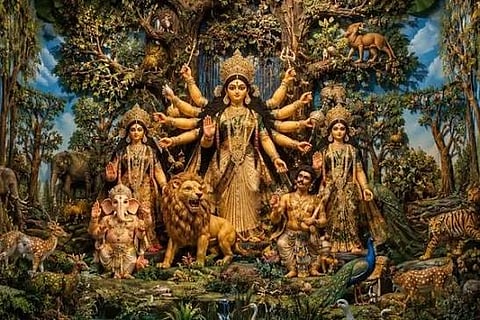
There was a question that stayed with Jaismita Alexander after her first real encounter with Durga Puja. She was about seven or eight when her grandmother took her to a neighbourhood pandal in Kolkata. Until then, Durga had mostly existed for her in pictures and newspaper advertisements. Now the goddess stood before her in three dimensions — dressed in a red sari and jewellery, with her children beside her, a lion at her feet and Mahishasura before her. There was the smell of dhuno, the sound of the dhak and the excitement of the crowd.
Someone called her Ma Durga.
The little girl wondered why.
If Durga already had four children, she asked her grandmother, why did everyone call her “Ma”?
The answer was simple: she was Ma to everyone who believed her to be.
Perhaps a child’s first encounter with Durga begins there—not with an explanation, but with a question.
And the questions continue.
Aarushi Chatterjee, writing as a Class IV student, remembered being told that she had first seen Durga Puja at 30 days old in Hong Kong. At five, she encountered the festival in Kolkata. What caught her attention was that there were many pandals with the “same Durga”, yet the Durgas looked different. Hong Kong’s Puja was held indoors; Kolkata’s pandals were open. She was later excited about experiencing Puja in Moscow.
For an adult, these differences might be matters of geography or artistic interpretation. For a child, the discovery is immediate: if it is the same goddess, why does she look different?
And sometimes Durga arrives even before the child sees her.
In Bordumsa, in Arunachal Pradesh, children counted down the days to Puja and repeatedly visited unfinished pandals. Bamboo frames, half-built structures and artisans at work were enough to set their imaginations going. The festival had already begun in their minds before the idol was ready.
Durga could arrive first as a sound, a smell, an autumn morning, a half-finished pandal—or simply the expectation of what was still to come.
Then come the stories.
For many children, mythology does not arrive as an elaborate lesson. It comes through a grandmother’s voice, a picture book, a comic, an animated story or a few pages read during the Puja holidays. Books such as Tales of Durga and Celebrate Durga Puja with Me!, along with animations such as Debi Durgar Maya Magic, give the goddess forms that a young imagination can enter.
And once a child can imagine Durga, the pencil is not far away.
In Kolkata, the artwork of nine-year-old Samriddhi Das of Baranagar became part of the visual conception of a public Durga Puja at Thakurpukur State Bank Park Sarbojanin. The pandal drew upon the world of children’s drawings.
The reversal was striking.
Adults were no longer simply creating something for children to look at. A child’s way of seeing had begun to shape what others would see too.
A 2014 Puja souvenir carried a “Children’s Art Corner” titled “My Puja (Through the eyes of children)”, inviting children to submit their interpretations of Durga Puja. The drawings show how quickly an inherited image can become personal: multi-armed goddesses, lions and Mahishasura, crowds and colourful festival scenes. And then there is the simple declaration: “MY DURGA.”
The words matter.
The child is not necessarily creating another goddess. The child is making space for a personal Durga within a familiar tradition.
But drawing her is not the final step.
Sometimes a child learns to make her.
In Silchar, 15-year-old Kunal Das, a Class IX student, had been helping his father, an idol-maker, since he was ten. He had already made smaller idols of Lakshmi, Saraswati and Vishwakarma, but he wanted to make Durga. His father had considered the larger idol too difficult for him.
Then came the pandemic.
With restrictions limiting the height of idols, Kunal got the opportunity to make his first Durga. He began constructing the framework of the smaller idol himself.
There is something quietly memorable about that moment. A pandemic that made the public festival smaller also opened a space for a young maker.
Kunal was no longer standing before Durga.
He was helping bring her into existence.
Yet a child’s Durga is not always one the child creates. Sometimes she is inherited.
Sohini Mukherjee’s childhood memory of a family Puja in Guwahati carries the particularity of an ancestral Durga—the idol, the old family house and traditions that belonged to that household alone. For a child, such details can become part of an understanding of the goddess that no book can quite provide.
This is the Durga of belonging.
She is not simply the goddess of mythology or the idol in the neighbourhood pandal. She is also the goddess of a particular courtyard, a family story, an old ritual and a memory that begins in childhood.
And yet inheritance does not mean unquestioning acceptance.
The child in Bordumsa who wondered why Durga needed a vehicle when she already had a tiger was doing what children have always done with inherited stories: testing them against the world they know.
That “why?” may be one of the most creative things a child can offer tradition.
Because children do not only receive culture.
They redraw it.
They give it new questions, new pictures and sometimes new forms.
Assam’s children’s magazine SOFURA, first published in 1982, reflects this creative impulse, giving children space not only to read but also to contribute stories, poems and illustrations. During Durga Puja, newspapers such as The Assam Tribune, Dainik Janambhumi, Dainik Samayik Prasanga, Dainik Nababarta Prasanga and Asomiya Khabar likewise publish children’s drawings, poems and stories on Durga. Children do not merely see Durga; they imagine and recreate her in their own way.
Perhaps that is what makes a child’s Durga so fascinating.
She is never entirely finished.
Jaismita asked why she was called “Ma”. Aarushi noticed that the same goddess could have different faces in different places. Children drew their own versions of her. Samriddhi’s artwork entered a public Puja. Kunal moved from helping his father to making his first Durga idol. Another child looked at an old story and asked whether it really made sense.
Each encounter is different. Together, they reveal something quietly powerful.
Tradition gives a child an image.
Imagination gives that image another life.
And perhaps the answer to that first question—why is she Ma?—is never exactly the same for every child.
For one, she may be the goddess in a picture. For another, the idol in an ancestral home. For another, a figure from a book, a drawing on paper, or a form slowly emerging from clay.
Durga returns every autumn in a familiar form.
But no child is required to meet exactly the same Durga.
Somewhere between the first glance and the first question, between the picture and the pencil, tradition becomes imagination—and the goddess becomes, in some small way, their own.
