
- Home
- Live Blog
- Breaking News
- Top Headlines
- Cities
- NE News
- Sentinel Media
- Sports
- Education
- Jobs
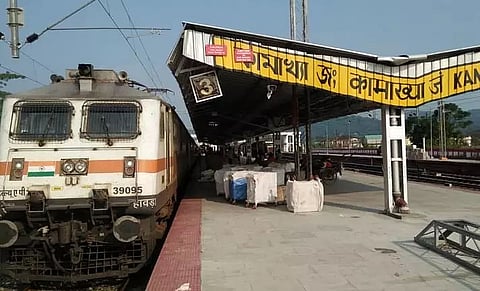
An electric locomotive hauled parcel train arriving at Kamakhya railway station in Guwahati on Friday morning marked a new milestone in railway connectivity in Assam. Brahmaputra mail originating in New Delhi became the first passenger train, to be pulled by an electric engine for the entire journey of 2000 km and reaching Guwahati. The gateway to India's Northeast is now connected to all major cities in India with seamless electric traction providing faster mobility. With coal-fired thermal power stations accounting for about 60% of the country's installed electricity generation capacity, any claim about electrification of railway lines being environment friendly will remain a debatable issue. Along its path of the journey, an electric train certainly produces fewer carbon emissions which are going to be a high gain for the state when the entire globe is making efforts to reduce carbon emission to prevent the rise in global temperature as a climate change mitigation measure. Doing away with the diesel locomotives up to Guwahati with certainly cut down diesel cost for Northeast Frontier Railway, Railway Ministry claims that due railway electrification up to Guwahati, monthly High-Speed Diesel (HSD) oil consumption will reduce by about 3400 KL and foreign exchange spent on HSD Oil of about Rs 300 crore per annum will be saved. Following electrification of 649 km from Katihar to Guwahati, the traction change at New Jalpaiguri, New Coochbehar from diesel hauled locomotives to electric locomotives will no longer be required which will facilitate faster mobility. The running time from Guwahati to Katihar/Malda town is likely to reduce by two hours due to seamless train operation which will be a huge gain not just from an operational point of view but also for passengers travelling to and from Guwahati. The ministry states that line capacity enhancement up to 10-15 % shall lead to a reducing level of saturation on many sections on the Northeast Frontier Railway which will eventually allow the running of more coaching trains and the introduction of additional Rajdhani express trains for the northeast region. Expansion of electrification to Guwahati will also facilitate running of an additional passenger coach on each of 15 pairs of trains originating or terminating at Kamakhya or Guwahati stations as the power cars on these trains will be eliminated and more passengers will be able to travel. Another benefit for the region from the electrification of the Broad Gauge line in the region, according to the Ministry, is heavier goods trains can run at higher speed electric hauled locomotives. It will eliminate the need for multi-diesel locomotives for difficult sections in the region as higher horsepower electric engines can maintain higher speed in gradient sections. Reducing the share of coal in the country's power mix will remain a critical factor in determining how much greener train running can be made by running electric locomotives. Some thermal power stations recently cutting down daily generation due to rising import cost of coal is a pointer that running electric train smoothly will be dependent on an uninterrupted supply of coal without global price fluctuations to thermal power stations. If seamless traction and faster mobility after electrification tell one part of the story of electrification of broad gauge network in the country, the first electric locomotive to Guwahati bringing supplies of coal to ensure adequate coal stock for the region tells the other part of the story. The running of the railway with electric engines remaining dependent on coal-powered power generation while phasing out diesel engines will keep the debates alive over rushing to the conclusion that electrification of railway lines also makes trains running greener. The trade-off between environment and development cannot be reduced to a singular issue of whether less or more carbon is produced due to the introduction of new technology but is a complex calculation in which the impact of lives of people need to be factored. Faster mobility leads to faster delivery of goods which in turn can expedite the execution of development projects aimed at ameliorating the lives of targeted people. Mobility has always been a key factor posing a hurdle in the timely execution of projects which lead to cost overrun and delays that cannot be ignored. The electricity demand is also poised to rise manifold with the government pushing for electric mobility on roads as the country will require plenty of charging stations along the highways to keep the battery electric vehicle running smoothly. Renewable power generation from solar power, wind energy, biofuels, and small hydropower accounting for a higher percentage of energy mix than coal will be a dominant factor for the long-term sustainability of electric mobility on Indian roads and railway lines. It is in this context India's target to generate 175 gigawatts of solar power by next year is significant and must be achieved to ensure not just uninterrupted these electric mobilities but also to make them truly environment friendly.
