
- Home
- Live Blog
- Breaking News
- Top Headlines
- Cities
- NE News
- Sentinel Media
- Sports
- Education
- Jobs
Izaaz Ahmed
(izaazahmed16@gmail.com)
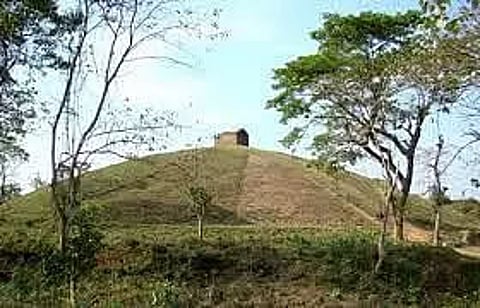
Most of us are fascinated by the Pyramids of Egypt or the ancient burial customs of the Mayans. But how many of us are familiar with the Moi-dams of Assam, the burial places of the Ahom royalty and nobility? Do we know that Moi-dams are much more than normal tombs and graves; that they are an architectural marvel having no equal in India?!
While talking about the Moi-dams of Assam, we often quote the examples of the royal Moi-dams of Charaideo, but we tend to ignore the other Moi-dams strewn over a vast stretch of Assam. This story is about two such Moi-dams, the history and significance of which seems to be sinking into oblivion. Most of us don't know anything about those two Moi-dams, despite the fact that they belong to two of Assam's greatest officers.
Those two extraordinary individuals were Alon Dihingia Borborua - a war hero who saved Assam from foreign dominance - and his son, Deka Dihingia Borborua, whose Moi-dams are located at Sessa in Dibrugarh, right next to the National Highway 37. Both the father and son held the much-esteemed position of the 'Borbaorua' under three different Ahom kings. In fact, it is because of a huge pond dug by one of these 'Borboruas' that the place itself came to be known as Barbaruah, although much later.
Now, before proceeding any further, let's try to understand the meaning of 'Barbarua'. During the Ahom rule, the office of the Barbarua was one of the most important and powerful offices. Borborua was a member of the Council of 5, a council whose powers were next only to those of the King. Although a direct comparison won't be accurate, the position of the Borborua was no less than that of a modern-day Cabinet Minister.
The office of the 'Barbaruah', however, hasn't always been there since the beginning of the Ahom rule. As the Ahom territories expanded, two new offices were created, that of the "Borphukan" and "Borborua", by the great Ahom King Pratap Singha. While the Borphukan was in control of the area to the West of Kaliabor, which is in modern-day Nagaon district, 'Borbaruah' used to enjoy administrative and judicial powers in those areas to the East of Kaliabor which were not under the sphere of influence of the 3 Dangoriyas, that is to say, Burhagohain, Borgohain and Borpatragohain.
Now that we know the meaning of the term Borboruah, let's proceed with the main story. One of these Moidams belongs to the great Alon Dihingia Barbaruah, who held the much-esteemed position of the "Borborua" for more than 10 years due to his unmatched leadership, bravery and abilities.
Alon Dihingia Borborua was initially the Borborua under King Sulikphaa, better known as Lora Roja, whose reign was of just 2 years. He, however, continued to hold that much-esteemed position for many more years during the illustrious rule of King Gadadhar Singha, the husband of the legendary Ahom princess, Joymoti Kunwori, who went on to become the quintessential example of supreme sacrifice and bravery across India.
One of the most important highlights of the career of Alon Dihingia Barbarua was his incredible leadership in the Battle of Itakhuli, which was fought in the year 1682. In that decisive battle, which took place around a decade after the Battle of Saraighat, the Assamese Army or the Ahom Army inflicted a crushing defeat on the Mughals, chasing them as far as the Manas River. That battle, which was fought on both land and water, was of utmost significance as it marked the end of the longstanding Ahom-Mughal conflicts.
Alon Dihingia Borbarua was the hero of the Battle of Itakhuli. In fact, it was under his leadership and supervision that the Assamese Army occupied the highly strategic Itakhuli Fort, which was located at the present-day location of the famous Sukreshwar Temple of Guwahati. Taking control of the Itakhuli Fort from the Mughals was a clear sign of victory. It was the final nail in the coffin of the Mughals, who retreated as far as the Manas River, never to invade the Ahom Kingdom again.
It was in recognition of the exemplary service offered by this Borboruah to the Ahom Kingdom that King Gadadhar Singha had an entire road built, and later dedicated this road to the Borborua. Known as the Barbarua Ali, that famous road started from a place close to the iconic Garhgaon Ali of Sivasagar and came all the way till Mohanaghat in Dibrugarh. Now, most of the parts of that iconic Borborua Ali have been replaced by the NH-37! It was again the same Alon Dihingia Borbarua who had the famous Thowra Doul of Sivasagar built in the year 1683-85. That brick-built temple, which also has a tank adjacent to it, now stands along NH-37, just a heartbeat away from the historic town of Sivasagar.
Within the premises of the Barbarua Tea Estate of Dibrugarh is the famous "Borborua Pukhuri or Pond", a more than 300-year-old pond. This beautiful pond, spreading over several acres of land, and which is even older than the iconic Borpukhuri and Gaurisagar Tank of Sivasagar, is said to have been dug by Deka Dihingia Barbarua in 1701 AD. Deka Dihingia Barbarua was the son of Alon Dihingia Borborua, who was appointed to the office of the Barbarua by King Rudra Singha.
Interestingly, the historical significance of this pond came to light only after the discovery of a rock inscription by a group of workers working at a nearby location in the year 1964. That rock inscription, which dates back to the period of Deka Dihingia Barbarua, throws much light on the historical significance of this pond. That inscription also tells us about a few land grants being made by Deka Dihingia Barbarua with the King's permission. It is also said that the present Borbaruah Haat or Bazaar that sits on either side of NH-37 previously used to sit on the banks of this historic Borboruah Pukhuri until this Pukhuri became a property of the Barbaruah Tea Estate.
Both Alon Dihingia Borborua and his son, Deka Dihingia Borborua were brave and accomplished officers of the Ahom Kingdom. Their acts of valour need to be preserved in a much better way. Their legacy needs to be conserved in a much better way. Their rich contributions to Assam need to be promoted far and wide.
