
- Home
- Live Blog
- Breaking News
- Top Headlines
- Cities
- NE News
- Sentinel Media
- Sports
- Education
- Jobs
Satish Kumar Sarma
(The writer is former Head of the Department of Economics,
Biswanath College, Kalyanpur, Biswanath Chariali)
Environmental pollution has become a global problem nowadays. The air, water and land are the three basic amenities for living organisms. Any sort of undesirable and harmful change in these media causes the pollution. Industrial revolution of twentieth century along with population explosion has led to the pollution problem of various kinds such as air pollution, water pollution, soil pollution, noise pollution, and so on.
Literally pollution means to make or render unclean. According to Odum (1971), “Pollution is an undesirable change in the physical, chemical or biological characteristics of our land, air or water that may affect the human life or desirable species”. In other words, pollution is the phenomenon of fouling of our environment or natural resources. Our environment comprises air, water and soil and these are indispensable for life.
The history of pollution dates back to the history of human civilization. Truly speaking, it started with the emergence of the man. The hat-makers of 19th century England used mercury to shrink fibres for felts. The people were of the opinion that whosoever wore hats would be driven mad. Today we know that such suspicion was not baseless because mercury has many toxic effects. The damage done by dumping of millions of pounds of toxic mercury in to the Great Lakes has come to light recently.
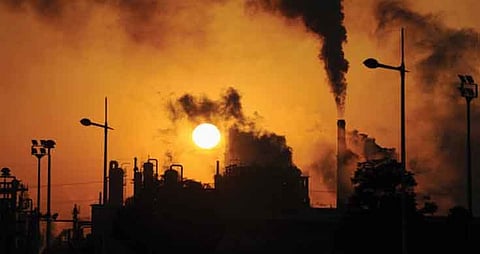
What is known as pollution is the reckless monkeying of the man with nature and natural resources, i.e., water and air in particular. The amount of various types of pollutants is increasing day by day due to increasing number of factories and industries. The automobile industry is one of the major causes of air pollution. The number of cars, scooters, motorcycles, buses and other smoke-emitting vehicles are on the increase. These vehicles let loose harmful gases and many others in the atmosphere. It is now well-known that lead damages the human brain. According to the latest explanation one major cause for the decline of Roman civilization was the lead poisoning. Today the lead content has reached almost to the level of maximum tolerance in our atmosphere. Intellectuals guess that our civilization, too, follow the same trend as Romans did.
Indeed pollution has become a burning problem of the day today. The UN Conference held in June 1972 on ‘Human Environment’ focussed the attention of all nations on the growing global menace of pollution. Thus, pollution is now the problem of both the developed as well as developing nations of the world. One survey says that India would soon face a major ecological crisis if it goes ahead with its western type of programme for industrialization in the country.
Pollutants are byproducts of man’s action. These are of various types. Today most of the lakes and rivers and other natural resources such as air and soil are polluted with industrial wastes, pesticides and insecticides, fertilizers, exhaust gases of automobiles, chimney smoke, etc.
The chief atmospheric pollutants are smoke, tar, dust, domestic wastes, chimney smoke and harmful gases, halogens, etc. Industrial pollutants include benzpyrene, ether, acetic acid and many other substances. Similarly, agricultural pollutants are pesticides, herbicides, fungicides, insecticides and fertilizers of various kinds. Besides these, there are a number of lethal radioactive pollutants which are produced as a result of nuclear tests and power generation. These include radium, uranium, cesium, etc.
Air pollution causes poor growth in plants. Drooping of leaves, stunted growth, small fruits, chlorosis and tissue collapse are some of the common phenomena caused by air pollution. So far as the case of animal is concerned, they get a number of diseases and disorders of respiratory tract due to air pollution.
We know that water is the primary need of life. It is used for various purposes. It has been polluted by dumping of industrial wastes and disposal of sewage. Now 70% streams and rivers in India contain polluted water. Furthermore, as a result of increase in population, large areas are becoming contaminated. This pollution of water is caused by disposal of wastes of various kinds. Thousands of acres of agricultural lands have been utilized for dwelling and transportation purposes. These activities lead to land pollution.
Sources of water pollution include domestic sewage, industrial effluents, fertilizers, pesticides, herbicides and mineral oils. Water pollutants make the drinking water impure and dirty. Finally the aquatic ecosystem is disturbed. Even our oceans are not pollution free. The beautiful sea beaches which were once places of recreation are now completely polluted.
Water pollution causes a great loss of aquatic wealth, i.e., fishes and other marine products such as phytoplanktons and zooplanktons. Liberal spraying of DDT and fertilizers has caused pollution of water and land.
Another serious threat is that of noise pollution. Noise is unwanted sound. Noise pollution is the dumping of unwanted and unpleasant sound into the atmosphere. Urbanization and industrialization have created all sorts of pollution, including noise pollution.
Noise pollution may cause a number of diseases and disorders of body and mind. High sound can produce tension and nervousness, high blood pressure and other physical and mental abnormalities. Sudden and loud noise affects the brain. Noise affects every-body but children and pregnant mothers are especially prone to it.
Indeed there is a very delicate and complex balance of forces in nature. The man must stop the so-called rape of the biosphere if he has to survive. Natural resources should be kept clean and pollution free. There should be rigorous enforcement of factory laws all over the country. Noise proof vehicles should be recommended. Only then we can hope for a better and bright future, healthy and happy atmosphere and above all a better human race.
