
- Home
- Live Blog
- Breaking News
- Top Headlines
- Cities
- NE News
- Sentinel Media
- Sports
- Education
- Jobs
Pallab Bhattacharyya
(Pallab Bhattacharyya is a former director-general of police, Special Branch and erstwhile Chairman, APSC. Views expressed by him is personal. He can be reached at pallab1959@hotmail.com)
Recently Pakistan-administered Kashmir (PoK/Azad Jammu & Kashmir) has
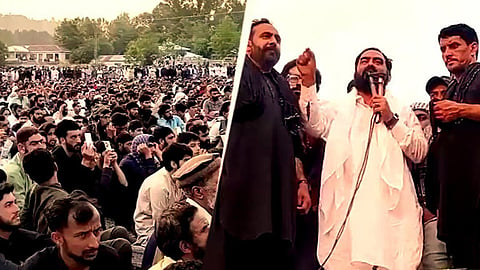
seen large, sometimes violent, protests led by the Joint Awami Action Committee (JAAC), with clashes between protesters and security forces, multiple deaths and a region-wide shutdown and communications blackout. Mainland Pakistan’s civilian authorities and the military have responded with a security crackdown—deploying extra forces, banning the protest group, launching clearance operations and justifying measures as necessary to restore law and order—while Islamabad’s foreign office has publicly rejected Indian criticism and framed the unrest as being addressed within constitutional frameworks. International and Indian media have highlighted rights concerns and accused Pakistan of heavy-handed tactics as local leaders set deadlines and mass rallies continue, raising tensions ahead of upcoming regional elections.
June 8, 2026, may well be remembered as a watershed in the history of Pakistan-Occupied Jammu and Kashmir (POJK) when Pakistani security forces opened fire on demonstrators protesting against political discrimination, economic exploitation and constitutional inequities, leaving several civilians dead and scores injured. What followed was an unprecedented wave of anger across Muzaffarabad, Rawalakot, Bagh, Kotli, Mirpur and other towns, accompanied by internet shutdowns, arrests and a sweeping crackdown on civil society. For many observers, these disturbances were not an isolated eruption but the culmination of nearly eight decades of accumulated grievances.
Unlike Pakistan’s provinces, POJK has occupied a peculiar constitutional position. Islamabad has projected the territory as self-governing, complete with a president, prime minister, legislative assembly and judiciary. Yet the reality has long been different. The constitutional framework established under the 1974 Interim Constitution ensured that decisive powers remained concentrated in Islamabad. The federal government exercises authority through institutions such as the Ministry of Kashmir Affairs and other supervisory mechanisms, leaving local governments with limited autonomy. Political parties advocating independence or alternative constitutional arrangements face severe restrictions, creating a democratic deficit that has generated growing resentment among the population.
A major source of discontent has been the structure of representation itself. The Legislative Assembly contains seats reserved for so-called Kashmiri refugees living across Pakistan. Since these voters are dispersed and often disconnected from the territory, critics argue that the arrangement allows Islamabad to influence electoral outcomes and maintain political control. The recent decision of the Azad Kashmir Supreme Court to uphold these reserved seats became one of the immediate triggers for the latest wave of protests. For many residents, this issue symbolises a larger problem: external interests routinely shape political decisions that affect their lives.
Economically, the story of POJK is equally complex. On paper, some social indicators compare favourably with those in certain Pakistani provinces. Literacy rates and basic development indicators in parts of AJK have historically exceeded those in Balochistan and former tribal areas. However, these statistics conceal structural weaknesses. The economy remains heavily dependent on remittances from overseas communities, particularly in the United Kingdom and the Gulf. The region experiences minimal industrialisation, limited employment opportunities, and uneven infrastructure development.
The contrast with Indian-administered Jammu and Kashmir has become increasingly visible. Large-scale investments in roads, education, healthcare and connectivity on the Indian side have generated inevitable comparisons. While such comparisons are often politically charged, they have nevertheless contributed to a perception among many residents of POJK that Islamabad has given their region less attention than it deserves, given its strategic significance.
Nothing illustrates this sense of economic injustice more vividly than the Mangla Dam. For decades, residents have argued that while their land and resources generate enormous benefits for Pakistan, they receive little in return. Local consumers continue to face high tariffs and shortages, while other provinces receive the water and electricity produced in the region.
The northern territory of Gilgit-Baltistan presents another dimension of the development debate. The China-Pakistan Economic Corridor (CPEC) passes through this strategically critical region and has brought significant infrastructure activity. Yet many local communities complain that promised employment and economic benefits have not materialised. Concerns regarding land acquisition, environmental degradation, demographic changes and the growing influence of external actors have fuelled recurring protests.
The recent violence must therefore be viewed against this broader backdrop. The current agitation is led largely by the Jammu Kashmir Joint Awami Action Committee (JAAC), a coalition of traders, lawyers, students, civil society groups and ordinary citizens. What began as protests against inflation, electricity tariffs and wheat shortages evolved into a broader movement demanding constitutional reforms, local empowerment, accountability and economic justice. Its charter encompasses issues ranging from representation and taxation to employment, healthcare and education.
The Pakistani authorities’ decision to ban JAAC and classify it as a threat to public order transformed an economic protest into a confrontation over civil liberties. The subsequent use of force, communication blackouts and mass arrests further intensified public anger. Far from extinguishing dissent, the crackdown appears to have broadened participation and attracted national and international attention.
An important question concerns the existence of pro-India sentiment within POJK. The answer requires nuance. There are undoubtedly individuals and groups who view integration with India favourably, citing historical, cultural and developmental considerations. There are also organisations that advocate complete independence from both India and Pakistan. However, the dominant mood behind the current protests is neither overtly pro-India nor secessionist. Rather, it reflects frustration with governance, representation and economic marginalisation.
The future of POJK remains uncertain. In the short term, Islamabad is likely to continue a familiar strategy of limited concessions combined with coercive control. Subsidies and administrative reforms may address some immediate grievances, but the deeper constitutional questions are unlikely to disappear. If the present movement survives repression and develops stronger organisational structures, it could evolve into a sustained campaign for greater autonomy and democratic reform.
The changes present both chances and problems for India. The unrest exposes contradictions in Pakistan’s long-standing narrative on Kashmir and highlights questions of governance, representation and human rights in territories under its control. India must also acknowledge that the people of POJK have diverse aspirations that go beyond simple geopolitical calculations. Any lasting transformation will ultimately depend on the choices made by the inhabitants themselves.
The events of June 2026 are an eloquent testimony to the contention that beneath the surface lies a region grappling with unresolved questions of identity, representation, development and dignity. Whether the current turmoil leads to meaningful reform, greater autonomy, continued repression or a more profound geopolitical realignment remains uncertain. What is clear, however, is that the people of Pakistan-Occupied Jammu and Kashmir have made their voices impossible to ignore. Their struggle has reopened a chapter of the Kashmir question that many believed had been frozen by history, and its consequences are likely to resonate across South Asia for years to come.
