
- Home
- Live Blog
- Breaking News
- Top Headlines
- Cities
- NE News
- Sentinel Media
- Sports
- Education
- Jobs
Pallab Bhattacharyya
(pallab1959@hotmail.com)
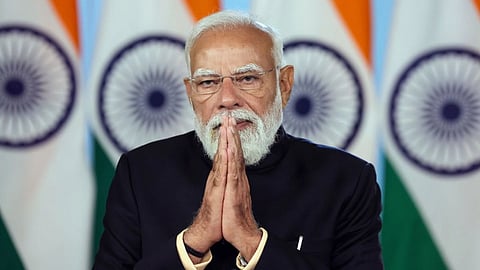
When Prime Minister Narendra Modi, speaking at Secunderabad and later at Vadodara in May 2026, appealed to Indians to embrace austerity in the face of a deepening economic crisis triggered by the West Asian conflict and the blockade of the Strait of Hormuz, the announcement marked one of the most candid acknowledgements by the union government of the scale of financial stress confronting the country. Calling upon citizens to reduce fuel consumption, defer non-essential imports, avoid extravagant spending, rely more on virtual meetings and public transport, and place "the nation first above personal comfort", the Prime Minister framed the crisis not merely as an economic challenge but as a moral test of collective endurance. The appeal carried echoes of wartime economies and earlier eras when nations under strain sought survival through sacrifice. Yet, beneath the emotional resonance of patriotism lay a stark reality: India's developmental model, heavily dependent on imported energy and global trade routes, has become acutely vulnerable to geopolitical disruptions and volatile commodity markets.
The circumstances that compelled such an appeal are extraordinary. The continuing turbulence in West Asia has sharply increased crude oil prices, pushing Brent crude beyond levels that threaten macroeconomic stability for large import-dependent economies like India. Nearly one-fifth of India's imports are petroleum products, and the blockade of the Strait of Hormuz disrupted supplies that cannot easily be replaced in the short term. Simultaneously, the rupee weakened to historic lows against the dollar, increasing the cost of imports and widening the current account deficit. Financial markets reacted nervously to the Prime Minister's announcement, reading the austerity message as a signal of mounting fiscal pressures and limited policy space.
The crisis has exposed the contradictions of India's growth story. For years, the nation projected itself as a rapidly expanding economic powerhouse aspiring to become a developed country by 2047. Massive investments in infrastructure, digital governance, expressways, manufacturing corridors, and urban development symbolized this ambition. Yet, the present situation reveals how fragile growth can become when foundational sectors such as energy, fertilizers, edible oils, and industrial inputs remain deeply dependent on external supplies. A nation that dreams of becoming a global manufacturing centre cannot indefinitely rely upon unstable geopolitical situations for essential commodities.
The Prime Minister's austerity framework seeks to reduce demand pressures through voluntary restraint. Citizens have been urged to reduce unnecessary travel, avoid lavish foreign holidays, cut down on imported luxury goods, minimize fuel consumption, postpone gold purchases, and rely increasingly on digital alternatives. The message is politically powerful because it appeals to the cultural instinct of sacrifice deeply rooted in Indian society. However, there are legitimate concerns about whether moral persuasion alone can resolve structural economic vulnerabilities.
Austerity often appears attractive during crises because it signals discipline and seriousness. Economists advocating fiscal restraint argue that when debt levels rise sharply, governments must reassure investors that public finances remain sustainable. Excessive borrowing can fuel inflation, weaken currencies, and reduce investor confidence. India's public debt burden has expanded substantially during the last decade due to pandemic-related expenditure, welfare commitments, subsidies, and infrastructure spending. Consequently, calls for prudence are not entirely misplaced.
Yet history also offers cautionary lessons. Excessive austerity during periods of economic weakness can suppress demand, reduce investments, and worsen unemployment. The experiences of several European economies after the global financial crisis of 2008 remain instructive. Countries that aggressively cut public expenditure without protecting productive investments and vulnerable populations often witnessed prolonged stagnation, social unrest, and political polarization. Conversely, nations that combined fiscal prudence with strategic state support recovered more effectively.
India therefore faces a delicate balancing act. It cannot afford reckless expenditure in a period of external uncertainty, but neither can it allow austerity to weaken domestic demand, rural livelihoods, and industrial momentum. The challenge lies in designing intelligent restraint rather than indiscriminate contraction.
Global best practices offer valuable guidance. During the energy shocks of 2022-23, several OECD economies adopted targeted support mechanisms instead of broad subsidies. Rather than reducing fuel prices for everyone, governments provided direct assistance to vulnerable households and sectors most exposed to rising energy costs. This approach preserved market price signals that encouraged conservation while protecting those least capable of absorbing inflationary shocks. India, with its sophisticated digital payment architecture and Aadhaar-linked welfare systems, is uniquely positioned to implement such targeted interventions efficiently.
One of the most urgent tasks before the Centre is to strengthen energy security. The current crisis demonstrates the strategic danger of excessive dependence on imported fossil fuels. Countries that navigated recent energy disruptions more successfully were those that had diversified energy sources, invested aggressively in renewables, expanded strategic reserves, and modernized power grids. India has made notable progress in solar energy and electric mobility, yet the pace remains insufficient considering the scale of future risks.
The government must therefore accelerate investments in renewable energy, green hydrogen, battery storage systems, and electric public transportation. Solar-powered irrigation pumps, decentralized renewable grids for rural areas, and electrification of freight systems can substantially reduce long-term vulnerability. Expanding strategic petroleum reserves is equally critical. India's present reserve capacity provides only limited protection against prolonged disruptions. In a world increasingly shaped by geopolitical rivalries, energy reserves are not merely economic assets but also instruments of national security.
Another major lesson from global experience concerns the importance of equitable burden-sharing. Austerity succeeds politically only when citizens believe that sacrifice is being distributed fairly. Extravagant governmental expenditure, excessive ceremonial spending, and non-essential administrative luxuries can undermine the moral credibility of calls for public restraint.
The Centre should also reconsider the structure of taxation and consumption. Instead of generalized appeals against spending, targeted taxes on luxury imports and high-end discretionary consumption could conserve foreign exchange while minimizing hardship for ordinary households. Temporary tightening of overseas remittance limits for non-essential expenditure may also help stabilize reserves. Such measures would be more effective than relying entirely on voluntary behavioural changes.
Protecting productive public investment is equally essential. Infrastructure expenditure generates employment, stimulates demand, and enhances long-term competitiveness. Cutting capital expenditure during crises often deepens economic weakness. The government must therefore preserve investments in railways, logistics, renewable energy, water systems, and manufacturing infrastructure even while curbing less productive spending. The objective should be to distinguish between consumption-orientated expenditure and growth-enhancing investment.
Rural India deserves particular attention. Inflation in fuel, fertilizers, and cooking gas disproportionately affects poorer households. For low-income families, rising energy costs represent a severe erosion of purchasing power. Welfare mechanisms such as rural employment guarantees, food security programmes, and targeted agricultural support cannot be weakened during such periods. Economic discipline that protects balance sheets while ignoring human vulnerability risks generating long-term social instability.
Institutional reforms are also indispensable. Investors seek not only fiscal stability but also predictable governance, transparent regulation, speedy dispute resolution, and policy continuity. Strengthening institutions may ultimately restore confidence more effectively than symbolic austerity campaigns. Simplified labour laws, support for formal employment generation, and improved ease of doing business can stimulate private investment even during difficult times.
India stands today at a decisive crossroads. The crisis of 2026 has revealed the limits of a growth model dependent upon imported energy, fragile global supply chains, and external geopolitical stability. The Prime Minister's austerity appeal may provide temporary psychological cohesion and short-term relief for the balance of payments. However, the deeper solution lies elsewhere - in building an economy rooted in energy independence, technological innovation, resilient institutions, diversified supply systems, and equitable social protection.
