
- Home
- Live Blog
- Breaking News
- Top Headlines
- Cities
- NE News
- Sentinel Media
- Sports
- Education
- Jobs
Lalit Nath
(lalitnath784@gmail.com)
Spring, the king of seasons, occupies a cherished place in Assamese life. After the dryness and stillness of winter, the arrival of spring in the months of Phagun and Chot transforms nature into a vibrant canvas. Tender buds bloom on trees and creepers, while flowers like palash, shimul and krishnachura spread their fiery hues across the landscape. This seasonal renewal is not merely a change in nature’s attire; it awakens love, hope and spiritual longing in the human heart. Amid this enchanting atmosphere, the festival of Doul Yatra—popularly known as Fakuwa—is celebrated with devotion and joy.
The scriptural foundation of Doul Yatra can be traced to the Brahma Vaivarta Purana, particularly in the Krishna Janma Khanda, where the celebration of Dolotsava on the full moon of Phalguna is mentioned:
“Phalguni Purnima tasya vatsaryena hi kirtita, Tasyam dolotsavam kritva gayanti cha namanti cha.”
The verse clearly speaks of Doul Purnima, devotional singing and reverential worship. According to this tradition, on the auspicious full moon day, the idols of Lord Krishna and Radha are placed upon a swing and taken out in procession amid kirtan and prayer.
Though known by various names—Deul, Doul, Doul Yatra, Fakuwa, Phalgutsava, or Basantotsava—the festival is essentially pan-Indian in character. It is celebrated with great enthusiasm in states like Rajasthan, Bihar, Uttar Pradesh, Gujarat and West Bengal.
However, the Neo Vaishnavite movement in Assam shapes the festival’s distinctive spiritual and cultural identity.
Ancient texts like the Kalika Purana and Yogini Tantra refer to the observance of Madan Chaturdashi. In early Assam, the festival was once associated with fertility rites during the full moon of Phagun. Under the spiritual guidance of Mahapurusha Srimanta Sankardeva, however, it underwent a profound transformation and emerged as a deeply devotional celebration rooted in bhakti.
According to Guru Charitra by Ramcharan Thakur, around 1470 CE, when Sankardeva was about twenty-one years old, he initiated the Doul festival at his birthplace, Bordowa. Tradition recounts that while preparing the foundation of the Doul platform, Sankardeva himself carried earth in a copper tray. During excavation, a Vishnu idol was discovered, which later came to be worshipped as Doul Govinda. Installing the idol on a seven-tiered seat, he began observing Doul Yatra on the full moon of Phagun with Naam Kirtan and the use of natural colours.
It is said that Sankardeva sent his disciple, Balaram Ata, to Maruapara to collect natural colouring powder. After ten days, Balaram returned with seven pitchers of the naturally prepared colours. Thus began a tradition that beautifully combined devotion with festivity.
Due to political unrest, Sankardeva was compelled to leave Bordowa around 1516–17. Later, at Barpeta Satra, Mathura Das Burha Ata institutionalized and organized the festival around 1596 CE. In Barpeta, the festival is popularly called Deul. Today, Barpeta Satra stands as one of the principal centres of Assamese Vaishnavite culture, where Doul is celebrated with grandeur and disciplined ritual.
The festival usually lasts three to five days, depending on the lunar calendar, and is divided into Deka Doul and Burha Doul. The first day is observed as Gandha Yatra or Gandhotsava, sometimes accompanied by a ceremonial fire reminiscent of Holika Dahan. The atmosphere reverberates with incense, lamps, Naam Prasanga, and devotional singing.
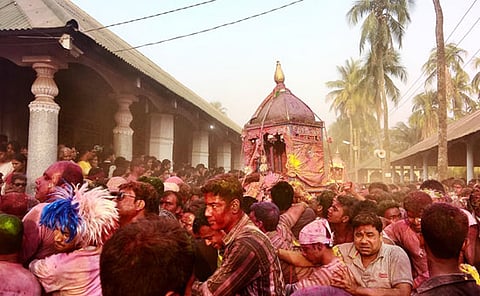
The second day marks the main celebration known as Bhor Doul. The idol of Lord Krishna is adorned magnificently and placed on a swing. A grand procession circles the xatra premises amid the rhythmic sounds of khol and taal, accompanied by Gayon Bayon performances. The entire environment becomes immersed in devotion.
The final day is observed as Suweri or Fakuwa, when devotees play with natural colours. Laughter, songs and collective participation fill the air with joy. Yet even in its exuberance, the celebration retains a sacred sequence—colours are first offered to the deity before being shared among devotees.
Distinctive customs enrich the Assamese celebration of Doul. In Bordowa, Naam Kirtan is used to take the deity to nearby villages as part of Gosai Furua. In Barpeta, the ritual of Duwar Dhara marks the ceremonial offering at the main gate of the Kirtanghar. The tradition of placing Faku upon the head of the Gosai symbolizes humility and devotion.
Music and performance play a vital role. Borgeet, Holigeet and Bhaona add a musical and theatrical dimensions to the festival. The Holigeets, composed by Mahapurush Madhavdeva, are rendered in ragas such as Sindhura, Bhatiyali, and Tur Basant, enriching the spiritual ambiance.
The mythological roots of the festival are linked with the pan-Indian celebration of Holi and the story of Prahlada from the Bhagavata Purana. The demon king Hiranyakashipu, empowered by a boon from Brahma, sought to destroy his son Prahlada for his unwavering devotion to Vishnu. His sister Holika attempted to burn Prahlada in fire, but by divine grace, Prahlada survived while Holika perished. The symbolic burning of Holika signifies the triumph of righteousness over evil.
Another devotional narrative appears in the Ghunucha Kirtan by Sridhar Kandali, which recounts how Lord Krishna, leaving Lakshmi, travelled in a swing to the house of Ghunucha, daughter of King Indradyumna. When Krishna stayed there for seven days, Lakshmi, in anger, destroyed Ghunucha’s city. Eventually, Krishna pacified Lakshmi, and harmony was restored.
The verses describe:
“Ehimote Jagannath jay doul chari Koutuke choli jant Ghunuchar bari
Indradyumna raja purbe mahotsav kori Krishnak doulot niya thhapila sadori
Ghunchha name jiukhani sarba saubhagini Krishnak dilanta biha bidhivate ani.”
These lines reflect the playful yet devotional spirit associated with the Doul tradition.
Although Holi and Doul Yatra share common roots, their cultural expressions vary. In Assam, Doul is deeply intertwined with Neo-Vaishnavite spirituality. The word ‘Doul’ signifies the divine throne or seat. Placing Krishna upon the swing symbolizes enthroning the divine within one’s own heart. The exchange of colours represents the sharing of love and devotion. Since colours are the same for all, they dissolve social divisions and promote equality.
Doul Yatra thus unites religious devotion, social harmony, and Assamese cultural heritage. It stands as a living symbol of unity, forgiveness and fraternity beyond caste, creed, and status. Like spring itself, it teaches renewal—the abandonment of ignorance and the embracing of spiritual awakening. For centuries, the spiritual glory of spring and Doul Yatra has illuminated Assamese society. It is more than a festival of colours; it is a celebration of life, faith, and the eternal victory of light over darkness.
