
- Home
- Live Blog
- Breaking News
- Top Headlines
- Cities
- NE News
- Sentinel Media
- Sports
- Education
- Jobs
Himangshu Ranjan Bhuyan
(hrbhuyancolumnist@gmail.com)
In the spiritual and cultural world of Assamese social life, the Borgeets composed by Mahapurush Srimanta Sankardeva and Sri Sri Madhavdeva are a stellar creation that not only shows the path of devotion but also bears the identity of high-level classical music. When discussing the classical or scriptural recognition of Borgeet, we must first realize that music is not merely a medium of entertainment; it is a rigorous discipline and an art conforming to grammar. When we look at the history of Indian music, we find that parallel to North Indian Hindustani music and South Indian Carnatic music, there exists in the bosom of Assam’s Satriya tradition a distinct, independent, and robust classical entity of Borgeet. This musical stream is neither folk music nor ordinary religious song; it is established on a well-ordered structure of raga, tala, mana, and laya, where an exquisite harmony of words and melody has taken place. The compositional style of Borgeet, its gravity, the depth of emotion, and the specific rules of performance have bestowed upon it a unique dignity that is in no way inferior to any other classical musical tradition of India. Examining this classical character of Borgeet not merely with emotion but with logic and theoretical analysis from musicology is one of the foremost demands of the present time. These songs are so intimately connected with the life of the people of Assam that their classical gravity sometimes remains hidden beneath the veil of devotion, yet theoretical analysis of music has always acknowledged their high standard.
Music is not only a source of satisfaction for the auditory sense of a society; rather, it is a powerful reflection of that society’s intellectual and aesthetic evolution. When Borgeet is called classical music, certain special technical and theoretical aspects are associated with it, the presence of which grants a musical style the status of “classical.” The main characteristics of classical music are that it must follow a specific grammar or scripture, it must have a long tradition, and its performance must adhere to the strict discipline of raga and tala. In the case of Borgeet, all these characteristics are vividly present. When Mahapurush Sankardeva composed the Borgeets, he did not think only of divine devotion; he also emphasized how the essence of that devotion could enter the heart of the listener through high classical music. Therefore, the Borgeets were composed not merely to be recited but to be sung in specific ragas and talas. The mention of the raga name at the head of each Borgeet proves that these songs are under a musical discipline. However, it must be noted that the method of applying raga and tala in Borgeet is not exactly the same as in other classical music of India. This difference or uniqueness has given Borgeet a special dimension. Although the names of the ragas in Borgeet resemble those of Hindustani music, their movement, expansion, and performance style are entirely different. This uniqueness proves that this musical stream of Assam is not borrowed; rather, it is an original creation that has developed with the essence and fragrance of its own soil, with an extremely strong theoretical foundation.
One of the main and thoughtful aspects of the classical character of Borgeet is the balance between its “pada” and “sura.” Generally, it is seen that in khayal or other classical music, more importance is given to the action or alap of melody than to words. There, words serve only as carriers of melody, and often the meaning of the words is lost in the twists of the melody. But in Borgeet, literature and music enjoy equal status. Here, the emotion that the poet wishes to express is made deeper and more meaningful through melody. Words are not distorted for the sake of melody, nor is their meaning allowed to be impaired. This does not mean that the place of music in Borgeet is secondary; rather, it means that here a “golden conjunction” of music and literature has occurred. If the primary objective of classical music is the “creation of rasa,” then in Borgeet, both words and melody cooperate equally to create that rasa. The rasas, such as shanta, dasya, and vatsalya, found in Borgeet play an immense role in carrying them to the listener’s heart through raga. The rule of performing specific ragas at specific times in Borgeet is also strong evidence of its scriptural nature. The ragas of Borgeet are determined according to the periods of morning, noon, evening, or night. This time the decision was taken by scientifically understanding the relationship between the change of nature and the mental state of human beings. This time-consciousness has separated Borgeet from mere emotional outburst and given it the status of a well-thought-out art.
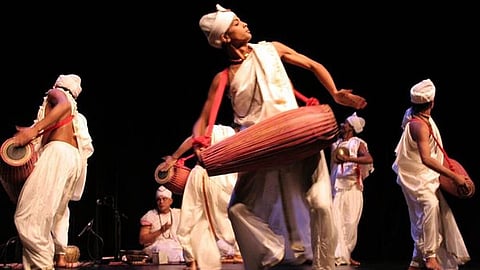
The tala system of Borgeet is also a subject of deep research, and its uniqueness is noteworthy. The names of the talas used in Borgeet and the division of their matras are different from other Indian tala systems. These talas are not mere tools for maintaining rhythm; rather, they are a powerful medium for giving dynamism to the emotion of the song. Satriya culture practices these talas with great devotion. The gravity that Borgeet receives with the accompaniment of khol or mridanga and tala is unparalleled. On the other hand, the language of Borgeet—known as Brajawali—has given these songs a pan-Indian acceptability as well as a classical gravity. This language is not an everyday spoken language; it is a literary and artificial language specially constructed for high literature and music. This language has separated Borgeet from ordinary folk songs and bestowed upon it an aristocracy. The use of dhruvaka or ghosha in the compositional style of Borgeet and the subsequent arrangement of padas remind one of the classical structure. First, the dhruvaka part is sung to express the main emotion, and then the emotion is expanded through the padas. This method establishes a connection of Borgeet with the ancient Indian musical tradition of “Dhruvapada” style, although the individuality of Borgeet always remains present. This structural discipline proves that Borgeet is not an accidental creation but the result of deep planning and knowledge.
From the perspective of spiritual philosophy, the purpose of Borgeet is not merely entertainment; rather, it is a path to self-purification and realization of God. The concept of “Nada Brahma,” or sound as Brahman in Indian philosophy, forms the basis of Borgeet. Here, music is accepted as a medium for attaining God. Yet this spirituality has never dimmed its artistic aspect. Rather, the combination of devotion and art has taken Borgeet to a unique height. The gravity, restraint, and purity adopted in the singing style of Borgeet are not found in lighter music. The singer must not only know how to hit the notes but also understand the inherent emotion and philosophy of the song. This need for intellectual preparation places Borgeet in the ranks of classical music. Within the satras, this knowledge has been practiced for centuries through the guru-shishya tradition. The fact that these songs’ melodies and singing styles have remained intact for centuries, relying on oral transmission without written notation, is astonishing. It proves how firm and scientific their practice method was. Although notation is now being used, the importance of oral teaching in the guru-shishya tradition remains intact. This continuity has preserved the traditional purity of Borgeet.
Sometimes controversy or disagreement arises regarding recognizing Borgeet as classical music, the main reason being lack of propagation and deficiency in comparative study. For the outside world, Indian classical music means only Hindustani or Carnatic music. But if one studies deeply the vastness and complexity of this musical stream belonging to Satriya culture, any musicologist will be compelled to acknowledge that the place of Borgeet is independent. The application of alankara, gamaka, and meend in Borgeet is extremely subtle, and mastering them requires long-term practice. Moreover, the instruments associated with Borgeet, especially the use of khol and tala, are so scientific that the sound waves created by them have a profound effect on the listener’s mind. In modern times, when we wish to introduce Assamese culture in the world arena, we should present Borgeet not merely as a religious song but as a full-fledged classical music system. For this, theoretical research, systematic notation, and performance in pure form will be needed. Of course, we must also be careful that the core spirit of Borgeet is not harmed in the name of modernity. Breaking the classical structure of Borgeet in the name of various experiments would be improper.
Another noteworthy feature of Borgeet is its universal appeal. Although these songs are composed on the basis of a specific religious belief, their musical and literary beauty can attract people irrespective of religion or caste. The transience of human life, the illusion of the world, and the longing for the supreme being—these subjects are expressed in Borgeet in such touching language that they touch everyone’s heart. Just as classical music takes the listener to a world of mental peace and higher thought, Borgeet does exactly the same. When the “alap” part of Borgeet creates the atmosphere of the raga, the daily clutter of the listener’s mind is removed, and a feeling of pure joy arises. This aesthetic joy, or “rasaswadana,” is the ultimate goal of classical art. In the case of Borgeet, this goal is fulfilled very naturally. Moreover, visionary figures like Sankardeva and Madhavdeva used music as a tool for social reform. They understood that a message given through melody works more effectively on people’s minds than dry preaching. Therefore, even in the classical gravity of Borgeet, one feels the pulse of folk life, which has made it very dear to the common people. Such a rare combination of classical nature and popularity is seen in very few musical traditions of the world.
In conclusion, it would be improper to confine Borgeet merely as a cultural asset of Assam. Within it lies the history of a nearly lost or evolved stream of Indian music. All the criteria of classical music—grammatical purity, discipline of raga-tala, depth of emotion, style of performance, and guru-shishya tradition—are present in full measure in Borgeet. Rather, in the field of fusion of literature and music, the position of Borgeet is higher than many other classical streams. In the present context, the practice and research of Borgeet should not remain confined within the four walls of the xatra; it needs to be included as an important part of the curriculum in universities and music colleges. Only when the new generation understands this classical essence of Borgeet will its future be secured. We must remember that Borgeet is our identity, our pride, and an eternal companion in our spiritual ascent. Establishing its uniqueness in the world arena is the responsibility of every Assamese.
