
- Home
- Live Blog
- Breaking News
- Top Headlines
- Cities
- NE News
- Sentinel Media
- Sports
- Education
- Jobs
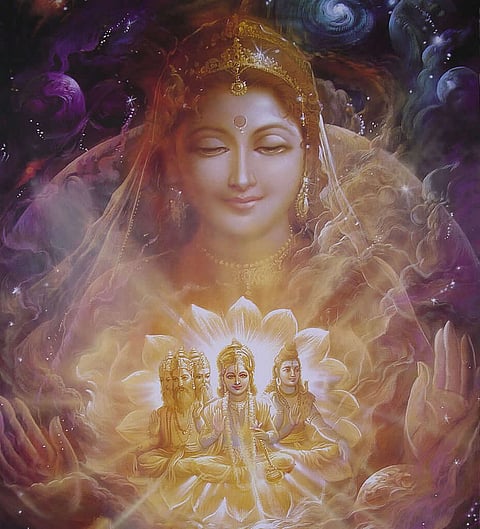
In his book In Praise of the Goddess, David Nelson, better known as the Vedanta scholar Devadatta Kali, describes the significance of the Divine Mother thus:
“The highest spiritual truth is the reality One. That reality, when personified as the Divine Mother, expresses itself in countless ways. The ten Mahavidyas, or Wisdom Goddesses, represent distinct aspects of divinity intent on guiding the spiritual seeker toward liberation. For the devotionally minded seeker, these forms can be approached in a spirit of reverence, love and increasing intimacy. For a knowledge-oriented seeker, these same forms can represent various states of inner awakening along the path to enlightenment.
In the series of the ten Mahavidyas or wisdom aspects of the Divine Mother, Kali comes first, for she represents the power of consciousness in its highest form. She is at once supreme power and ultimate reality, underscoring the fundamental Tantric teaching that the power of consciousness and consciousness itself are one and the same.
Kali appears to us in countless ways, but some aspects are more commonly encountered than others. In the esoteric Krama system of Kashmir, she is said to have a succession of twelve forms, beginning with Guhyakali, the supreme mystery, the Absolute. The other eleven forms represent every subsequent level of awareness, all the way down to our ordinary, unenlightened state. From pure formlessness and throughout the countless forms she assumes, Kali is the sole reality. Mother is all, and all is Mother.
The earliest descriptions of Kali belong to the Puranas, and they place her on the battlefield. The Devimahatmya vividly depicts a scene with Kali and her associated goddesses ready to take on an army of demons. Here, Kali has emerged as the personified wrath of the Divine Mother Durga. She appears emaciated, with her dark flesh hanging loosely from her bones. Her sunken eyes glow red in their sockets. She is clad in a tiger’s skin and carries a skull-topped staff. A garland of human heads adorns her neck. Her gaping mouth shows her to be a fearsome, blood-thirsty deity. The battle culminates with the slaying of two demon generals, Canda and Munda, and this act earns her the name Camunda.
In the next episode Camunda takes on the demon Raktabija. His name means ‘he whose seed is blood’. Whenever a drop of his blood falls upon the ground, another demon of equal size and strength springs up. In the battle, he sheds blood profusely until the world is teeming with Raktabijas. Just when the battle looks hopeless and the onlooking gods despair, Camunda roams the battlefield, avidly lapping up the blood and crushing the nascent demons between her gnashing teeth. Finally, drained of his last drop of blood, Raktabija topples lifeless to the ground.
On the surface this appears to be a grisly tale, but it symbolizes profound insight. Raktabija’s amazing replicative ability symbolizes the human mind’s ordinary state of awareness. The mind is constantly in motion, and one thought begets another in an endless succession. The mind rarely rests and is never fully concentrated. In the light of Patanjali’s Yogasutra, we can understand Camunda as the power to restrain the mind’s endless modulations, to stop them altogether.
When all mental activity (cittavritti) ceases, that state is called yoga: consciousness resting in its own infinite peace and bliss. In that state of ultimate absorption, represented by Camunda’s imbibing of every drop of blood, the soul regains knowledge of its own original divinity. Camunda Kali’s battle scene represents the resorption of fragmented human awareness into transcendental wholeness.”
— the harbinger