
- Home
- Live Blog
- Breaking News
- Top Headlines
- Cities
- NE News
- Sentinel Media
- Sports
- Education
- Jobs
Dr SP Sharma
(The author is a Professor & Chief Economist, NDIM-NEO Research Centre (NNRC), New Delhi)
India is on the expressway of economic growth. All indicators point to rapid expansion across key sectors of our economy. What the country needs is to secure supplies of key raw materials and improve power connectivity, reducing the cost of doing business and enabling reliable transport of people and goods.
India has seen rising Foreign Direct Investment (FDI) over the years and is one of the top recipients of FDI in Asia. In the financial year 2024-25, India recorded substantial FDI inflows of around USD 81 billion.
We have therefore developed growth corridors in India - strategically planned geographic zones designed to accelerate economic development, industrialisation, investment, and infrastructure development along specific routes. They are part of India's long-term vision to enhance connectivity, reduce costs, create jobs, and make regions more competitive domestically and globally.
Aviation is a key piece of the puzzle. It reduces the distance and time taken to travel along these economic corridors. The sector is therefore a key enabler of economic growth and must be nurtured.
According to data from the International Air Transport Association (IATA), aviation contributes 53.6 billion US dollars to India's GDP each year, equivalent to 1.5% of GDP. It has created 7.7 million jobs.
It enables trade, tourism, and global linkages, thereby amplifying tourism's share of GDP and jobs.
India has more than doubled the number of operational airports over the past decade, with plans for many more, which is stimulating construction, investment, and long-term productive capacity. Major new hubs such as Noida International (Jewar) Airport and Navi Mumbai International Airport are catalysts for real estate, logistics, industrial growth zones, and job creation.
Investing in aviation not only creates airline jobs but also supports activity in supporting sectors (hotels, catering, transport, and manufacturing). Each direct aviation job creates several additional jobs in the economy.
By attracting foreign investment and facilitating the faster movement of goods and people, aviation enhances productivity and national competitiveness.
India has had a somewhat chequered aviation industry, marred by occasional carrier bankruptcies and exits. What we now need is a diversity of players in the sector. That can come only when the industry remains attractive through predictable policy and regulation and when existing players demonstrate success.
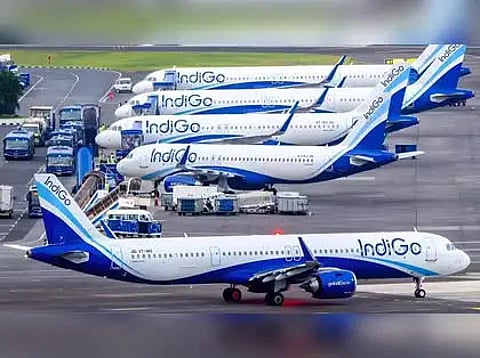
The recent troubles faced by India's largest airline and the intense media attention on Indian aviation should be viewed in the proper perspective. Despite the sector's structural challenges, IndiGo has emerged as a stabilising force in Indian aviation, making affordable air travel accessible across a vast and diverse country. Its unmatched scale and extensive network connect destinations that many other carriers do not serve, supporting regional mobility and economic integration. IndiGo's record aircraft order further underscores the airline's business discipline, long-term vision, and strong confidence in the sustained growth of India's aviation market.
What India needs now is not just growth in passenger numbers, but also depth and resilience in the aviation ecosystem. Large economies do not rely on fragile airline systems. The United States, Europe, and China all have a healthy mix of strong, scaled carriers that provide redundancy, absorb shocks, and compete globally. Consolidation in these markets has not weakened aviation; it has strengthened it by creating airlines with the size, balance sheets, and operational capability to invest for the long term.
India is entering a similar phase. As the country is poised to become the world's third-largest domestic aviation market, it will need airlines that match the size, scale, and potential of the economy. Just as India has banks, telecom companies, and consumer brands that operate at a global scale, its aviation sector too must produce carriers capable of competing internationally, expanding overseas networks, and carrying the India brand to the world.
Indian airlines repeatedly struggle due to a mix of structural, financial, and policy-related issues. It is not a lack of demand; India is one of the fastest-growing aviation markets, but it is a case of thin margins and high costs. We import all our passenger aircraft, and aviation turbine fuel remains a highly taxed commodity. Planes must routinely undergo expensive repair and overhaul at foreign facilities. All these costs squeeze airlines, making aviation a precarious affair. Amidst all of this, we have IndiGo, which has navigated the maze effectively, focused on execution, and been consistently profitable. And with this, the carrier has catalysed India's growth.
All leading aviation markets, such as Europe, the United States and China, have a healthy mix of strong airlines. The Indian aviation market is expected to become the third largest in the world sometime next year. If we want resilient skies, we must have a bevy of stable carriers. Aviation is a capital-intensive business. It takes years to build dependable airline operators. It is therefore time to look at the larger picture and focus on growing Indian aviation by bringing vibrancy to the sector so more global investors find it attractive and we have a variety of strong carriers. This is in the interest of millions of Indian businesses and passengers and is ultimately the best for India.
