
- Home
- Live Blog
- Breaking News
- Top Headlines
- Cities
- NE News
- Sentinel Media
- Sports
- Education
- Jobs
Dr Sudhir Kumar Das
(dasudhirk@gmail.com)
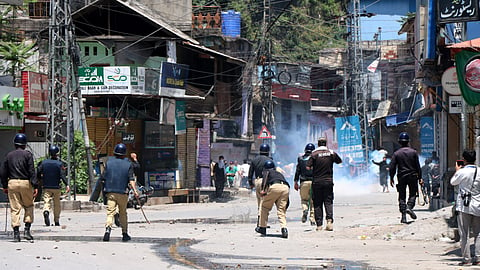
Since 2023 Pakistan-Occupied Jammu and Kashmir (POJK) has been in a state of turmoil, ripping apart the façade of normalcy propagated by its hybrid regime. The simmering cauldron of public discontent in occupied Kashmir has been venting its frustration sporadically in the form of street protests and long marches against the exorbitant power bills, shortage of food grains, lack of infrastructure in the region, and an apathetic political system. Earlier, when the movement started in May 2023, public anger was directed against the government's bad economic policies, but this time the protestors have included some contentious political demands, such as the abolishment of the twelve reserved seats for the refugees from India in 1947 and structural reforms of the state assembly to cater to the changing needs of the people of the region. The Jammu and Kashmir Joint Awami Action Committee (JAAC), the organisation that has been spearheading the present movement, has metamorphosed itself from a pressure group consisting of a few traders, transporters, lawyers, and students to a massive civil rights movement challenging the mighty civil-military establishment of Pakistan. The federal government of Pakistan, apprehending a mass-based organic movement led by the JAAC, acted like an authoritarian regime, banning it by declaring it an unlawful organisation and cracking down on the agitation with brutal force, resulting in the loss of about thirty lives in June alone.
The JAAC declared its agitational programme of Paiha Jam (halt to all modes of transportation) on 9th June in support of its 38-point charter of demands, which included the abolishment of 12 reserved seats for refugees who crossed over from the Indian part of Kashmir in 1947 but now live abroad. On 5th June, the federal government of Pakistan proscribed the JAAC as an unlawful organisation and started a brutal crackdown on the proposed long march to Muzaffarabad, the administrative capital of Pakistan-occupied Kashmir. The hard-handed crackdown by the security forces on the march reportedly resulted in the loss of many civilian lives. There has been a complete internet blackout since then in the region. The Supreme Court of Pakistan-Occupied Kashmir's contentious verdict on 7th June, which validated the continuation of the system of 12 reserved seats in the regional legislature, as they are constitutionally protected, exacerbated the situation. On July 15th the JAAC announced its march to Muzaffarabad, and a police crackdown claimed the lives of 7 civilians and 2 policemen. The situation may further deteriorate before the regional elections scheduled to be held on 27th July.
The demand for the abolition of the 12 reserved seats has a historical background to it. At the time of Partition in 1947, many refugees from Indian Jammu and Kashmir migrated to the Pakistani-occupied part. Most of these refugees settled in Punjab and Sindh, where there were better economic opportunities, since the occupied part of Kashmir had few. Since they were registered with the UNO as refugees, their status as refugees provided them with access to the occupied Kashmir assembly as members of the reserved category. In 1960, the federal government of Pakistan introduced a new administrative system known as the Basic Democratic Act. This act introduced a hierarchical system of governance that included a hierarchical system of governance in the form of union councils, tehsil councils, and district councils. These councils elected 24 members (12 members elected by the people of occupied Kashmir and 12 others were reserved for the refugees) to the State Council, which in 1970 was converted into the State Assembly. All through these administrative reforms, the reserved seats for refugees remained unchanged. In 2018, the 13th amendment to the constitution was carried out, which envisaged a 53-seat State Assembly for occupied Jammu and Kashmir out of which 33 are to be elected from Kashmir, 12 are reserved for the refugees, 5 women members, 1 technocrat, 1 ulema or a religious leader, and one seat was reserved for the representative of overseas Kashmiris. What really has sparked resentment among the people of occupied Kashmir is that the members of the 12 reserved refugee representatives are not required to be permanent residents or domiciled citizens of the region. The refugee representatives can be ministers and hold high public offices in the state of occupied Kashmir without being a domiciled citizen of the region. They have been enjoying disproportionate power and influence in the state politics while having their roots outside the region. This situation has allowed national political parties to interfere in state affairs through these members, leading to political instability.
JAAC's opposition to the 12 reserved seats in the state assembly stems from the fact that it regards the provision of reserved seats for refugees as a temporary political measure adopted to meet the exigencies of the Partition. Decades have passed since Partition, and the situation has changed dramatically. JAAC argues that in the present changed political scenario, reserving seats for a group of people who are neither refugees nor domiciled residents of the region is unnecessary. JAAC demands that the system of reservation must be abolished, and in its place, 12 indigenous members should be elected to the State Assembly. However, neither the federal government nor the federal political parties of Pakistan support this contention of the JAAC on the ground that yielding to this demand on the status of the refugee seats would substantially dilute Pakistan's stand on Jammu and Kashmir internationally. At the time of Partition a few thousand refugees had migrated to the occupied part of Kashmir but now they number around twenty lakhs. The leadership in Pakistan is still very optimistic that if a UN-supervised plebiscite in Jammu and Kashmir is held at some point in time in the future, the vote of these people will help in tilting the scale in its favour. If their refugee status the JAAC's demand, as demanded by the JAAC, India will get an opportunity to exploit the situation.
Apart from the demand for the structural reform of the Jammu and Kashmir State Assembly, the JAAC charter included demands like opening new institutions of higher education, improving general infrastructure in the region, constructing an international airport at Mirpur and other such demands normally asked for by an aspiring group of citizens to improve the standard of living of the people inhabiting the region. A more profound analysis of these demands indicates that there is a growing desire among the people of occupied Kashmir to bypass mainland Pakistan in their everyday dealings. Opening institutions of higher education and an airport at Mirpur would effectively end their dependency on mainland Pakistan. The federal government does not want the region to be self-sufficient in any matter and wants it to remain dependent on mainland Pakistan for everything.
There is a discernible contradiction in the approach of the federal and regional governments to this unrest. When the prime minister of occupied Kashmir, Raja Faisal Mumtaz Rathore, insisted on negotiations with the leaders of the agitation in an interview with the BBC, the federal government declared the JAAC a terrorist organisation, forcing its frontline leadership, like Umar Nadeem Kashmiri, to go underground, effectively shutting the door on any future negotiations.
What could be more paradoxical for Pakistan than basking in the glory of rediscovering its lost mooring in the geopolitics of South Asia after playing the role of a mediator in the now-concluded Iran-US war, only to be singed by serious internal security issues? Out of its five main provinces, three-Baluchistan, Khyber Pakhtunkhwa, and occupied Jammu and Kashmir-are engulfed in separatism, public discontent, and violent civil unrest. The POK turmoil illustrates that if a country aspires to project itself as an Asian middle power of any consequence, it should first be capable of looking after its citizens.
