
- Home
- Live Blog
- Breaking News
- Top Headlines
- Cities
- NE News
- Sentinel Media
- Sports
- Education
- Jobs
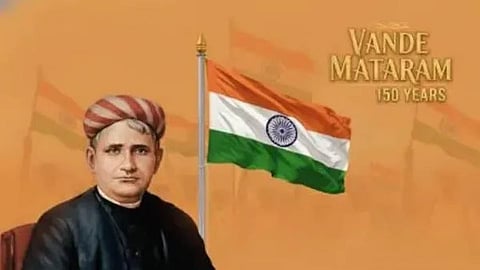
As India honours Vande Mataram at 150, the nation celebrates a hymn that helped ignite the freedom struggle, continues to inspire unity, and remains a timeless reminder that love for the motherland transcends every barrier - Duina Barbaruah
As India commemorates 150 years of Vande Mataram, the nation finds itself reflecting on a hymn that has shaped its journey across centuries. More than a literary composition, more than a patriotic slogan, Vande Mataram has stood as a pulsating symbol of national unity, courage, and emotional belonging. The decision to hold special discussions in both Houses of Parliament to mark this milestone is a step in the right direction, honouring a song that played a defining role in the freedom struggle and continues to inspire unity across caste, creed, and religion.
A hymn born in an age of awakening
Bankim Chandra Chatterjee composed Vande Mataram in 1875, during a period of rising national consciousness. India's encounter with British imperial rule had sparked introspection and a yearning to reclaim cultural self-confidence. It was in this climate that Bankim Chandra penned the hymn, later publishing it within his celebrated 1882 novel Anandamath. Written in a seamless blend of Sanskrit and Bengali, the song personified the motherland as graceful, bountiful, and compassionate-an image that deeply resonated with a people longing for freedom.
Bankim Chandra's verses did something revolutionary: they transformed the land itself into an object of devotion. At a time when colonial rule sought to undermine India's civilisational identity, Vande Mataram restored pride and self-belief. Its emotional intensity made it not just a poem but a call to awaken one's soul and stand in defence of the motherland.
The battle cry that stirred a nation
By the early 20th century, Vande Mataram had become the heartbeat of India's anti-colonial struggle. It was sung in political meetings, whispered during protests, etched on banners, and carried by volunteers marching into the unknown. At a time when public dissent invited imprisonment or worse, the hymn gave people a language of courage. British authorities soon recognised its galvanising effect and attempted to curb its public recitation - but this only intensified its symbolic power.
During the Swadeshi Movement that erupted after the partition of Bengal in 1905, the song became the rallying call of millions. For thousands of ordinary Indians-students, workers, peasants, and leaders-Vande Mataram functioned as an emotional force that transcended fear and despair. It reminded them that the fight for freedom was not merely political but civilisational. The song infused the struggle with moral purpose, transforming scattered resistance into a unified national movement.
A cultural bond forged across identities
Perhaps the most remarkable quality of Vande Mataram is its ability to transcend barriers of caste, creed, region, and religion. What began as a literary hymn soon evolved into a shared emotional experience. Regardless of one's background or beliefs, the verses stirred a deep sense of belonging.
In colonial India - fractured by hierarchical structures and administrative divisions - Vande Mataram offered an alternative identity rooted not in social labels but in devotion to the motherland. The freedom struggle drew strength from this shared sentiment, which allowed people to march together, sacrifice together, and dream together.
This bridging quality remains equally relevant in the 21st century. In an India that is diverse and dynamic, the song continues to evoke unity beyond boundaries, reminding citizens that the essence of patriotism lies in collective pride in the land they share.
A living tradition in independent India
Recognising its central role in shaping the national movement, the Constituent Assembly conferred on Vande Mataram the status of national song in 1950. Since then, it has become an integral part of India's civic and cultural life. Schools teach it, orchestras perform it, and national events invoke it with reverence. Artists reinterpret it through classical ragas, choral symphonies, and contemporary musical styles, ensuring that each generation discovers the song anew.
Its adaptability has allowed it to thrive in modern contexts. From digital platforms to cultural festivals, from sports arenas to community gatherings, the song continues to inspire and unify. Its message of devotion and pride feels as fresh today as it did during the freedom struggle.
A symbol of unity in contemporary India
In today's society-shaped by rapid technological change, urbanisation, and evolving social identities-Vande Mataram continues to serve as a cultural anchor. Its imagery of strength encourages collective resilience; its celebration of natural beauty inspires environmental consciousness; its invocation of unity fosters social harmony.
For young Indians, who may encounter the song in classrooms, films, music videos, or national celebrations, Vande Mataram becomes a gateway into understanding the emotional history of the nation. It reminds them that patriotism is not merely inherited from textbooks - it is felt, experienced, and renewed with each generation.
Parliament's tribute: honouring legacy, acknowledging relevance
The decision to dedicate special discussions in both Houses of Parliament to commemorate 150 years of Vande Mataram underscores its enduring significance. Parliamentary recognition elevates the anniversary from a cultural observance to a national moment of reflection. It allows lawmakers, historians, and citizens to reconsider what the song has meant across time and what it continues to offer India today.
By honouring the hymn in this way, Parliament affirms that Vande Mataram is not a relic of the freedom movement but a living legacy. It acknowledges that the values the song embodies - unity, courage, devotion, and pride - are as relevant to nation-building today as they were in the century gone by.
A hymn for the India of tomorrow
As India moves toward the centenary of Independence in 2047, the country is reflecting more deeply on its identity, aspirations, and collective future. In this journey, Vande Mataram serves as a cultural guidepost. It connects the past with the present, reminding the nation that unity has always been its greatest strength. The song's capacity to transcend social divisions offers a blueprint for building a more cohesive and harmonious society.
A timeless bond between people and their land
One hundred and fifty years after its creation, Vande Mataram remains more than a piece of poetry. It is an emotion, a memory, a call to unity, and a symbol of shared heritage. It binds together citizens across generations, social backgrounds, and belief systems. It stirs pride not only in the land's beauty but also in its spirit - a spirit that has sustained India through struggles and triumphs.
As India honours Vande Mataram at 150, the nation celebrates a hymn that helped ignite the freedom struggle, continues to inspire unity, and remains a timeless reminder that love for the motherland transcends every barrier.
(The author can be reached at dwinakashyap@gmail.com.)
