
- Home
- Live Blog
- Breaking News
- Top Headlines
- Cities
- NE News
- Sentinel Media
- Sports
- Education
- Jobs
(A travelogue across the mountains of Bhutan, Mon Yul, Tibet and over the oceans)
Raktim Phookan
(The author can be reached at email: raktimphookan@hotmail.com)
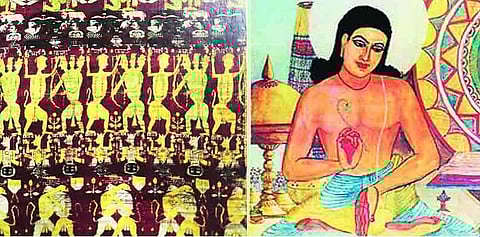
With Bhutan opening up only recently and Tibet always being a “forbidden frontier”, the West was puzzled. What were these Assamese tapestries doing in Bhutan and Tibet?
Come then, walk with me, as we trail up the mountain paths along the Drangme Chu, to peep into the past! To rediscover links and bonds between a South Asian region
We begin with western Assam, which included today’s North Bengal. In 1583, Ralph Fitch, an enterprising English Merchant traveler to the “Couche” kingdom of King Nara Narayan (1555-1587) records that a flourishing trade existed between Cooch Behar, Bhutan and Tibet. The Koch Royalty is known to have had close relations with Druk Yul. A bond that peaked with the personal friendship between the Koch King Prana Narayan and the very respected unifier of Bhutan Zhabdrung Ngawang Namgyal (1594-1651).
Moving further east to Kamarupa, a kingdom that included Cooch Behar in its times, one learns of inscriptions dating from the 5th to the 13th centuries, of trade with Bhutan. According to Hiuen Tsang, the famous Chinese traveller, traders of “Ka-ma liupo” used to trade with Sichuan. A convenience that continued for Bhutan, as it traded with Burma and Yunnan through the Ahom kingdom.
The Tibetans too, have been trading with Assam since time immemorial. Mainly using the southern pathways running through Trashigang, in eastern Bhutan and the ones via Laog Yulsum; also known as Mon Yul and now as Tawang. The “duars” or administrative gates opening into Assam, standing testimony to border trade.
Naturally, such exchanges left a deep imprint in their cultures as well. Similarities abound. Ceremonial greetings still begin with an offer of a silk or a cotton weave. A sign of welcome and respect, like the offering of doma/tamul, pani/paan and tsune/sune to guests.
Starting with their remote locations, usually high up in the mountains or in the middle of the Brahmaputra at Majuli, life in the monasteries, the Gompas/Xatras are very similar. So are their structures. Inducted at a young age, boys graduate to become celibate monks, living a life of devotion while enjoying the benefits of a community under a Head Abbot.
A clear cultural resemblance, is the use of masks in the plays of Assamese monastic theatre and the dances of Bhutan and Tibet. The rhythmic moves and hand gestures reveal a common heritage.
Observant eyes will not miss the similarity of their cymbals and the manner in which they are played. Unlike the Hindus of mainland India, Vaishnavite Assamese crash their cymbals horizontally, just like their Buddhist neighbours do! The Tibetans, Bhutanese monasteries and many Assamese Xatras, to this day, source their cymbals only from the bell-metal artisans of Sarthebari, in Assam.
While it could have been trade that saw the Assamese tapestries reaching Tibet, the reason for their importance and preservation must have been religious.
Very close to Sarthebari, lies the holy town of Hajo. According to both Tibetan and Bhutanese belief, Hajo is Kusinagara, the final resting place of Lord Buddha. In a survey conducted in 1693 titled ‘Vaidurya ser po’ to compile monasteries and holy places and during the search for the Sixth Dalai Lama, Desi Sangye Gyatso, the Regent of the Fifth Dalai Lama, states this very fact. The devoted, therefore, congregated at Hajo.
Even though Kusinagara is now believed to be the renamed village of Kasia Bazaar in northern India, Hajo is still venerated by many. This is because Lord Buddha is said to have passed away on a hill amidst a “grove of paired Sal trees”. The Bura Hal at Hajois revered by both the Hindu and the Buddhist. Sandor Csoma de Koros (1784-1842), the Hungarian Orientalist and author of the first Tibetan-English dictionary, cites Tibetan scriptures to state that the death of Shakya happened in Assam near the city of Kusa or Camarupa. The Tibetan Buddhist canons, the Tengyur and the Kangyur, assert that the temple at Hajo was the great Caitya built over the cremated relics of Buddha’s body.
In fact, it would not be wrong to say that Assamese Hinduism and Tibetan Buddhism overlap. Apart from Hajo, this is explained by the reverence of both faiths for the ancient Gopeshwar temple at Singri, near Tezpur. The great Master Rigdzin Jigme Lingpa (1729-1798), who visited Singri in the 18th century, writes about this temple as a place of pilgrimage for both Tibetans and Bhutanese since the 14th century. A custom that carries on to this day, as the Sherdukpen, Monpa and Hrusso/Aka brethren from the hills of Kameng continue to venerate the temple. The Sherdukpens, who claim their mythological descent from a Tibetan Prince and an Ahom Princess, are known to perform the last rites of their dead at this temple in Singri.
The closeness between Buddhism and Assamese Vaishnavism can be gauged by the reverence of their followers to a fundamental characteristic of their faiths, ahimsa or non-violence. Interestingly, in his Kirtan Ghosa, Sankardev regards the venerable Buddha as an avatar of Lord Visnu.
Tantra, is another weave, which binds this region. The official state religion of Bhutan, which guides and impacts all aspects of Bhutanese life; to ensure gross national happiness: is the tantric form of Mahayana Buddhism, the Vajrayana. Considered as a repository of tantric knowledge and skills, Assam has always been looked up to by many Buddhist Tantra practitioners with immense respect. A fact acknowledged by none other than the Third Panchen Lama. In a treatise written in 1775, the Panchen Lama writes about Kamaru-pa being one of the twenty-four centres of excellence in tantric practice, where the revered Tantric deity Nyuguchen dwells.
In the light of such deep-rooted ties, it was only but natural for the woven strips of exquisite beauty, especially from the holy land of Kusinagara and Ca-ma ru-pa, to be preserved with reverence by the monks at Gobshi.
With providence wishing, destiny ensured that the world got to see the colourful hanging of Gobshi. What escaped the attention of Lt. Col. Laurence A. Waddell, the Official Antiquarian of the Younghusband Expedition and a person who knew first hand about Hajo’s reverence by the Tibetans, caught the fancy of a journalist! Perceval Landon could discern the beauty of the piece to collect by whatever means, carry it all the way to England and take the trouble of ensuring its proper preserving. One of the many efforts for which Assam needs to be grateful.
To each individual and institution concerned, in the deciphering and preservation of such vrindavani vastras, I doff my cap in appreciation and gratitude. Merci Beaucoup.
In tribute also, to an ancient art and artisans of Assam, who wove the first documentary! Time and again in the dexterity of their weaves, to reveal the genius of a master designer and their mastery over a craft. Woven reels of a silent movie, which captured the brilliance of story-telling for posterity to acknowledge. In awe and wonder, four centuries later. (Concluded)