
- Home
- Live Blog
- Breaking News
- Top Headlines
- Cities
- NE News
- Sentinel Media
- Sports
- Education
- Jobs
It cannot be denied that the spurt of extreme weather conditions that occurred in recent times has increased weather awareness among the people many folds. From the very ancient time, people have had a curiosity to know about weather forecasting in a nutshell before the execution of a plan.
The weather is the state of the atmosphere, and the weather condition prevailing for a long time over a particular area is called the climate. Weather forecasting using astrology, studying clouds, and examining wind patterns was the old weather forecasting method that still exists in some remote parts of the country. This method was basically based on the observed pattern of events, for example, it was believed that a “lunar halo” was an indicator of inclement weather, and likewise, an exceptionally red sunset might be followed by fair weather within a day or two, and so on. Around 340 BC, the Greek philosopher Aristotle wrote “Meteorologica”, a philosophical treatise that included theories about the formation of rain, clouds, hail, wind, thunder, lightning, and hurricanes, which was the basal dose for forecasting model evolution. Ancient India’s greatest poet, Kali Das, mentioned the monsoon wind and its movement along with monsoon clouds over India in his famous book “Maghdoot,” written around the seventh century, which was the foundation of the monsoon forecast over India. Meteorology started burgeoning after two Italian physicists, Galileo Galilei and Evangelista Torricelli’s invented the thermometer and barometer, respectively.
Scientific research on meteorology progressed after the formation of the World Meteorological Organization (WMO), which was established on March 23, 1950, to exchange weather data among the different countries.
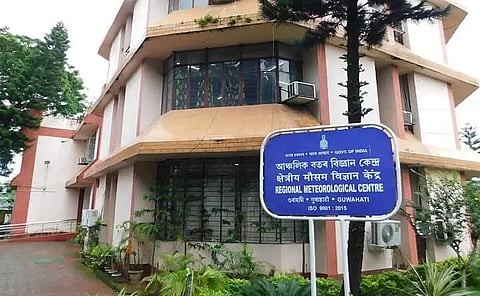
The India Meteorological Department (IMD) was established in 1875 and became a member of the WMO in 1949, having the onus of weather forecasting and weather data storage in India. IMD’s forecasts exert tangible influence in the fields of agriculture, aviation, transportation, fishing, and navigation. In this 148-year-long journey, IMD has nurtured the growth of meteorology and atmospheric science simultaneously. For easy dissemination of weather information in real-time round the clock, six regional meteorological Centres (RMCs), i.e., RMC Delhi, RMC Mumbai, RMC Chennai, RMC Nagpur, RMC Kolkata, and RMC Guwahati, had been established phase-wise. RMC Guwahati is the newest RMC under IMD, which was upgraded from the Meteorological Centre (MC) in 1997 under the supervision of SN Deka (then DDGM, LACD). There was another proud moment for the state when MC Guwahati was inaugurated by Dr Sarojini Mahishi, Minister of State, Ministry of Tourism and Civil Aviation, Government of India, on March 25, 1974. RMC Guwahati is the bona fide office for issuing different weather forecasts as well as different weather-related bulletins. The agro-met advisories, which are farmers’ aspirations, have been issued by RMC Guwahati twice a week. Short-range weather forecasts (validity up to 24 hours), medium-range weather forecasts (validity up to five days), and now cast (validity up to 3 hours) and various weather warnings are also issued to make the general public cautious. During special occasions such as in Ambubasi Mella, different national or international programs weather forecasts are delivered at the request of a competent authority. RMC Guwahati also issues a flood bulletin for the general public from May to October to make them aware of the impending flood fury. Aviation weather service is another remarkable service rendered by RMC Guwahati and allied AMSs (Aviation Meteorology Stations) to LGBI Airport in Guwahati and other airports in the NE region.
The viable tools for weather forecasting are surface observations, upper air observations, RADAR echo, and different numerical weather prediction (NWP) models. It is also mentionable that there are twelve departmental surface observatories, a lot of active part-time observatories, and a network comprising several automatic weather stations (AWS) to collect the weather data in real-time.
The RSRW (Radio Sonde Radio Wind) ascent collects the upper air data till tropopause level and above. Through computer simulations of different forecasting models and observed real-time data, weather forecasts have been issued and verified accordingly. The forecast verification indicates the quality of the forecast, which is satisfactory in RMC Guwahati’s forecast.
Though there are still miles to go before achieving the intended target, IMD has left no stone untouched to accomplish its goal. Though RMC Guwahati is facing an acute staff shortage and inadequate infrastructure, it is also progressing at a good pace. The project for the installation of Doppler Weather Radars (DWR) versus AWS in all states of the NE region is in an advanced stage and would definitely add a new dimension to RMC Guwahati. It is also worth mentioning that a lot of research scholars have completed their PhD courses using meteorological data. It reflects that RMC Guwahati is making valuable contributions to the holistic development of society, but the irony is that a significantly smaller number of candidates from the NE region can qualify themselves to get recruitment in this prestigious department, which is a matter of serious concern and needs to be mooted in the proper forum.
