
- Home
- Live Blog
- Breaking News
- Top Headlines
- Cities
- NE News
- Sentinel Media
- Sports
- Education
- Jobs
Madhurjya Saikia
(madhurjyatu15@gmail.com)
Artificial intelligence is no longer just a tool for writing text, creating images or answering questions. It is becoming a new way of doing business, creating platforms and organising work. People need to explore different AI tools and understand what they can do for them in the form of completing tasks in an efficient way. This basic familiarity is becoming an important form of digital literacy. People also need to know the basics of different types of AI models and how to provide effective instructions, or prompts, to solve certain work. The aim is not for everyone to become a programmer. Rather, people need to learn how to communicate with AI and understand which model is suitable for which task.
Artificial intelligence has moved from simple automation to becoming a major force shaping modern society. In healthcare, advanced AI systems can study medical images and patient records together, helping doctors detect diseases early and choose better treatments for individual patients. In finance and logistics, multi-agent AI systems can independently predict market changes, manage supply chains, and handle complex tasks with less need for human involvement. At the same time, AI is integrating intelligent software into robots and machines used in various fields such as education and smart learning, factories and farms, aerospace, defence, biotechnology, nanotechnology, quantum-level processing and computing, digital payment infrastructure, and cyber-security, enabling these systems to adapt to unexpected real-world situations and continuous changes. In the future, multimodal AI systems will combine text, voice, images, and sensor data, reducing the gap between digital planning and real-world action. With edge computing, AI will also be able to process information instantly on everyday devices, helping manage smart cities, support cleaner energy systems and sustainable energy, and work as an intelligent partner in solving major problems around the world.
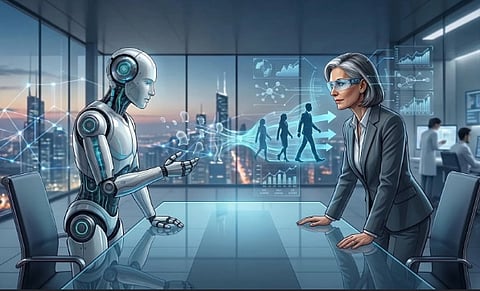
Artificial intelligence has fundamentally transformed the modern workplace, moving far beyond mere administrative assistance to become an active collaborator and task performer alongside human teams. Organisations are now incorporating various autonomous tools and intelligent automation systems to optimise operational workflows, manage logistics, draft complex code, and synthesise multi-variable business data in real time to address complex problems. While this deep integration initially ignited a widespread fear of mass unemployment, recent findings presented at the World Economic Forum Annual Meeting in Davos offer a far more optimistic reality: AI is not simply replacing workers but actively driving job growth, having already generated over 1.3 million new high-skilled roles globally. Instead of getting rid of human jobs, AI technology helps change the workforce by taking over boring, repetitive tasks and creating new specialised jobs, such as AI systems architects, data annotators, and prompt integration experts. Consequently, the dialogue within business leadership has shifted from replacing people with machines to heavily investing in employee upskilling and continuous learning. By connecting human intelligence and judgement with raw AI-driven speed, the modern workplace is ushering in a “new-collar” era where human intellect and artificial intelligence mutually enhance economic growth and productivity.
As artificial intelligence establishes itself deeper into institutional infrastructures, governance frameworks are rapidly maturing to balance innovation with public safety and digital infrastructure. New rules, especially the strict requirements for AI compliance and transparency in the EU AI Act, now demand detailed risk assessments, careful reviews of algorithms, and clear labels for synthetic content to keep the system safe and trustworthy. The primary divide in today’s economy is no longer a science-fiction clash of human versus machine; rather, it is a sharp economic split between the human who knows how to leverage AI and the human who does not. Modern professionals utilizing real-time AI workflows and advanced prompt engineering are seeing massive leaps in output, while those lacking AI literacy risk market adaptability. Consequently, global compliance mandates and workplace policies are converging on a single motive: democratic access to continuous upskilling and converting the workforce to an AI demographic dividend. Bridging this digital skill gap ensures that safeguards do not merely regulate code but empower every worker to remain competitive, adaptive, and essential in an AI-augmented world.
To successfully track the shifting macroeconomic landscape, the true corporate solution lies not in firing employees but in aggressively upskilling them to align with their inherent strengths and interests and with AI upskilling and industry requirements. Rather than using automation as a core mechanism for downsizing, forward-thinking enterprises are recognizing that human adaptability remains their most valuable asset. A benchmark example of this strategy is retail giant IKEA. When the company introduced its AI assistant, Billie, to handle routine customer service enquiries, it chose not to eliminate the affected positions. Instead, IKEA reskilled 8,500 call-centre employees into remote interior design advisors, utilising human empathy and visual creativity for complex, value-adding customer interactions while letting AI absorb the repetitive administrative load. This humane redeployment model unlocked billions in new sales channels and a new roadmap for opportunities, proving that investing in human potential yields far greater returns than reactionary mass layoffs. Modern organizations must take note: by using intelligent internal platforms to assess worker interests and map personalised learning pathways, businesses can seamlessly transition staff into specialised, AI-augmented roles that integrate with human intelligence. Ultimately, the future of work relies on building a sustainable ecosystem where technological efficiency handles operational scale, while empowered human workers drive strategic growth, innovation, and long-term economic resilience.
