
- Home
- Live Blog
- Breaking News
- Top Headlines
- Cities
- NE News
- Sentinel Media
- Sports
- Education
- Jobs
Amitava Mukherjee
(The author is a senior journalist and commentator. He can be reached at amitavamukherjee253@gmail.com)
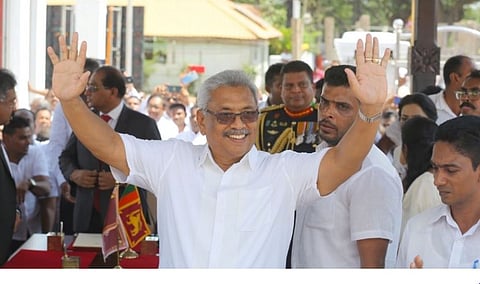
There is a stark similarity between Narendra Modi, the Prime Minister of India, and Gotabaya Rajapakse, the newly elected President of Sri Lanka. Both are pragmatic in nature and do not put much premium on what their expectations are about the ideological path the world should follow. At this point we do not know much about the likely composition of Gotabaya’s ministerial and bureaucratic composition. But in India, Narendra Modi has a no-nonsense foreign minister who diligently follows the former’s line of thinking. So far as Subramaniyam Jaishankar’s views are concerned, India’s Sri Lanka policy will not be dictated by any past ideological baggage and New Delhi will not be influenced by any American or West European reservations about the Rajapakse clan. This is certainly a pure exercise in real politic.
So we are far away from the days of Jawaharlal Nehru or Solomon Bandarnaike and the latter’s wife Sirimavo Bandarnaiake when the Indo-Sri Lanka relationship was fashioned to a great extent by a spirit of anti-colonialism and non-alignment. We are even quite a distance away from the days of Chandrika Kumaratunga who had a significant contribution to the Sri Lankan politics in matters of constitutional governance. Narendra Modi and Gotabaya Rajapakse may be hard realists. But will hard realism, and not any ideological mooring, be sufficient to shape things up in the Indian Ocean and the Indo-Pacific which are fast becoming epicenters of big power rivalries?
Still, friendly relation with Sri Lanka, under a Rajapakse dispensation, is extremely important for India at a time when China has already spread its financial, political and security related tentacles in the island nation. True, the Chinese connection has now turned out to be a noose around Sri Lanka’s neck due to heavy debt burden. So much so, that Colombo’s foreign debt now amounts to 45 percent of its GDP and one-third of this debt burden is linked up to China. The situation is so grim for Sri Lanka that having been unable to pay up Chinese debt, Colombo has been forced to hand over Hambantota port to China. Beijing has invested heavily in infrastructure projects like the Colombo Port City and some airports. Sometime back, even Chinese submarines had docked in the Colombo port.
Let us come back to the words of Indian foreign minister S. Jaishankar. It may be prudent not to be burdened with ideological hangover. But how can New Delhi wish away the concept of federalism which, if practiced by the Rajapakse regime, is sure to act as a huge confidence building measure among the Tamils of the country, battered and devastated by the long insurgency carried on by the LTTE and brutal repression by the government. This issue is sentimentally connected to political developments in Tamil Nadu, and Tamil political parties are certain to mount pressure on Government of India for a just and lasting solution to the problem.
The second contentious issue is in regard to the rights of Indian fishermen to harvest fish in waters which Sri Lanka claims to be its own. The problem arises from a decision by the Indira Gandhi-led government in New Delhi in the 1970s to surrender the rights over the Kachhathivu island near Rameswaram to Sri Lanka. The problem is lingering and the Sri Lankan navy not only attacks Indian fishing vessels but often sink or confiscate many of them. Still, now there are not much signs that the Government of India is prepared to deal with this issue with any kind of seriousness.
Whatever may have been the opinion of the Indian foreign minister, the fact remains that Sri Lanka has a long history of anti-Indian strategic initiatives. During the Bangladesh liberation war of 1971, Sri Lanka had given refueling and other logistic facilities to the aircrafts of Pakistan International Airlines after India had stopped rights of overflights to Pakistani civilian aircrafts before the full scale war between India and Pakistan had broken out. Even during the LTTE insurgency, several Pakistan Air Force pilots are reported to have carried out numerous aerial bombing sorties on LTTE bases. It will not be out of place to mention here that Gorabaya Rajapakse, basically a military man, had a good part of his army training in Pakistan.
It is a diplomatic failure of India that New Delhi could not effect a compromise between Maithripala Sirisena, the previous President of Sri Lanka and Ranil Wickremesinghe, the previous Prime Minister. Both of them, particularly Wickremesinghe, were pro-India figures. Now, with the Rajapakse clan at the helm of affairs in Colombo, Gotabaya as President and his elder brother Mahinda as Prime Minister, the strategic scenario in the Indian Ocean region may not be favourable for New Delhi.