
- Home
- Live Blog
- Breaking News
- Top Headlines
- Cities
- NE News
- Sentinel Media
- Sports
- Education
- Jobs
Gunin Borah
(Biswanath College)
Zubeen Garg passed away in Singapore on the 19th September, 2025. Assam lost not just an iconic singer but a part of its very soul. His untimely death reawakened something profound within the Assamese soul – that eternal spirit of brotherhood, compassion and communal harmony which has long defined the land of Srimanta Sankardeva and Ajan Peer. For centuries, Assam has been a land where peace, tolerance and coexistence thrived, where music, faith and humanity walked hand in hand. In recent years that harmony began to fade. But when Zubeen Garg left this world, those divisions dissolved in an instant, and people of every faith became one united family and regenerated Assam with one call: #JusticeforZubeenGarg.
Zubeen Garg was a singer, a musician, a cultural icon, and a humanist. He was all in one. He was also a versatile singer, composer, lyricist, music director, actor, and filmmaker. He has contributed immensely to society as a humanist and a socialist through his philanthropy, activism, and youth engagement. Music was his language, but humanity was his purpose. Through his songs, words, love for nature, and fearless way of living, he became the voice of the people.
Zubeen Garg was not only a legendary singer but also a passionate lover of nature. Zubeen’s love for nature was another defining part of his life. He adored the hills, rivers, trees, and animals as family members. Despite his success in Bollywood, he chose to return to Assam to live close to nature and his own people. Protecting the environment was his passion. He often said that trees were more valuable than material gifts. On many occasions, when people offered him gamosas or flower bouquets, he humbly requested instead to plant a tree in my name – that will live longer than a flower or gamosa.
Zubeen Garg was a passionate environmentalist and a close friend of nature, whose legacy is honoured through wildlife conservation initiatives. A newborn elephant calf in Kaziranga National Park was named “Mayabini” after one of his famous songs, symbolising new life and his harmonious connection with nature. Garg was also involved in other environmental efforts, such as supporting animal rescue. He was a vocal advocate for environmental causes and wildlife protection, and his work included supporting the rescue and rehabilitation of injured animals. Garg used his voice and influence to raise awareness about protecting forests, rivers, and wildlife, and his commitment to the environment was a central part of his public image.
Protecting the environment was his passion. Jubeen Garg actively spoke against deforestation, and one protested the cutting of trees at Dighali Pukhuri in Guwahati. The trees were more than 100 years old and part of the city’s history. Zubeen did not stay silent. He joined citizens in their protest and spoke publicly against cutting down the trees. This example shows that Zubeen was not only a singer but also a citizen who cared for his surroundings. His actions encouraged many young people to also speak up for the environment. He said that saving green life was more important than symbolic honours. For him, trees were not just part of the environment but a part of humanity’s survival. Zubeen’s deep love of nature reflected his larger philosophy of life – music, humanity, and the environment are all connected. He believed that protecting trees was a way of protecting future generations.
Zubeen Garg also had a long connection with Kaziranga National Park. He often supported campaigns to save rhinos and other wildlife. He used his popularity to make people aware of the importance of Kaziranga wildlife. Many people learnt about conservation issues because of him. His involvement made him a respected figure not only in music but also in the environment movements.
In Northeast India, climate change is not a distant threat but a frequent crisis. The annual flood of the Brahmaputra displaces millions of people, erodes Majuli, the world’s largest river island, by hundreds of metres yearly, and imperils Kaziranga National Park’s rhinos and tigers. Zubeen, a nature lover who trekked Assam’s forests with a poet’s eye, saw these crises as existential. Through his “Kalaguru Artiste Foundation”, Zubeen turned stardom into stewardship, funding flood relief, scholarships and COVID-19 aid, even playing charity football to support climate-ravaged communities. Zubeen’s fan clubs planted thousands of trees annually, far outpacing government efforts, turning melody into a movement for reforestation.
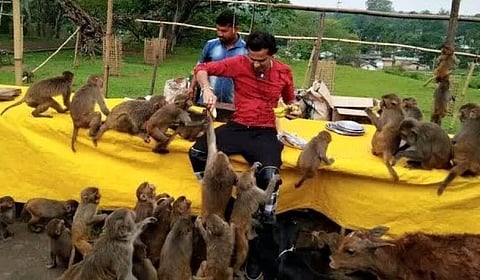
Zubeen Garg had rescued a number of animals from different parts of the state and arranged medical treatment for them. As a wildlife lover, he was closely associated with the Kaziranga-based Centre for Wildlife Rehabilitation and Conservation and had taken the initiative to shift a number of rescued animals to the centre from time to time. Particularly during floods in Assam, Zubeen always tried to provide support to the affected animals.
Kaziranga National Park in Assam is famous for the one-horned rhino and is a UNESCO World Heritage Site. It also has tigers, elephants, deer, buffalo, and many birds. Tourists make Kaziranga bookings every year and help the local economy. Events like tree planting for Zubeen Garg teach visitors to care for nature. These efforts show that Kaziranga is about both tourism and protecting the environment, which inspires many people to support nature conservation.
Zubeen Garg wasn’t just a rockstar; he was a bridge between humanity and the wild, reminding us that true harmony comes from compassion. Zubeen’s deep love for nature reflected his large philosophy of life – music, humanity, and the environment are all connected. He believed that protecting trees was a way of protecting future generations. The new generation’s duty is to carry forward his legacy and inspire others to save nature and wildlife.
(The writer is the HOD of Geography, Biswanath College, and can be reached at Email ID: borah.gunin@gmail.com.)
