
- Home
- Live Blog
- Breaking News
- Top Headlines
- Cities
- NE News
- Sentinel Media
- Sports
- Education
- Jobs
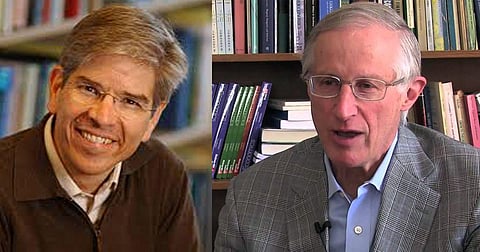
The Nobel Prize in Economics for the year 2018 is announced by the Royal Swedish Academy of Sciences on Monday and the American duo William D Nordhaus and Paul M Romer won the prestigious award.
The Nobel Prize, awarded in memory of Alfred Nobel, does not include the Economic Sciences in it but as the same principles are followed when handing out the other Nobel Prizes, it is also being termed as the Nobel Prize in Economics.
American economist William D Nordhaus got recognized for his work on climate economics and Paul M Romer got the award for his work on the endogenous growth theory. As stated by the Royal Swedish Academy, the designed methods of the economists “address some of our time’s most fundamental and pressing issues: long-term sustainable growth in the global economy and the welfare of the world’s population.”
Speaking about the awarded economists, the academy said Nordhaus was honoured for “integrating climate change into long-run macroeconomic analysis” and Romer for “integrating technological innovations into long-run macro-economic analysis”.
The academy further states that the research findings of Nordhaus illuminate the most efficient remedy for problems caused by greenhouse gas emissions which is a global scheme of carbon taxes uniformly imposed on all countries. The statement also says that Nordhaus is the first person to create a quantitative model that describes the global interplay between the economy and the climate.
The statement adds, “His model is now widespread and is used to examine the consequences of climate policy interventions, for example, carbon taxes. His research shows how economic activity interacts with basic chemistry and physics to produce climate change.”
The academy further speaks about Romer’s research as depicting how the collection of ideas sustains long-term economic growth. According to the statement, “The theory has generated vast amounts of new research into the regulations and policies that encourage new ideas and long-term prosperity.”