
- Home
- Live Blog
- Breaking News
- Top Headlines
- Cities
- NE News
- Sentinel Media
- Sports
- Education
- Jobs
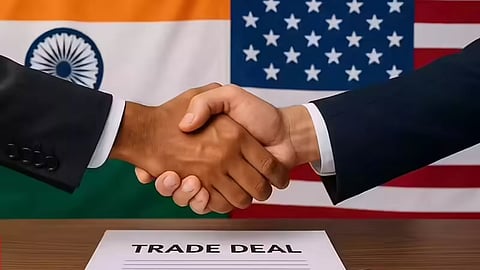
Washington: The newly announced India-US trade framework is a "positive development" that could unlock major export gains, deepen supply chain integration, and strengthen the broader strategic partnership between the two countries, former US Commerce Department official Atman Trivedi said.
Trivedi, who earlier served as Senior Director for Policy in Global Markets at the US Commerce Department and helped shape the US-India Strategic and Commercial Dialogue, said the agreement opens new space for businesses on both sides. He noted that the framework lowers long-standing tariff barriers and expands access across key sectors.
For the US, the deal opens up important segments of the Indian market, including industrial goods and other sectors that previously faced high applied tariffs. Reduced barriers are expected to make it easier for American companies to sell into India, the world's most populous country. From India's perspective, the framework provides expanded access to its largest export market - the United States - particularly in textiles, gems and jewellery, leather, and other labour-intensive industries.
Trivedi said India made a "significant give" by reducing tariffs, in some cases bringing them down to zero on industrial goods. In return, the US agreed to cut tariffs on certain Indian exports from as high as 50 per cent to 18 per cent. This shift, he said, gives India a competitive advantage over countries such as Vietnam, Malaysia, Indonesia, Bangladesh, and Pakistan, which face higher tariff rates in the US market.
The agreement also sets ambitious purchase targets, including India's commitment to buy $500 billion worth of US goods and services over five years. Energy and defence are expected to play a central role, alongside civilian aircraft and other industrial products. However, Trivedi cautioned that reaching the $500 billion mark - up from roughly $87 billion in US exports to India in 2024 - will require sustained effort.
He acknowledged that non-tariff barriers remain a concern for US firms, including localisation rules and regulatory standards, while issues such as services mobility and skilled worker access continue to matter for India. Despite these challenges, Trivedi expects renewed momentum in economic ties, with spillover benefits for cooperation in technology, defence, and energy, aligning trade more closely with the two countries' shared Indo-Pacific strategic goals. (IANS)
Also Read: AI must not replace human potential, but augment it: UN chief Antonio Guterres
