
- Home
- Live Blog
- Breaking News
- Top Headlines
- Cities
- NE News
- Sentinel Media
- Sports
- Education
- Jobs
Shilpika Rajguru
(shilpikarajguru2018@gmail.com)
At present, there are vast untapped resources of bamboo that can open avenues for utilization of bamboo for many productive works. Such a huge surplus of bamboo is not to be found elsewhere in India. The prospects of the establishment of several pulp and paper plants, big and small, on bamboo alone, are tremendous. The important species mentioned below are available in commercial quantities. 1. Muli (Malocanna Bambusoides), 2. Hill Jati (Oxytenanthera Parvifola), 3. Kako (Dendrocalamus Hamiltoni), and 4. Dalu (Teinostachyum Dalloa). Some other common bamboo products: “Murrah”, Bamboo (stool) Bamboo brooms, knife handles, bamboo curtains, bamboo handbags, flower vases and ashtrays. Wall-hanging folding fans, walking sticks, cane furniture, etc., are common. The manufacture of cane furniture calls for a high degree of skill on the part of the workers. Such skill is found to be traditional.
In the manufacture of cane furniture, the Cachar district enjoys a special advantage over the other districts of the state as far as skilled artisans are concerned. The craft has commercial production in almost all the important urban areas of the state. Bamboo and cane products manufactured for use for domestic purposes. A brief description of some cane and bamboo products manufactured for use for domestic purposes is given below: Unusual basket from Kheruni Village, in Mikir Hill, Assam Chalani (sieve). It is woven with fine bamboo slips in a criss-cross way, keeping some open spaces between the different slips as required for different purposes.
The ‘chalani’ is a round-shaped disc-like object, and its diameter varies from 1? ft to 3? ft. It is used for sieving rice, paddy, tea leaves, etc., and also for washing fish.
Kula (winnowing fan) is prepared out of flat bamboo slips for winnowing purposes in different sizes and shapes.
A twilled design is used for a ‘kula’: the edge of the ‘kula’ is made strong by fixing two sets of one-inch-wide bamboo pieces wrapped up in flexible cane strips.
Khorahi (small basket): Khorahi is made of fine bamboo splits for washing rice, vegetables, fish, etc. It is a small basket-like thing with provision to allow water and dirt to pass out. The Khorahi is woven in a plain and square form but is gradually bent into a round form at the time of final stitching by flexible cane slips.
Dukula/Tukuri (big basket): The shape of a dukula is exactly the same as that of the Khorahi, but the size and process of preparation are a bit different. The required shape of a ‘tukuri’ is made by bending the bamboo splits forming the warp gradually when the process of weaving with the weft is in operation. Fixing two or four flat bamboo strips strengthens the edge. The last stage is to stitch the edge along with those flat bamboo strips with some flexible cane slips. The size of a ‘dukula’ or a ‘tukuri’ is much bigger than that of the Khorahi and is used for carrying as well as keeping paddy, rice, etc.
Dala (bamboo tray): Dala is prepared out of flexible bamboo slips in a twilled design. The shape of a dala is exactly like a disc, with various sizes for different purposes. The edge around the dala is stitched in the same way as that of the edge of a tukuri or dukula, but the bamboo rims used in the edge of the dala are about. The dala is used especially for rearing silkworms and for winnowing in addition to other domestic purposes.
Duli (Assamese)/Tali (Bengali) or big basket: The ‘duli’ or ‘tali’ are used for preserving paddy.
Doon (Assamese) or Kathi (Bengali) or measure: It is prepared in an almost conical shape with fine bamboo strips for measuring rice or paddy. Its holding capacity varies from 2 seers to 3½ seers from place to place. A ring is attached at the bottom to enable it to stand on the ground.
Dhol (big measure): The process of preparation of ‘dhol’ is just like that of the doon. However, it is much bigger in size. It is used for measuring paddy only. In the Cachar district, it is known as ‘pura’. This is not generally bought or sold in the markets.
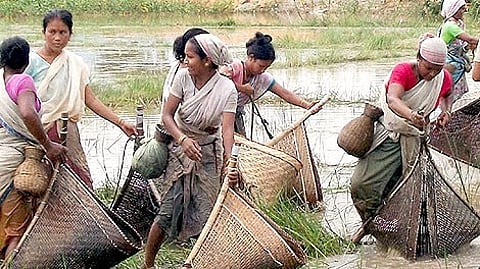
Fishing Implements: There are various kinds of fishing contraptions prepared out of cane and bamboo in different parts of the state. A brief description of some of the fishing implements widely used, like polo, Jakai, Khalai, Dori, Chepa, Paran, Jhuti, Hogra, etc.
Polo: It resembles the shape of a dome with a short stem of about 6? diameter open at the top. The diameter at the bottom varies from 2 ft 3? to 4 ft, and the height varies from 2 ft to 3 ft. It is prepared out of small bamboo strips fastened with fine and flexible cane slips. Polo is used for fishing in shallow water. The man who uses the polo holds it by the side of the stem, presses its rim into the mud, then pulls it back and lifts it to the water's surface, pressing it again while moving through the water.
Jakai: A wickerwork shovel made with bamboo slips that are dragged along the bottom of the water to catch small fish.
Dolonga, Derjakori, Tak, or Hukuma: These are artificial bamboo structures, varying in shape (bowl, funnel, or pyramidal), that are stuffed with natural materials to act as a hiding place for fish.
Banas: Barricades or barriers made from bamboo to guide fish into a specific area.
Bubu: In Borneo, bamboo screens can be used next to a bubu (fishing trap) to guide fish into it.
Raw materials and their uses: Assam has probably the maximum resources for the cane and bamboo industry in India, comparable with Canada and the Scandinavian countries, Sweden, Norway and Finland.
In bamboo and reeds, Assam has the most concentrated forests in the whole of India. As many as 51 species of bamboo grow in Assam, and they are being used for diverse purposes, mainly for buildings, furniture and diverse contraptions. Studies are being conducted in some research centers in India as to whether bamboo can be used as reinforcement to replace mild steel bars in light concrete structures. Bamboo is also used for umbrella handles, walking sticks, tool handles, fishing rods, tent poles, cords, ladders, yokes, baskets, toys, hand fans and various domestic and agricultural implements. All these articles can be produced on a cottage and small-scale basis with small machinery.
Despite its immense potential, the bamboo industry in Assam faces significant challenges. Unsustainable harvesting practices threaten the long-term viability of bamboo forests, leading to soil degradation and loss of biodiversity. Additionally, a shortage of skilled labour hampers the industry’s ability to compete with bamboo-producing giants like China and South Korea. Market limitations and logistical constraints further restrict the growth of the Assam bamboo industry. The absence of large-scale bamboo processing units and insufficient marketing strategies prevent local artisans and entrepreneurs from reaching broader markets. Moreover, the lack of adequate funding and investment in research and development stifles innovation in bamboo-based industries. The main raw materials for the industry, i.e., bamboo and cane of various types, are abundantly available throughout the state. It requires little or no investment and can be pursued by anybody and everybody in a household as a subsidiary occupation. As a result, the industry offers significant potential for growth, as it can produce a variety of new products tailored to contemporary tastes using bamboo and cane. The critical state of the craft further increases the need to revive it and to maintain it as a source of Assamese culture and tradition. Research needs to be carried out on using bamboo as a building material. Mechanisation of the arts is of the utmost priority. With the continuous and perennial rise of technology, the need to make the art fit the needs of the present day is a necessity. The new generation of Cane & Bamboo artisans has seen a big fall, as this era of craftsmen doesn’t find traditional instruments worthwhile. The introduction of machines is important to make this craft faster and more efficient and hence, able to earn more money to sustain the lives of the modern-day craftsman.
ARCHITECTURAL POINT OF VIEW: As an architect, studying the cane and bamboo crafts of Assam is vital. The usage of cane and bamboo as building materials needs more research, as, presently, such construction is only practised traditionally by the villagers. ‘The study of cane and bamboo as materials that provide structural support as well as aesthetics to buildings’ is a topic which is severely untouched.
The RAINFOREST RESEARCH INSTITUTE (RRI) holds a workshop in its JORHAT unit about the CANE and BAMBOO CRAFT every year. The RRI has a total of 6 units around the country. An architect should be a part of the workshop at least once to be able to fully understand the true value and nature of the Assamese bamboo and culture. The properties of cane and bamboo need to be studied and further developed both as a building material and as a raw material for the traditional craft.
A vision for the future: Bamboo is more than just a plant; it is a symbol of sustainability, culture, and economic prosperity. If harnessed effectively, the Assam bamboo industry has the potential to drive rural development, generate employment, and establish itself as a global leader in eco-friendly industries. With the right policies, investment, and innovation, bamboo can usher in a new era of economic growth for Assam, paving the way for a ‘Viksit Assam’—an industrially robust and environmentally conscious state.
