
- Home
- Live Blog
- Breaking News
- Top Headlines
- Cities
- NE News
- Sentinel Media
- Sports
- Education
- Jobs
Jubail Hussain
(jubailh55@gmail.com)
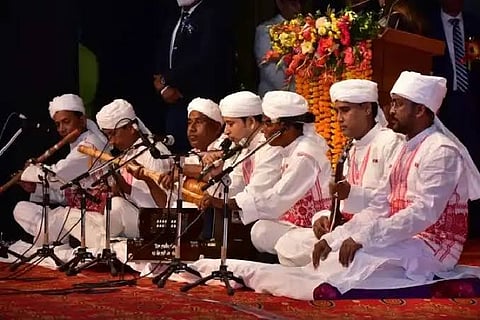
The unique spiritual history of the Brahmaputra Valley has always thrived on deep adaptation and the blending of different styles. While mainstream historical discussions often limit the famous Zikir and Zari devotional songs to a purely Assamese-Muslim folk identity, a major cultural shift is taking place across the state today. The ambitious efforts to translate and record these centuries-old Sufi songs into seven major indigenous tribal languages—including Bodo, Mising, Karbi, Dimasa, Tiwa, Rabha, and Deuri—mark a fresh path in our regional literature. This linguistic movement moves the core message of Sufism away from a static historical fact and turns it into a living, fluid link that connects the diverse communities of the hills and the plains. By crossing old language boundaries, this multi-lingual approach offers a fascinating view into how folk arts can actively adapt to keep our shared cultural heritage alive.
To fully understand this modern transformation, one must look closely at how Sufi thoughts originally spread across medieval Assam. When the 17th-century saint-poet Hazrat Azan Fakir began composing these lyrics, his main success lay in avoiding complex Arabic or Persian theological terms. Instead, he picked up the everyday, colloquial speech of the local farming and fishing communities of the valley. He borrowed the local structures of Dehabichar Geet — philosophical folk songs centered on the human body — and used domestic visual themes like the rising river waters, the local birds, and native boat-making. This initial process of adapting to the local language set a historical precedent: Sufi music in Assam was never meant to be rigid or unchangeable. It was always a flexible form of music designed to match the emotional needs and sounds of the immediate community around it.
By translating these songs into tribal languages like Bodo or Mising today, local cultural bodies are not just doing standard translation work. They are discovering deep, shared spiritual connections. When a Zikir is sung using the specific musical scales of a Karbi or a Rabha folk instrument, it immediately gains a completely new aesthetic value. The core human values in the lyrics—such as humbleness, the temporary nature of earthly power, and respect for nature—fit perfectly with the traditional worldviews of Assam’s indigenous tribes. This continuous exchange shows that our local languages do not divide us; instead, they act as creative bridges. A Muslim devotional song performed within a tribal cultural setting proves that deep spiritual expressions easily break through hard religious and ethnic borders.
Furthermore, this multi-lingual focus directly addresses a critical challenge of our digital era: the rapid loss of minority dialects and oral traditions. As young people across rural communities increasingly switch to dominant languages for education and tech, smaller tribal dialects face a real threat of fading away. Introducing classic regional poetry like Zikir into these native tongues creates an active space for language revival. It encourages local youth, writers, and musicians to explore their own mother tongues through a unique, cross-cultural medium. This approach prevents regional folk music from becoming an old museum piece; instead, it turns it into an expanding, creative art form that changes with the times.
Historically, the strong unity of Assamese society was built because different cultures constantly learned from and influenced one another. The legendary Vaishnavite saint Srimanta Sankardev successfully brought various ethnic communities together into a single cultural fabric through his inclusive Xattras and Borgeets. In the exact same way, the broad spirit of Assamese Sufism has always rejected exclusion or rigid communal divisions. Presenting these historic songs through various tribal voices helps protect the pluralistic spirit of the region from modern social divisions. It sends a clear message that our cultural assets belong equally to every community living along the Brahmaputra, regardless of their specific tribe or faith.
Ultimately, this ongoing multi-lingual initiative reminds us that the true identity of Assam is like a rich, hand-woven tapestry. The beautiful values of humanism first shared by our medieval reformers can only survive if we keep sharing them through new voices and media. Translating Zikir and Jari into indigenous tribal languages is a powerful statement of cultural unity. It shows that the collective soul of our state does not live in one single dialect or group, but in our shared love for harmony and mutual respect. In a rapidly changing world, letting our diverse regional languages sing the same timeless notes of peace is the best way to keep Assam truly connected, rooted, and strong.
(The author is a researcher at Darul Huda Islamic University, Kerala, Assam Centre. He writes extensively on regional history, cultural syncretism, and community harmony in Northeast India, and is based out of Kalaigaon, Udalguri, Assam.)
