
- Home
- Live Blog
- Breaking News
- Top Headlines
- Cities
- NE News
- Sentinel Media
- Sports
- Education
- Jobs
Book Review
by Rupak G. Duarah
(rintu.duarah@gmail.com)
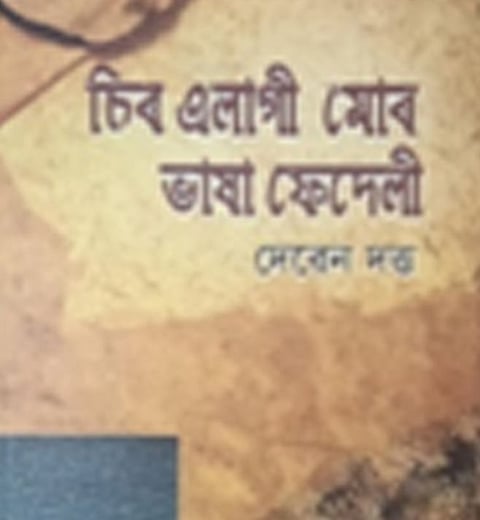
Chiro Elaagi Mor Bhasha Phedeli’ is a compilation of essays by Deben Dutta, a notable educationist, writer, outspoken newspaper columnist and consumer-rights activist from Assam. The book features a collection of seventy-eight essays that he wrote over many years for newspapers and magazines. It is not a conventional grammar textbook; rather, it is a sharp, satirical and detailed campaign for correctness in written and spoken Assamese. He argued that a person who has not mastered their mother tongue cannot properly master any other language. The title itself expresses a complaint: the language is being neglected or abandoned. He regarded newspapers, magazines, books, radio and television as the principal sources of linguistic deterioration and set out to correct them.
Some remarkable essays included in the book are ‘Asomiya Bhashar Byaboharot Bishingkhala’, ‘Batori Kakotot Asomiya Bhashar Biloi’, ‘Asomiya Bhashat Banglar Ohoituki Prabhav’, ‘Asomiya Bhashat Diruktir Atyachar’, ‘Sangbadiksokol Alop Satorko Hobone’, ‘Sotobarshikit Bhulunthito Matribhasha’, ‘Bhashar Arajokata’ and ‘Songbadpatra, Doordarshan Aru Akashbanir Bhasha’, among others. The essays systematically catalogue everyday errors, including incorrect spellings, the confusion between similar-looking but distinct letters, the proper use or avoidance of reph with doubled consonants, and several other grammatical issues. He repeatedly demonstrated how writers ignore traditional rules or invent new ones. He noted that many classical distinctions (mûrdhanya versus dantya, and short versus long vowels) survive mainly on paper, as few speakers actually pronounce them differently. Even so, he insisted that written Assamese should not casually abandon these distinctions.
Dutta demonstrated how the unwanted influence of Bengali, Hindi and English had affected Assamese through faulty compounds, Bengali-style sentence structures, the use of Hindi and English loanwords where exact Assamese equivalents already existed, and the practice of writing names or titles in mixed scripts. He also held the media and public use of language to account. Sloppy newspaper headlines, radio and Doordarshan announcements, official notices and even speeches by political leaders came under his scrutiny. He highlighted concrete examples of linguistic errors, including unnecessary doubling of letters and the invention of words.
Assamese speakers, he argued, had become less conscious of grammar and usage. The result was unnecessary reduplication, incorrect verb forms, misplaced inverted commas and the tendency to ‘correct’ genuine Assamese words into more Bengali-sounding alternatives. Dutta combined linguistic observations with social satire. He presented errors as symptoms of carelessness, imitation and a lack of pride rather than as isolated mistakes. His use of humour and sarcasm made the lessons all the more memorable.
The book remains useful to discerning readers because of its serious concern for the correctness of Assamese. It serves as a practical reference for anyone who writes in the language and stands as a record of one teacher’s long-standing insistence that the mother tongue deserves the same precision that he demanded of English. Each of its seventy-eight essays on the Assamese language and grammar offers a distinct explanation of linguistic errors and their corrections. Through this book, Dutta made a significant contribution to the preservation and promotion of Assamese, and the work continues to receive widespread appreciation.
The thoughtful cover design by Champak Barbora and the evocative title enhance the volume’s dignity and appeal. The illustrations and printing are equally elegant. This 400-page collection, which examines common mistakes in the use of the Assamese language, has been published by Pee Gee India, Guwahati, and is priced at just Rs 350.
