
- Home
- Live Blog
- Breaking News
- Top Headlines
- Cities
- NE News
- Sentinel Media
- Sports
- Education
- Jobs
Anjali Tirkey
Long before “foraging”, “sustainable gastronomy” and “farm-to-table” entered the global culinary vocabulary, Adivasi communities were living its principles. Their cuisine — shaped by forests, shifting seasons and collective memory — is a sophisticated food system built on biodiversity, patience and respect for nature.
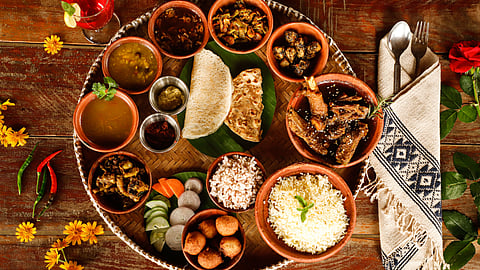
When Adivasis were brought from the Chotnagpur plateau to Assam during the colonial period to clear forests and build tea gardens, roads and railways, they carried more than physical labour. They carried seeds, fermentation starters, songs of harvest — and a culinary philosophy deeply rooted in the land and often served in sal leaf plates carrying the fragrance of forests and home. In the tea estates of Assam, food became a repository of memory, even as displacement and hardship threatened to erode it.
Adivasi cuisine is fundamentally forest cuisine. It relies on intimate ecological knowledge — which leaves and mushrooms are edible after the first rain, which tubers must be roasted to neutralise toxins, and which flowers bloom briefly and must be gathered at dawn.
Among the seasonal treasures are sanaiphool, delicate edible blossoms of the hemp plant; kudrum (roselle); and phutkal, a tangy green from white fig that defines many summer meals, and the monsoon mushrooms, including the precious ones found in Sal forests called rugda. Villages across Jharkhand celebrate a wide repertoire of saag — koinaar, karmi, chakod, sarla, mungasaag and mungaphool, and amaranth greens — eaten fresh when abundant and sun-dried carefully for lean months, becoming sukhti or hadwa that carries nutrition through drought or scarcity.
Nothing is wasted. Stems are cooked, peels become chutneys, and surplus greens are dried carefully on woven mats.
Even foraging follows ethics: never strip a plant bare, never waste, and never harvest without gratitude. Tubers dug from forest floors are often fire-roasted and transformed into chokha — a mashed preparation seasoned simply with salt, chillies and mustard oil. The technique enhances flavour while preserving nutrients, demonstrating a culinary minimalism that foregrounds ingredient integrity.
Fermentation in Adivasi kitchens is both art and science. Bamboo shoots, harvested tender, are fermented in stages depending on the season and humidity. Known locally as ‘sandhana’, the process can produce sharp, pungent notes or milder, earthy tones. Stored carefully, fermented bamboo becomes a flavour base that enriches vegetables, fish or meat. It is also made into pickle using mustard oil, sarson seeds and other spices.
Rice, too, is central. Hand-processed as dekhi-pounded rice, it retains bran and micronutrients often lost in milling. The starchy water drained from boiled rice is consumed as maadjhod, a probiotic-rich broth prepared with dried herbs and leafy greens that cools the body and aids digestion.
Natural fermentation produces hadiya, a rice-based beverage prepared with herbal starters. In moderation, hadiya is valued not merely as a drink but as a digestive aid and social binder, consumed during festivals and communal labour. Similarly, flowers of the mahua tree are fermented or distilled in some communities, though mahua’s culinary range extends far beyond beverages. The mahua tree and its flowers are central to many Adivasi economies and cosmologies. Its fleshy, nectar-rich blossoms are sun-dried and stored, providing sweetness long before refined sugar entered rural markets. Mahua flowers are transformed into mahua bhajji — lightly battered fritters — or shaped into desserts such as mawalatha, where their natural sugars caramelise into deep, complex flavours. Nutritionally dense and rich in natural sugars and micronutrients, mahua sustains communities during agrarian lean seasons. It is food security embodied in a flower. But mahua-based cuisine is being affected by the climate changes, deforestation, modernity and the misunderstanding about mahua by the mainstream.
Millets such as finger millet become madwa roti, dense and mineral-rich. Rice and lentils are soaked, stone-ground and fermented for dhuska; rice flour is steamed into dumbu; mixed batters yield chilka roti. Pulses are shaped into sun-dried bari, ensuring protein availability year-round. Sun-drying is not incidental but foundational. Leaves, herbs and even certain tubers are preserved under careful watch, protected from dew and insects. This technique extends shelf life without chemicals, concentrating flavour while maintaining nutritional value.
Such slow processes require time — and time is increasingly scarce in today’s lifestyle.
In Assam’s tea gardens, where generations of Adivasi families have lived with low wages, limited healthcare access and fragile educational opportunities, daily survival often overshadows culinary continuity. Market dependence introduces packaged foods; refined grains replace millets; younger generations grow unfamiliar with the names of forest greens their grandparents knew intimately.
Food heritage, like language and song, becomes vulnerable under economic stress.
Yet resilience persists. In many homes, elders still dry phutkal leaves for sukti. Protein-rich berries are shaped in the winter sun. Madwa flour is kneaded for rotis. Bamboo shoots ferment or pickle quietly in jars. The forest survives in taste, even when geographically distant.
The Assam-based non-profit Injot Trust, which works for the empowerment of Adivasi communities, is making efforts to revive this culinary knowledge. It is bringing these foods into public view by preparing and selling traditional dishes with the self-help group women of the Adivasi communities of Assam. The organisation hopes to spark pride within the community for their culinary heritage and the due recognition beyond it. At Stall 14 in the Food Court of the Saras Mela at Srimanta Sankaradeva Kalakshetra, Panjabari Road, Guwahati, visitors can taste chilka roti, madwa roti, dhuska and dumbu until the 8th of March — an invitation to engage with a cuisine shaped by centuries of ecological intimacy.
Globally, indigenous food systems are increasingly acknowledged for influencing contemporary sustainable dining movements. Yet within India, Adivasi cuisine remains under-represented in mainstream gastronomy. One must recognise that this cuisine is a living archive that encodes environmental knowledge, nutritional science, community ethics and historical memory. To reclaim madwa roti, ferment sandhana, dry sanaiphool, or prepare maadjhod is to assert identity. It is to say that survival has not erased heritage.
If Assam acknowledges the distinct identity of its Adivasi communities — and the food traditions that sustain them — it will not merely diversify its culinary map. It will honour a knowledge system that has quietly modelled sustainability, seasonality and respect for nature long before the world learned to name them.
