
- Home
- Live Blog
- Breaking News
- Top Headlines
- Cities
- NE News
- Sentinel Media
- Sports
- Education
- Jobs
Dipen Gogoi
(gogoidipen3686@gmail.com)
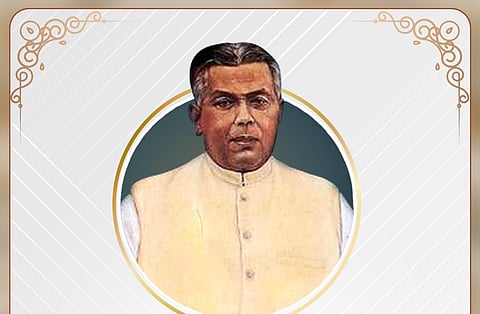
There are some leaders whose names remain confined to history books, remembered only during official ceremonies and anniversaries. Then there are a few rare figures whose legacy continues to echo through generations, shaping public thought long after their time. Lokpriya Gopinath Bordoloi undoubtedly belongs to the latter category. As Assam prepares to observe his birth anniversary on June 6, it becomes important not merely to pay tribute to the state's first Chief Minister, but also to revisit the values and vision he stood for - values that remain deeply relevant in today's political climate.
At a time when public life often appears clouded by aggressive rhetoric, political polarisation, and short-term calculations, Bordoloi's leadership reminds us that politics can also be rooted in integrity, patience, and farsightedness. He was not a leader who thrived on dramatic speeches or divisive slogans. Instead, he quietly emerged as the guardian of Assam's political identity during one of the most uncertain chapters in Indian history.
Born on June 6, 1890, at Raha in present-day Nagaon district, Gopinath Bordoloi grew up during the rise of India's freedom movement. Inspired by Mahatma Gandhi and nationalist ideals, he joined the Indian National Congress and actively participated in the struggle against British rule. Like many freedom fighters of his generation, he endured imprisonment and political hardship. However, his contribution to Assam extended far beyond the national freedom movement.
The defining moment of Bordoloi's political life arrived during the final years before independence. In 1946, the British Cabinet Mission proposed a grouping plan that would place Assam together with Bengal under a Muslim-majority administrative arrangement. For many leaders outside the Northeast, the proposal may have appeared administrative in nature. But Bordoloi immediately recognised its long-term implications for Assam's identity, culture, and political future.
At that crucial juncture, he stood firm against the grouping plan despite immense pressure. His resistance was not driven by narrow politics or communal considerations; rather, it stemmed from a deep commitment to preserving Assam's distinct identity within the Indian Union. Historians widely acknowledge that his efforts played a decisive role in ensuring that Assam did not become politically absorbed into what later became East Pakistan.
In many ways, Bordoloi's intervention altered the destiny not only of Assam but of the entire Northeast. Had he failed to oppose the grouping proposal, the political map of the region could have turned out very differently. It is because of leaders like him that Assam retained its place within the framework of democratic India.
Following Independence, Bordoloi became Assam's first Chief Minister and began the difficult task of building institutions in a newly independent state. His administration focused on education, governance, infrastructure, and social harmony. Several important institutions that continue to shape Assam today either took birth or gained momentum during his tenure. Gauhati University, the Assam High Court, and various educational and administrative initiatives bear testimony to his developmental vision.
One of the most remarkable aspects of Bordoloi's leadership was his understanding of Assam's diversity. Long before identity politics became a dominant theme in contemporary discourse, he recognised the importance of protecting the interests of tribal and indigenous communities. He believed that Assam's strength lay in coexistence rather than confrontation. His efforts towards safeguarding the constitutional rights of tribal communities reflected a rare sensitivity towards the complex ethnic fabric of the Northeast.
This aspect of his politics becomes especially significant in present times. Assam today continues to grapple with issues relating to migration, identity, communal tension, cultural preservation, and regional aspirations. Public debates frequently become emotionally charged, while political narratives often deepen social divisions instead of bridging them. In such an atmosphere, Bordoloi's politics of balance and restraint appear more relevant than ever.
He demonstrated that protecting regional identity does not necessarily require hostility or exclusion. His leadership balanced Assamese interests with national unity without allowing either to overshadow the other. That ability to maintain equilibrium is something modern politics often struggles to achieve.
Another reason why Bordoloi remains relevant today is the ethical standard he represented in public life. Politics in contemporary times is increasingly judged through media optics, social media trends, and electoral calculations. In contrast, Bordoloi believed in patient institution-building and responsible governance. He understood that leadership is not merely about winning elections but about creating stability and trust among people.
Even his critics rarely questioned his personal integrity. He carried himself with humility and simplicity, qualities that made him accessible to ordinary citizens. In an era when public confidence in political institutions sometimes appears fragile, Bordoloi's life serves as a reminder that honest leadership can still inspire lasting respect.
The Government of India posthumously awarded him the Bharat Ratna in 1999 in recognition of his immense contribution to the nation. Yet for the people of Assam, his true recognition lies not in awards alone but in the enduring emotional connection they continue to feel towards him. The title "Lokpriya" itself reflects the affection and trust he earned from the masses.
As Assam observes his birth anniversary this year, remembering Gopinath Bordoloi should go beyond ceremonial speeches and floral tributes. His life offers valuable lessons for both political leaders and citizens. In a world increasingly marked by confrontation and noise, Bordoloi's politics reminds us of the strength of dignity, patience, and principled leadership.
History often celebrates those who capture power, but societies truly survive because of those who protect their foundations during difficult times. Lokpriya Gopinath Bordoloi did exactly that for Assam. More than seven decades after Independence, the shield he raised for the state still stands tall, silently reminding every generation that courage and integrity can indeed change the course of history.
