
- Home
- Live Blog
- Breaking News
- Top Headlines
- Cities
- NE News
- Sentinel Media
- Sports
- Education
- Jobs
Mowsam Hazarika
(mowsam2000@yahoo.co.in)
The devastating floods that struck Upper Assam in July 2026 have once again highlighted the fragile ecological balance of the Brahmaputra Valley. While heavy rain and high river levels are usually considered the main reasons for the floods, new evidence points to a more serious issue—widespread environmental damage in the hills along the Assam–Nagaland border, mainly caused by uncontrolled coal mining.
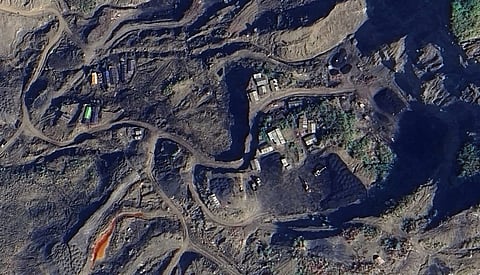
A close examination of satellite imagery and terrain data from platforms such as Google Maps and Google Earth indicates extensive deforestation in the hill ranges adjoining Upper Assam. Areas around Naginimora in Nagaland, marked by coordinates 26.860855, 94.919141 and 26.755990, 94.824868, show visible signs of ecological disturbance. These regions, once covered with dense forest, now appear scarred by mining activity, exposing the land to erosion and destabilisation.
This environmental damage has direct downstream consequences. The Dikhow River, which originates in the hills of Nagaland and flows through Sivasagar district, has become increasingly prone to sudden surges. When heavy or abnormal rainfall occurs in these degraded hill areas, the absence of forest cover prevents water absorption. Instead of being retained and gradually released, rainwater rushes downstream with tremendous force, carrying silt, debris, and runoff into the plains. The result is flash flooding in low-lying areas, as witnessed in Sivasagar during the recent floods.
The scale of devastation in Upper Assam underscores this linkage. Sivasagar alone reported lakhs of affected people, with widespread submergence of villages, agricultural lands, and infrastructure. While the intensity of rainfall plays a role, the speed and severity of flooding point to altered hydrological behaviour—largely driven by upstream ecological disruption.
Coal mining in these hill regions appears to be a significant contributor to this crisis. Unregulated or poorly managed mining leads to large-scale tree felling, soil loosening, and landscape fragmentation. Over time, such activity weakens the natural capacity of the hills to act as water buffers. If such activities continue unchecked, every episode of heavy rainfall will translate into disaster for the plains of Assam.
The situation calls for urgent and decisive intervention. If coal mining in Nagaland is officially permitted and contributes to state revenue, then the Government of Assam must take up the matter with the Government of India. A policy mechanism should be explored whereby adequate compensation is provided to halt such environmentally destructive practices in ecologically sensitive zones.
On the other hand, if these mining activities are illegal, strict enforcement action must be taken against those involved. If these mining activities are illegal, authorities must take strict enforcement action against those involved. against those involved. Equally important is the initiation of ecological restoration measures. Reforestation of degraded hill slopes, soil stabilisation, and watershed management must be prioritized to restore the natural resilience of the region. The Dikhow River floods serve as a warning. They highlight the interconnectedness of ecosystems across state boundaries and the consequences of neglecting environmental safeguards. Flood management in Assam can no longer be limited to embankments and relief measures in the plains. It must extend to protecting and restoring the upstream landscapes that regulate water flow.
In conclusion, the recent floods in Upper Assam are not merely a result of excessive rainfall—they are a manifestation of cumulative ecological neglect. Unless coal mining is halted and large-scale afforestation undertaken in the Assam–Nagaland border hills, such disasters will recur with increasing intensity. A coordinated, science-based, and ecologically sensitive approach is essential to safeguard the future of the region and its people.
