
- Home
- Live Blog
- Breaking News
- Top Headlines
- Cities
- NE News
- Sentinel Media
- Sports
- Education
- Jobs
The Fair of Faith, the Festival of Unity
Neelim Akash Kashyap
(The writer can be reached at neelimassam@gmail.com.)
The moment the word ‘sabha’ is uttered, the names of many renowned as well as remote places of lower Assam immediately come to mind. This is because the sabha is essentially a cultural asset of lower Assam. In many places across the region, ‘rajohuwa sabhas’ have been organized for generations during the months of Magh and Fagun. Although these Sabha festivals were originally organized mainly to preserve religious traditions enriched with spiritual thought and consciousness, over time they have also woven a strong bond of unity and harmony among people, transcending divisions of caste, class, and status. Across lower Assam, numerous small and large sabhas have been celebrated over the years. Among them, the Sarthebari Sabha, Chenga Sabha, Byaskuchi Sabha, Haribhanga Sabha, Makhibahar Sabha, Bongaon Sabha, Sualkuchi Sabha, Rangia Sabha, Chamata Jamartal Sabha, Rana Sabha, Bori Sabha, Jagara Sabha, Amrikhawa Sabha, etc. are particularly noteworthy.
According to the limited information available, one of the most attractive and arguably the largest sabhas in Assam is the Sri Sri Jagannath Mahaprabhu Sabha Mahotsav of Sarthebari, located on the eastern boundary of Barpeta district. Sarthebari, historically renowned for its bell-metal and brass craftsmanship, continues to be governed by a public committee in keeping with ancient tradition. This committee consists of five office-bearers, headed by a leader known as the ‘panchpradhan’. This leader, elected by the people, is locally called the ‘majumdar’. As per tradition, the ‘majumdar’ is the principal authority responsible for organizing and managing the Sarthebari sabha. All sabhas and melas of Sarthebari are conducted under the majumdar’s supervision. The organizer convenes various activities and fairs, while the ‘bhandari’ maintains accounts of all income and expenditure. The ‘borpathak’ oversees matters related to the sabha as well as public affairs of Sarthebari, and the ‘orchok’ conducts all religious rituals and worship.
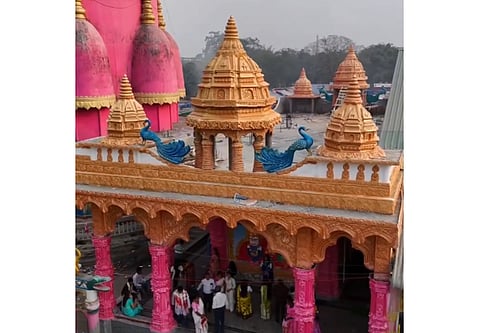
According to age-old custom, from the Amavasya preceding Maghi Purnima until the conclusion of the sabha, a public fair is held under the open sky at the ‘sabhar khola’ of Sarthebari. (In lower Assam, the open ground where a sabha is held is called sabhar khola.) The mela is managed by the ‘majumdar’. On the eve of Maghi Purnima, the ‘Gosain Uliuwa Utsav’ is being observed. In the evening, idols are brought from the ten small and large namghars of Sarthebari to the Borgosain Ghar at the sabhar khola, accompanied by fireworks, drumbeats of dhol, khol, and tal, and continuous Harinam chanting. With this, the sabha formally begins.
The following day, on Maghi Purnima, the ‘sabha hom’ is performed. From early morning, devotees throng the Borgosain Ghar to light ghee lamps. One hundred and eight Brahmins perform the ‘hom yajna’ by chanting Chandi Path, Batuk Path, Shiva Path, Mangal Path, Durga Sahasra Path, and Vishnu Path, along with Bhagavat Path, concluding the ritual amid the chanting of thousands of devotees’ names. On this day, an overwhelming gathering of people arrives not only from the Barpeta, Bajali, Baksa, and Nalbari districts but also from different parts of the state. On the day of the ‘hom’, the residents of this bell-metal town observe a completely vegetarian diet. After the ‘hom’, the invited Brahmins are taken to the ‘Tamuli Chupa’ (in Sarthebari and many parts of Lower Assam, neighbourhoods are called ‘chupa’) kirtan ghar, where they are hosted by the local people with curd and refreshments.
The Sarthebari Sabha is distinguished by several other unique traditions. The security system of this centuries-old sabha is exceptionally well-managed, perhaps unmatched by any other public sabha festival in the state. The entire security arrangement is extremely strict, and police assistance is generally not sought within the sabha premises. Any offence related to the sabha is tried in the ‘bhandar ghar’ under the leadership of the ‘majumdar’. Appropriate punishment is awarded to anyone disturbing the peace and sanctity of the sabha. Shopkeepers participating in the commercial fair are provided complete security. Another remarkable tradition that continues to this day is the ancient Assamese practice of the ‘xidha diya’ tradition. To ensure that pilgrims and visitors travelling long distances do not remain hungry, this tradition involves providing them with ‘xidha’—rice, oil, pulses, firewood, and earthen utensils. This stands out as one of the most admirable aspects of the Sarthebari Sabha. Equally famous is the ‘senior roxor gaaji’ of Sarthebari Sabha. Unlike the usual prasad of gram and sweets, the prasad here is uniquely prepared from sugar and gram. Moreover, the sabha has been organized for generations solely through donations from the people of Sarthebari, making it another significant feature of this centuries-old festival.
When exactly was the famous Sarthebari Sabha first organized? A definitive answer remains elusive. Discussions with several informed locals and local social activist Nakul Talukdar reveal that while no precise historical records are available, local belief holds that the sabha is over 150 years old. According to Nakul Talukdar, Kali Puja at the Jagannath idol of Sarthebari began on the first Purnima of the Kali Yuga, which later evolved into the Sarthebari Sabha. It is also believed that during the Buddha era, the Tamuli Chupa living in Kaka Kanhar and his grandsons initially organized the sabha as a public event. Another group of elderly locals believes that after winning a legal dispute against one Pitambar Choudhury, the inhabitant of Sarthebari organized the first public sabha in 1842 on Maghi Purnima under the leadership of the late Rammal Thakuria. Initially a one-day event, the sabha later expanded to three days, then five days, and eventually to its present eight-day duration.
The Sarthebari Sabha is not merely a symbol of religious tradition and communal harmony; it can also be regarded as a leading commercial fair. From textiles and bell-metal products to utensils, furniture, and various other goods, traders from across Assam and even outside the state participate in this fair. The sabha ground transforms into a pilgrimage of mass gathering, featuring dhuliya performances, nam-prasanga by men and women, cinema shows, circuses, mobile theatres, and dramas by various jatra parties. All these enrich the grandeur of the sabha and firmly establish the centuries-old Sarthebari Sabha as a confluence of religion, commerce, folk culture, and tradition—a living example of harmony.
