
- Home
- Live Blog
- Breaking News
- Top Headlines
- Cities
- NE News
- Sentinel Media
- Sports
- Education
- Jobs
Every home has its own Neelkanth. Listen… what is life trying to tell you?
- Neelim Akash Kashyap
Every year, when the sacred month of Shravan-known as Sawan also-arrives, the sky seems to remember an ancient journey. The clouds gather in silent devotion, as though they are finding their way back to Mount Kailash, the eternal abode of Lord Shiva. And when they finally surrender themselves to the earth as rain, they do more than awaken rivers and forests. They touch something far deeper within the human heart. They soften memories that time has hardened. They cool wounds that remain hidden from the world. They awaken emotions that words often fail to express.
Perhaps that is why the rains of Shravan never feel ordinary. They carry the fragrance of faith. They carry the silence of prayer. They carry the hope that just as nature renews itself every monsoon, the human heart too can begin again.
For millions of devotees, Shravan is the holiest month dedicated to Lord Shiva. Temples echo with bells and sacred chants. Pilgrims walk barefoot carrying holy water. Devotion flows endlessly over the Shiva Linga as countless hearts whisper prayers that the world may never hear.
Yet beneath these rituals lies a timeless philosophy. The greatness of Shiva is not only in His divine power. It is in the lesson He offers humanity.
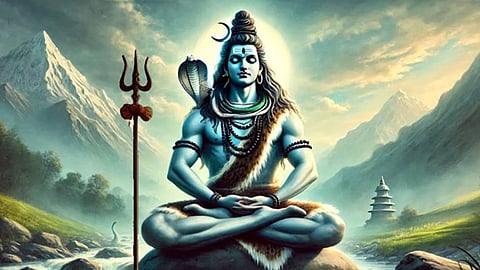
When the deadly Halahala poison emerged during the churning of the cosmic ocean, it threatened to destroy all creation. Shiva drank the poison to save the universe. But He did not allow it to enter His heart. It remained in His throat, transforming Him into Neelkanth-the Blue-Throated One. Perhaps no symbol speaks more deeply about human life. This is because every person encounters poison, not the poison of mythology, but the poison of betrayal, disappointment, humiliation, loneliness and grief. Sometimes it comes from strangers. Sometimes it comes from those we love the most. No life is free from suffering.
But Shiva teaches us a profound truth: Life may force us to drink poison. But it must never force us to become poison. The bitterness we experience must never become the bitterness we spread.
Perhaps this is why the ritual of offering water during Shravan continues through generations. It is not merely worship. It is a silent prayer that the invisible fires within us may also be cooled.
That anger may transform into forgiveness. That pain may not destroy kindness. That suffering may not steal our humanity.
Yet the story of Shravan belongs not only to Shiva. It belongs equally to Parvati.
For centuries, Parvati's devotion has been remembered as the love of a woman seeking her beloved. But her story is far greater than romance. It is the story of patience without losing dignity. Faith without losing wisdom. Love without losing identity.
Parvati did not choose Shiva because He possessed kingdoms or riches. She chose Him because truth mattered more than power, simplicity more than splendour, and compassion more than conquest.
That is why Shiva and Parvati continue to inspire generations. Their relationship is not merely a divine marriage. It is a vision of companionship built upon respect, equality and trust.
Even today, many young women pray during Shravan for a life partner like Shiva. Perhaps what they truly seek is not perfection. They seek understanding.
Someone who listens to silence without demanding explanations. Someone who respects dreams instead of limiting them. Someone who walks beside them-not ahead of them, not behind them. And Parvati reminds us that true love never requires the loss of one's identity. The strongest relationships are those where two individuals grow together while honouring each other's existence.
Then mythology quietly steps out of ancient scriptures and enters our homes.
This is because every home has its own Neelkanth - not the one who sits upon a mountain with a crescent moon upon His head and a trident in His hand, but the ordinary souls who silently absorb life's difficulties so that others may live with greater peace.
Sometimes she is a mother, sometimes a wife, sometimes a grandmother, sometimes he is a father silently carrying responsibilities that nobody notices.
Every day they swallow invisible poisons-financial worries, unspoken disappointments, broken expectations, silent fears, and sacrifices that may never be acknowledged. Yet they continue to smile.
History rarely remembers such people. No monuments celebrate their struggles. No great epics are written about their endurance. Yet upon their quiet sacrifices, families survive.
Generations flourish. And societies endure.
The world is not held together by extraordinary people alone. It survives because of ordinary men and women who quietly choose compassion over convenience, responsibility over recognition, and love over pride.
They are the invisible hands that hold our world together - the hands that prepare meals without expecting praise, the hands that wipe tears without announcing their own pain, the hands that work silently so that another person's dream may find wings, the hands that forgive even when forgiveness is difficult, the hands that remain gentle even after life has been unkind. Perhaps these are the true pilgrims of Kailash. Not because they have climbed sacred mountains, but because they have conquered the greatest mountain within themselves - the mountain of ego, anger and selfishness.
Whenever Shravan arrives, one memory returns to me with the fragrance of rain.
My mother would wake before dawn every Monday, bathe quietly, fill a small brass vessel with water, gather fresh bael leaves and walk to the Shiva temple.
Sometimes I walked beside her. One rainy morning, I asked,
"Mother, what do you pray for?"
She smiled. Looking at the rain falling gently upon the leaves, she replied,
"Most people pray for happiness, prosperity and success."
She paused.
"I only pray that the people in our home never stop being truly human."
As a child, I did not understand those words. Life has taken years to teach me what she understood in a single prayer. Wealth can be earned. Success can be achieved. Knowledge can be acquired. But humanity must be protected every single day. Perhaps that is the greatest blessing of Shravan. Not merely that rain falls from the heavens.
But that it reminds us that the highest form of devotion is not found only in temples. It is found in forgiveness when revenge appears easier. In compassion when indifference seems convenient. In truth when falsehood appears profitable. In love that gives without keeping account. For the purpose of faith is not only to seek blessings. It is to become a blessing in someone else's life.
A prayer whispered before Shiva is sacred. But so is a hand extended to someone in pain. A lamp lit before a shrine is sacred. But so is the light of hope we bring into another person's darkness. An offering placed before God is sacred. But so is the love with which we serve those who depend on us.
When the rains of Shravan fade and the skies grow clear, life returns to its familiar rhythm. The temple bells become quieter. The pilgrims return home. The rivers continue their timeless journey towards the sea. Yet something remains - the fragrance of rain upon the earth, the memory of a mother's prayer, the silent strength of Parvati, and the compassion of Shiva, and whatnot.
And the quiet courage of countless human beings who hold families, relationships and hopes together without ever asking to be remembered.
Perhaps that is the true blessing of Shravan. Not that it changes the season. But that, if we are willing to listen, it changes us.
For the greatest pilgrimage is not the one that leads to Kailash. It is the one that leads the human heart towards greater compassion. The journey from ego to humility. From resentment to forgiveness. From indifference to kindness. From pride to gratitude.
The clouds return to Kailash every year. They travel across endless skies, carrying memories of oceans, mountains and forests. They arrive silently, without announcement, and leave behind the gift of life. Perhaps there is a lesson hidden in their journey.
The greatest things in life often arrive quietly. A mother's prayer. A father's sacrifice. A friend's kindness. A stranger's compassion. A word of forgiveness spoken at the right moment.
None of these create noise. None of these seek attention. Yet they transform lives.
In our search for greatness, we often overlook goodness. We celebrate achievements that the world can see. But we forget the invisible efforts that made those achievements possible.
Behind every successful person, there are often invisible hands - hands that encouraged, hands that supported, hands that waited patiently, hands that gave without expecting anything in return.
Perhaps this is why the quiet people around us are the true guardians of humanity. They may never stand on grand stages. They may never receive awards. They may never become stories written in books. Yet their love becomes the foundation upon which families stand and generations grow. They are the silent keepers of hope - the unseen protectors of dreams, the gentle forces that remind us that humanity still survives.
And perhaps, somewhere beyond the mountains of Kailash, Shiva smiles upon such ordinary acts of extraordinary love. Because the Divine has always lived not only in temples, but also in hearts that choose compassion.
Not only in sacred chants, but also in words that heal. Not only in offerings placed before the altar, but also in sacrifices made for those we love.
So, when the clouds return to Kailash once again, let them remind us of the journey we must continue within ourselves - a journey towards humility, a journey towards forgiveness, a journey towards love, and a journey back to our own humanity.
For in the end, the greatest blessing of Shravan is not the rain that falls from the sky. It is the compassion that begins to rain within the human heart.
Perhaps that is why the clouds always find their way back to Kailash. They are not only returning to a mountain. They are returning to a place where silence meets surrender, where devotion meets humanity, and where every heart learns the timeless truth -
the path to the Divine does not begin with reaching the heavens. It begins with becoming more human.
(Neelim Akash Kashyap is a novelist of English and Assamese literature. You can reach him at neelimassam@gmail.com)
