
- Home
- Live Blog
- Breaking News
- Top Headlines
- Cities
- NE News
- Sentinel Media
- Sports
- Education
- Jobs
Siddharth Roy
(siddharth001.roy@gmail.com)
Prime Minister Narendra Modi’s recent visits to the Netherlands, Sweden, Norway, and Italy mark an important moment in India’s evolving engagement with Europe. Coming at a time of geopolitical flux, technological competition, energy insecurity, climate challenges, and shifting global supply chains, the tour reflected India’s attempt to deepen strategic partnerships with countries that occupy significant positions in technology, clean energy, defence manufacturing, maritime security, innovation, and industrial collaboration. More than ceremonial diplomacy, the four-nation outreach demonstrated India’s growing importance in Europe’s strategic calculations and highlighted New Delhi’s effort to build partnerships aligned with its long-term economic and geopolitical interests.
The most significant breakthrough came in the Netherlands, where India and the Dutch government elevated bilateral ties to a strategic partnership and adopted a roadmap for cooperation from 2026 to 2030. This marked a major step because the Netherlands is among India’s most important economic partners in Europe and a key gateway to the European market. The agreements covered semiconductors, artificial intelligence, quantum technologies, defence cooperation, maritime security, clean energy, critical minerals, water management, and space collaboration.
The semiconductor dimension was particularly important. In a world where chips have become central to national security and industrial competitiveness, India’s engagement with Dutch semiconductor equipment expertise, especially through ASML-linked technological cooperation, could significantly strengthen India’s manufacturing ambitions. Discussions on resilient supply chains, electronics manufacturing, and critical technologies reflected a shared understanding that economic security has become inseparable from technological partnerships.
Water management and climate resilience also emerged as key areas of cooperation. For Assam, Bengal, and other flood-prone regions of India, Dutch expertise in flood control, irrigation systems, and sustainable water engineering could have practical long-term benefits. The Netherlands’ decision to join India’s Indo-Pacific Oceans Initiative also carried geopolitical significance, reflecting growing European interest in India’s maritime vision in an increasingly contested Indo-Pacific region.
In Sweden, the emphasis shifted towards innovation, sustainability, industrial partnerships, and emerging technologies. Sweden remains one of Europe’s most innovation-driven economies, with strengths in artificial intelligence, clean technology, electric mobility, advanced manufacturing, and green industrial transition. India’s engagement with Sweden therefore fits into its broader ambition of building a future-ready economy based on digital transformation and sustainable growth.
Discussions in Sweden focused on AI, digital governance, defence manufacturing, innovation-led employment generation, research partnerships, and industrial collaboration. Meetings involving business leaders and the India-Sweden strategic dialogue reflected growing interest in expanding investment and technology cooperation. Sweden’s expertise in clean urban infrastructure, smart manufacturing, green mobility, and digital innovation complements India’s developmental priorities, particularly in the context of urbanization and sustainable industrialization.
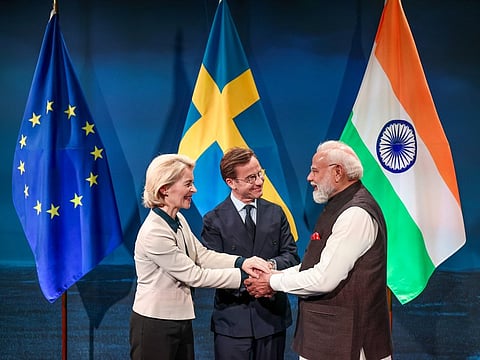
The Sweden leg also had a larger European dimension. Prime Minister Modi’s interaction with European Union leaders reinforced India’s role as a strategic partner for Europe amid rising concerns over global supply-chain disruptions, China-related dependencies, and geopolitical instability. Ongoing India-EU trade negotiations and cooperation in technology standards, digital regulation, and clean energy indicate that India’s engagement with Sweden is also part of a wider effort to strengthen ties with the European bloc.
In Norway, India’s partnership acquired a distinct environmental and maritime focus. The two countries elevated ties to a green strategic partnership, underscoring cooperation in renewable energy, climate action, digital technology, sustainable development, ocean-based economies, healthcare, and outer space research.
Norway’s expertise in renewable energy, maritime technology, Arctic research, and sustainable ocean industries makes it a strategically important partner for India’s long-term green growth agenda. The agreements signed during the visit covered space cooperation, healthcare, digital development, green technologies, and scientific research. Collaboration between ISRO and Norwegian institutions could strengthen India’s capabilities in satellite applications, environmental monitoring, and scientific innovation.
The emphasis on the blue economy was particularly relevant. As India seeks to expand maritime infrastructure, sustainable fisheries, offshore energy, and ocean-based economic activity, Norway’s experience in these sectors can offer valuable technological and policy lessons. Arctic cooperation also reflects India’s growing interest in polar science and climate research, areas increasingly linked to global environmental governance.
The Norway visit also carried symbolic importance, with Prime Minister Modi receiving Norway’s highest civilian honour. While ceremonial recognition is not policy in itself, such gestures often reflect a broader warming of bilateral relations and political trust between nations.
The final leg in Italy added another crucial strategic layer to the tour. India and Italy have in recent years moved beyond earlier diplomatic stagnation to build a stronger strategic partnership focused on defence, trade, energy, advanced manufacturing, clean technology, and geopolitical coordination.
Prime Minister Modi’s meeting with Prime Minister Giorgia Meloni helped define a new roadmap for bilateral cooperation at what both sides described as a decisive stage in relations. Italy is an important industrial economy within the European Union and a major player in defence manufacturing, engineering, green technology, infrastructure, and high-value industrial production.
Discussions focused on trade expansion, industrial cooperation, defence collaboration, energy security, technology partnerships, and investment opportunities. Cooperation in sectors such as aerospace, renewable energy, food processing, advanced manufacturing, and strategic industries can help diversify India’s European partnerships beyond traditional diplomatic frameworks.
Italy also matters geopolitically because of its influence within the European Union and the Mediterranean region. India’s engagement with Rome reflects a broader strategy of strengthening ties with influential European powers at a time when global alignments are shifting.
Collectively, the visits to the Netherlands, Sweden, Norway, and Italy reveal the changing nature of India-Europe relations. These partnerships are increasingly driven not merely by trade or diplomatic symbolism but by strategic cooperation in semiconductors, AI, green energy, clean technologies, maritime security, defence manufacturing, digital innovation, and climate resilience.
The larger message is clear: Europe increasingly sees India not just as a large market but as a strategic partner in shaping the future global order. For India, however, diplomatic success must now translate into implementation. Technology transfers, investments, research collaborations, industrial partnerships, and strategic projects must produce measurable outcomes.
If effectively pursued, the outcomes of Prime Minister Modi’s European outreach could strengthen India’s technological capabilities, green transition, economic resilience, and geopolitical standing, while positioning the country as a more influential player in an era defined by strategic competition and technological transformation.
