
- Home
- Live Blog
- Breaking News
- Top Headlines
- Cities
- NE News
- Sentinel Media
- Sports
- Education
- Jobs
Where Germany, Brazil, and Argentina meet in Assam
Neelim Akash Kashyap
(neelimassam@gmail.com)
Whether it is football or cricket, a World Cup is more than a tournament—it is an emotion. It embodies the essence of pure excitement. Whenever a World Cup is underway, the world seems to shrink into a single neighbourhood. There appears to be an invisible thread connecting the celebrations in a Brazilian alleyway, the passion in the streets of Buenos Aires, the craziness inside a football club in Berlin, and the cheers at midnight from a corner of Assam. At the heart of that connection lies the World Cup. This global festival of football transcends language, nationality, and geography, binding millions together through a shared passion. That is why a World Cup is never merely a sports competition. It is a collective human experience—whether on the football field or the cricket ground.
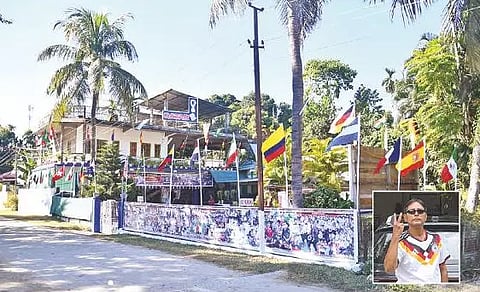
For football lovers in Diphu, the headquarters of Assam’s hill district of Karbi Anglong, World Cup football fever has taken on a unique and remarkable form. Here, the World Cup is not confined to television broadcasts or digital screens. Instead, it has evolved into something resembling a community festival—an unwritten social tradition that returns every four years. The place at the centre of this extraordinary story is known as the ‘German Stadium’.
A “German stadium” in Assam? For those hearing the name for the first time, it may sound surprising, even improbable. Yet the truth is that in the hill town of Diphu, there exists not only a place called the ‘German Stadium’ but also a fascinating story behind it—a story of unwavering devotion to football and the realization of an extraordinary dream.
The man behind the ‘German Stadium’ is Putul Bora, a lifelong football enthusiast. His love for the sport is not recent, nor is his admiration for the German national football team. For decades, football has been an inseparable part of his life. Long before giant screens, smartphones, and streaming platforms became commonplace, Bora believed in the joy of watching football together. Since the 1990s, he had been inviting local football lovers to his home to experience World Cup football matches collectively. Watching football with Putul Bora became an event in itself. And when the occasion was a World Cup match, the excitement seemed to double.
As years passed, the number of spectators gathering at his residence continued to grow. Encouraged by the enthusiasm of fellow football lovers, Bora began nurturing a larger dream. That dream eventually transformed a small gathering inside a room into a major community event—the ‘German Stadium’. Determined to create a venue where more than a thousand people could watch World Cup football matches together, Bora embarked on a journey driven entirely by personal commitment. To turn his vision into reality, he saved money little by little over the years and even took a bank loan exceeding one million rupees. Without seeking government grants or depending on external patronage, he relied solely on his confidence, perseverance, and love for the game. Thus, the ‘German Stadium’ in Assam’s Diphu came into being.
Even before the World Cup football begins, the stadium seems to awaken with anticipation. And once the tournament starts, the transformation is remarkable. The venue begins to resemble a real World Cup arena. Flags of different nations flutter outside. Photographs of football legends adorn the surroundings. Inside, hundreds of spectators sit facing a giant screen that broadcasts the matches live. The tension before a decisive moment, the thunderous roar after a goal, the collective heartbreak of defeat—all blend together to create an atmosphere that feels no different from that of a stadium thousands of miles away where the match is actually being played. At Assam’s ‘German Stadium,’ supporters of Germany sit beside fans of Argentina. Fans of Brazil and France cheer together, united in their love for the game. For in this unique gathering place created by Putul Bora, every other identity becomes secondary. Football alone matters.
Yet the ‘German Stadium’ is about far more than just football. Quietly and naturally, it celebrates the human desire to come together. In an age when almost every match can be watched individually on a smartphone, when shared viewing has increasingly become a nostalgic memory, Bora’s extraordinary initiative revives the spirit of collective experience. It brings people together to share joy and disappointment, victory and defeat, excitement and anxiety. Those who gather at the ‘German Stadium’ are not merely spectators enchanted by the game’s magic. They spend time together. They exchange opinions freely. They laugh, debate, celebrate, and sympathise together. In doing so, they become participants in a larger bond of fellowship and community.
The ‘German Stadium’ demonstrates a simple but profound truth: sport has the power to unite people. It can build bridges of friendship and understanding where differences once stood. Perhaps that is the true beauty of a World Cup. And the ‘German Stadium’ of Diphu stands as a living symbol of that beauty.
History may never record Diphu’s name among football’s iconic landmarks. The story of Putul Bora’s remarkable initiative may never secure a place in official football archives. Yet, the people of Assam will continue to remember and celebrate the ‘German Stadium’ whenever conversations about the FIFA World Cup arise. Through the spirit of World Cup football, Assam’s ‘German Stadium’ seems to echo the timeless words of D. Bhupen Hazarika: “He bhatri, aami ekekhan naawore yatree...”
