
- Home
- Live Blog
- Breaking News
- Top Headlines
- Cities
- NE News
- Sentinel Media
- Sports
- Education
- Jobs
Suprobh Ahna Borah
(suprobhahnaborah@gmail.com)
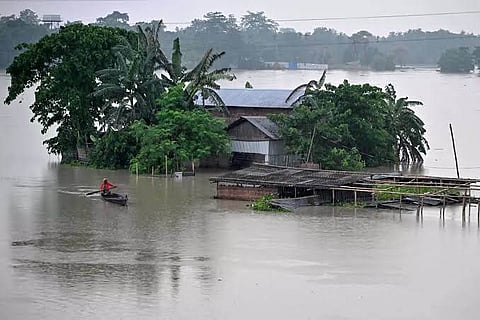
Assam has recently faced a cataclysmic flood in Monsoon 2026, and the disaster has left a devastating trail of infrastructure destruction and widespread agricultural, animal, and human loss in multiple districts of Upper Assam, especially in the historic town of Sivasagar. The timeless spirit of Assam's Ahom heritage has Assam's worst flood crisis in the last fifty years, has completely destroyed the timeless spirit of its Ahom heritage. The timeless spirit of Assam's Ahom heritage has been completely destroyed by the worst flood crisis in the last fifty years. While the flood waters have begun to recede in these areas, health issues are still prevalent in the affected regions. The stagnant water after the heavy rain and the lack of clean water result mainly in water-borne diseases, vector-borne diseases, and injuries to mankind.
While the physical destruction and loss are visible, the emotional and psychological impact often remains unnoticed. Hence, a major and new problem has been rising over the last two decades not only in India but throughout the world. The survivors of floods often face mental health issues, and there is a chance that people may suffer for months or even years. Some people who experience a flood for the first time are prone to such illness. It is known that stress is an inescapable element in life, and it further increases when flood events have led to disruption of employment and income for families. In Assam, the majority of the flood-affected population is dependent on agriculture and animal husbandry, and therefore, huge loss of their agricultural land and animals results in immediate shock due to confusion, fear, and helplessness during and right after the disaster. The hidden struggles resulting from emotional pain and ongoing stressors related to financial loss exacerbate emotional pain and ongoing stressors due to financial loss worsen the mental toll.
The 2015 English National Study of Flooding and Health conducted among Southern England Flood survivors showed higher levels of depression, anxiety, and post-traumatic stress disorder (PTSD) in participants whose homes had been flooded. It has been reported that post-traumatic stress disorder following a flood has also resulted in suicide; although very limited evidence is present, it may turn into a concerning problem in the near future. This study was essential in providing insights into mental health issues among survivors of floods. In adults, there is a possibility of relapse of any pre-existing psychiatric disorder, which can result in sleepless nights. The behavioural and developmental health of children: such a massive disaster also impacts the behavioural and developmental health of children. after such a massive disaster. School students have lost their study materials and experienced educational setbacks, while other children have disrupted daily routines and lost the structure of their friend circles after a disaster. So there comes the role of mental health professionals to train, negotiate, and rehabilitate from day one to the restoration phase in camps and flood-affected areas. Earlier, disaster interventions were made at the individual level, but at present times, public health updates have shown that disaster prevention should be more focused on community interventions in promoting health, preventing, planning, and mitigating suffering through capacity building of the affected community. Therefore, in the flood relief camps and the areas of flood survivors, there is a requirement for community-based interventions, including yoga, meditation, and spiritual activities, for the affected ones. The volunteers and NGOs, along with mental health professionals, should focus on therapies and techniques which might prevent common people from suffering long-term psychological disorders.
"Psychological debriefings" can be defined as group discussions that occur 48-72 hours after an event. These sessions provide a platform for people to share the factual and emotional aspects after a disaster. Such concepts are required to be promoted in flood-prone regions such as Upper Assam, basically in Sivasagar, Charaideo and Dibrugarh districts, even at workplaces and schools, so that preventive measures can be known by the population. The World Health Organisation recommends the concept of "Psychological First Aid" to be used in conditions such as those Assam faced during and after the flood disaster. This primarily can be done by understanding the mental status of the people and taking the appropriate measures at once, which can be protection from further threat and distress, normalisation or validation of the emotions, helping to locate family members, etc.
Although there are several psychotropic medications present, such as Clonazepam, Temazepam, Prazosin, etc., their use has been discouraged in disaster management because of their long-term side effects. Some important mental health interventions needed post-disaster, as suggested by public health experts, include:
¦ Use of the internet and social media to provide mental health services
¦ Personal interventions can
¦ Student volunteers, health professionals, and teachers can deliver personal interventions. Personal interventions can Student volunteers, health professionals, and teachers can deliver personal interventions. by student volunteers, health professionals, and teachers. Personal interventions can be delivered by student volunteers, health professionals, and teachers.
¦ The interventions can be delivered at school occasionally and in workplaces in the flood-affected areas of the country.
¦ There should be psychological first aid training along with medical first aid management.
Disasters are an ineluctable truth of life. Planning and preparedness are essential to cope with such challenges. A positive, mental, emotional, and optimistic approach to life situations can help an individual and the whole community to cope with stress. It can be concluded that a holistic and integrated approach should replace the post-disaster management so that the people who faced the deluge in Upper Assam and other northeastern regions can overcome the physical, emotional, and economic challenges in the near future.
