
- Home
- Live Blog
- Breaking News
- Top Headlines
- Cities
- NE News
- Sentinel Media
- Sports
- Education
- Jobs
Abihotry Bhardwaz
(abihotrybhardwaz72@gmail.com)
Water hyacinth did not belong to Assam originally. This aquatic plant, scientifically known as Eichhornia crassipes, originated in South America and was introduced to India during the British colonial period as an ornamental plant because of its attractive flowers. At first, it appeared harmless and decorative. But over time, it escaped cultivation and spread across rivers, ponds, and wetlands. Assam became one of the regions mostly affected by this invasion. The state's geography unintentionally created ideal conditions for water hyacinth to thrive. Assam is dotted with rivers, wetlands, lakes, and floodplains connected through the Brahmaputra River system. During monsoon floods, floating clusters of hyacinth moved from one water body to another. Since the plant reproduces extremely fast, it gradually forms dense green blankets across lakes and wetlands. What looked green and peaceful on the surface created serious environmental damage underneath.
These thick floating mats blocked sunlight from entering the water, reducing oxygen levels and affecting underwater ecosystems. Fish populations began to suffer, local fishing communities faced difficulties, and movement across water became harder. Wetlands that once supported biodiversity slowly became choked with invasive vegetation.
One of the most visible examples is Deepor Beel near Guwahati - an internationally recognised wetland where water hyacinth became an ongoing challenge. Removing the weed repeatedly required labour and resources, yet the plant returned season after season.
The beginning of Kumbhi Kagaz was not in a laboratory or a business conference. It began with observation.
While working around Assam's wetlands and being closely connected to environmental conservation efforts, Rupankar Bhattacharjee witnessed the growing spread of water hyacinth and its impact on local ecosystems. The plant was being removed again and again, but there was no lasting solution.
Together with Aniket Dhar and with guidance from their mentor, a different possibility started to emerge.
Instead of treating water hyacinth as waste, they began asking whether it contained something valuable.
Research indicated that water hyacinth has fibrous characteristics that could potentially be processed into paper. That discovery led to an unforeseen opportunity. Rather than simply removing the invasive plant and discarding it, why not transform it into something useful?
The idea was ambitious. Paper manufacturing traditionally depends heavily on wood pulp and chemical processing. Creating paper from an aquatic weed seemed difficult. But innovation often starts when we view problems from a different perspective.
Through experimentation, learning, and refining techniques, the team began developing methods to convert water hyacinth fibres into handmade paper. Eventually, this effort grew into Kumbhi Kagaz, an Assam-based initiative built around environmental restoration and sustainable production.
Their vision was not only to create products but also to build a circular model where ecological problems could become economic opportunities.
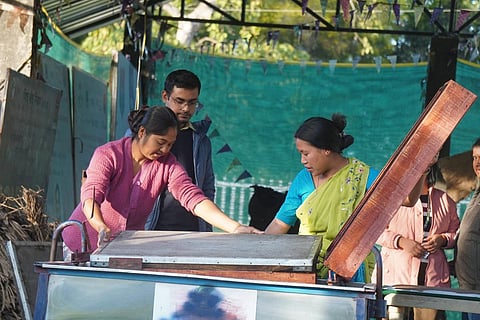
Creating paper from water hyacinth is not simply about drying plants and pressing them together. The process begins with collecting the invasive weed from affected water bodies. The harvested plants are cleaned, separated, and processed to extract usable fibres. These fibres are then converted into pulp and transformed into handmade sheets using specialised techniques. What makes this process especially meaningful is that it focuses on producing paper without relying on conventional chemical-heavy methods.
The result is chemical-free handmade paper that carries both environmental and social value.
From this paper, Kumbhi Kagaz produces eco-friendly stationery products, including notebooks, journals, calendars, greeting cards, packaging materials, and other paper goods. Each product represents something larger than stationery.
It represents cleaner wetlands, reduced dependence on tree-based raw materials, and an alternative way of conceptualising production. The transformation itself carries a symbolic meaning-taking a plant once considered useless and turning it into something creative, functional, and sustainable. Kumbhi Kagaz is not simply a business producing paper.
Its work connects environmental conservation, local engagement, and sustainable entrepreneurship.
Every collection cycle removes portions of water hyacinth from water bodies that would otherwise continue expanding. This contributes to improving water movement, restoring ecological balance, and reducing pressure on wetlands. At the same time, the initiative creates local opportunities through collection, processing, and manufacturing activities.
The impact goes beyond products placed on store shelves.
It demonstrates how environmental challenges do not always require only removal or destruction. Occasionally they require rethinking.
By creating value from an invasive species, Kumbhi Kagaz offers an example of circular economy thinking where waste becomes raw material and restoration becomes part of production.
The journey has not been simple. Building production systems, experimenting with fibres, managing operations, and growing a sustainable market require persistence and long-term commitment.
Yet the project gained attention because it showed something powerful: solutions do not always arrive from imported technology or large industries. Sometimes they emerge from local observation and a willingness to look at familiar problems differently.
The story of Kumbhi Kagaz changes the narrative of water hyacinth in Assam.
A plant once introduced for decoration became an ecological burden. That burden spread across lakes and wetlands, affecting biodiversity and livelihoods. But instead of accepting the problem as permanent, a group of innovators imagined another possibility.
Today, what once floated across Assam's lakes as waste is being turned into paper, products, and purpose.
Kumbhi Kagaz reminds us that sustainability is not only about protecting nature. It is also about discovering value where others only see problems.
