
- Home
- Live Blog
- Breaking News
- Top Headlines
- Cities
- NE News
- Sentinel Media
- Sports
- Education
- Jobs
Dipak Kurmi
(The writer can be reached at dipakkurmiglpltd@gmail.com.)
Festivals play a crucial role in the socio-cultural fabric of human society, acting as mechanisms for social cohesion and reinforcing a sense of belonging among individuals within a community. Across the world, societies mark specific moments of significance—be it seasonal transitions or life-cycle events—through festivals that celebrate cultural heritage, beliefs, and communal identity. As noted by Smith (1972), festivals serve as powerful tools for integrating individuals into society through recurrent, positively reinforcing performances. They are deeply rooted in tradition, though traditions themselves evolve over time, adapting to changing lifestyles and belief systems (Goswami, 1995). The case of the Thengal Kachari tribe in Assam and their celebration of Tora Chira Bihu serves as a testament to this dynamic interplay of tradition and modernity.
The Thengal Kachari Tribe: A Historical Perspective
The Thengal Kachari tribe is one of the plain tribes of Assam, considered an offshoot of the greater Kachari group. According to B.M. Das in People of Assam (2010), the Kacharis are widely distributed across the state and are divided into several subgroups, including the Dimasa, Sonowal, Thengal, and Jharua. While the Sonowal Kacharis form a larger demographic group, the Thengal Kacharis remain a relatively smaller yet culturally distinct subgroup. Their physical features closely align with the Mongolian racial groups, as described by historians. Despite the existence of numerous narratives regarding the origins of the broader Kachari population, historical records remain largely silent on the exact origins, migration patterns, and settlements of the Thengal Kacharis.
However, historical traditions provide some insights. The absence of written records regarding Kachari rule necessitates reliance on oral histories and legends. According to Devi (1992), there were two major Kachari branches—one ruling in Sadiya and another in the south, with capitals at Dimapur, Maibong, and Khaspur. Dr. Jogeswar Borah (2005) recounts a legend in which two Kachari warriors, Jangbahadur and Chakradhwaj, emerged victorious in a battle against the Ahoms in 1526 A.D. Following their victory, they established a separate Kachari kingdom at Kachamari Field, with Jangbahadur as its first king. These warriors and their followers, known for wearing trousers called ‘Thenga’ during battles and even in peacetime, came to be called Thengal Kacharis.
The Cultural and Religious Beliefs of the Thengal Kacharis
The Thengal Kacharis share significant cultural similarities with the Sonowal Kacharis. They are primarily settled in Assam’s Jorhat, Golaghat, North Lakhimpur, Nagaon, and Karbi Anglong districts. Traditionally, the Thengals engaged in silver washing under the Ahom rulers, earning them the alternative name Rupowal. However, some contemporary Thengals prefer not to use this term. Hiteswar Borbaruah notes that some Kacharis procured silver from the Dhansiri River, leading to their classification as Thengals or Rupowals.
Religiously, the Thengal Kacharis are primarily devotees of Lord Shiva but also retain various animistic practices. They worship nature and elemental forces, sacrificing to spirits and deities beyond conventional idol worship. Over time, many Thengal Kacharis embraced Vaishnavism, particularly through the influence of Basudev Gosain of Auniati Satra. This led to the bifurcation of the community into two religious sects: those following the Brahma Samhati tradition, engaging Brahmin priests in rituals, and those aligned with the Ekasarna Naam Dharma under Srimanta Sankardeva’s influence.
The Thengals are divided into twenty-one exogamous clans based on occupational lineages, including Hajowal, Manikial, Durrungial, Dalangiyal, and Biyagharal, among others. Endogamy within the same clan is strictly prohibited. The Thengals primarily speak Assamese, though historical linguists suggest that their original language belonged to the Boro-Garo linguistic family. Over time, Assamese became their mother tongue due to socio-cultural assimilation.
Tora Chira Bihu: A Unique Festival of the Thengal Kacharis
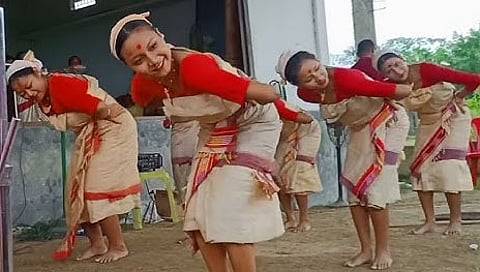
Among the various festivals celebrated by the Thengal Kacharis, Tora Chira Bihu holds special cultural and historical significance. While the Assamese community broadly celebrates three major Bihus—Bohag Bihu, Kati Bihu, and Magh Bihu—Tora Chira Bihu is a unique pre-Bihu festival observed by the Thengal Kacharis. This festival begins on the second Wednesday of Choitra (the last month of the Assamese calendar). It marks the commencement of Bohag Bihu preparations and symbolises communal unity, tradition, and reverence for nature.
The celebration of Tora Chira Bihu involves distinct rituals. Young men venture into nearby forests to collect tora (cardamom plants), a task from which women are traditionally excluded. Before embarking on this endeavour, they offer prayers to Bon Debota (forest deity) to ensure a safe journey, reflecting their deep belief in supernatural influences. Upon their return, the collected tora plants are dried and fashioned into ropes, which are later used to tie cattle on Goru Bihu, the day dedicated to the community’s livestock.
A significant aspect of Tora Chira Bihu is the involvement of village elders, who visit homes to assist in rope-making. In return, they are served Xereka (a traditional rice beer) and Khaji (food gathered by the youths). The festival is marked by communal singing and dancing, with villagers performing traditional Bihu geet (folk songs) that celebrate the spirit of the occasion:
Tora Chiri golurongbairohimola
Pogha bati golurongbairohimola
Budhebrihospoti bihu he rongbairohimola
Risip sip Jorourouwa
Tora siriboloiRongbairohimola
The song emphasises the collection of tora plants and the preparation of new ropes for the cattle, signifying the onset of Bihu celebrations.
Preservation of Thengal Kachari Heritage in Contemporary Times
The traditions of the Thengal Kacharis, including Tora Chira Bihu, faced a decline due to modernisation, assimilation, and the impact of globalisation. Over time, many aspects of their cultural heritage became nearly extinct. However, in 2009, efforts were made to revive Tora Chira Bihu, with public celebrations organised in Bihpuria, Lakhimpur district. This festival was subsequently declared the national festival of the Thengal Kachari community.
Despite the challenges posed by socio-cultural assimilation, the Thengal Kacharis have become increasingly aware of the need to preserve their heritage. Revival efforts have included documentation, public celebrations, and a renewed interest in indigenous traditions. The celebration of Tora Chira Bihu has emerged as a means of reclaiming their lost identity while fostering a sense of unity among community members.
Tora Chira Bihu is not merely a festival but a cultural emblem of the Thengal Kachari tribe, reflecting their deep connection with nature, their ancestral customs, and their collective identity. The festival exemplifies the broader significance of traditional celebrations in reinforcing social bonds and preserving indigenous heritage. As the Thengal Kacharis continue their efforts to uphold their cultural identity, the revitalisation of Tora Chira Bihu stands as a testament to their resilience and commitment to cultural preservation in an ever-changing world.
