
- Home
- Live Blog
- Breaking News
- Top Headlines
- Cities
- NE News
- Sentinel Media
- Sports
- Education
- Jobs
Sandeep Bhardwaj
(Sandeep.meet@gmail.com)
The past few days have shaken me to the core. As someone deeply invested in wildlife, someone who has always revered nature not merely as scenery but as a living, breathing system that sustains us all, I found myself disturbed—almost paralysed—by two incidents that unfolded before our eyes. These were not isolated events. They were symptoms of a deeper, more dangerous apathy that has crept into our collective conscience.
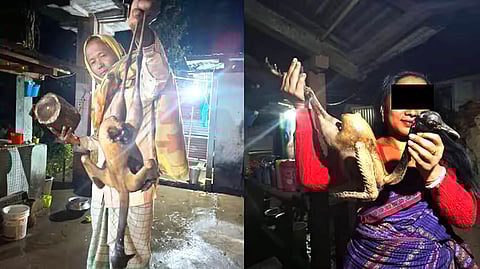
The first was the horrifying incident involving the Bengal Florican, one of India’s most endangered birds. “Images began flooding social media—photographs of a bird that should have been soaring over grasslands, instead lying lifeless, sold openly in weekly rural markets of the Brahmaputra valley. Reports suggested that the bird was being sold for a paltry sum and consumed as casually as one would eat chicken or duck. This wasn’t just shocking—it was heartbreaking.
Yes, one could argue that many people may not be aware of the Bengal Florican’s conservation status. But let us be honest. People do know this bird comes from the wild. This is not a domesticated species, not a farm-bred animal. It is a creature of our remaining natural landscapes—landscapes already shrinking at an alarming rate.
For centuries, communities living close to forests have depended on natural resources for survival. That history cannot be denied. But history cannot be used as a shield to justify destruction in the present. Times have changed. Ecosystems have changed. Wildlife numbers have collapsed. What may once have been survival has now become irreversible loss.
In today’s world, where species are disappearing faster than ever before, killing a critically endangered bird is not tradition—it is extinction in action. It was reassuring to see swift action by the authorities. Arrests were made. Investigations were launched. And it must be acknowledged that social media outrage played a decisive role. Without public pressure, this incident might have quietly disappeared, like so many others before it.
But this cannot be where the story ends. “We know such incidents are not rare. Wildlife—whether birds, mammals, or aquatic species—continues to be hunted, sold, and consumed illegally across regions. The difference today is visibility. In the age of social media, ignorance can no longer be an excuse. Every citizen now has a responsibility to remain vigilant, to question, to report, and to speak.“ Because if we do not, silence becomes complicity.
The second incident that shook me just as deeply was the death of elephants on railway tracks in Assam, near Hojai. Tragically, this was neither the first such incident nor—if things continue this way—the last.
Elephants have walked these corridors long before railway lines were laid. But relentless development has reduced forests to fragmented islands, forcing animals to move through human settlements, highways, and railway tracks. Every such crossing is a gamble with death.
Yes, systems exist. Monitoring mechanisms like Gajraj alerts are in place. The Railway Gajraj Alerts refer to Gajraj Suraksha, an AI-based surveillance system by Indian Railways that uses optical fibre sensors near tracks to detect elephant movements, sending real-time alerts to station masters and train drivers to prevent collisions, thereby protecting elephants and ensuring their safety, particularly in elephant corridors in states like Assam.
Forest and railway departments claim coordination. But repeated tragedies expose a painful truth—our infrastructure is still not wildlife-sensitive enough.
With railway electrification and faster trains, reaction times have reduced drastically. In elephant corridors, this is a lethal combination. Other states have begun experimenting with technology, speed regulation in sensitive zones, and even elevated corridors that allow animals to pass safely. I read in some newspapers that in the southern state of Tamil Nadu, encouraged by the success of an AI-based early warning system in Madukkarai, Coimbatore—which has ensured zero elephant deaths on railway tracks over the past two years—the Tamil Nadu government has now launched an AI-powered Command and Control Centre in Gudalur. Using thermal cameras to detect elephant movement near tracks, the system has already enabled nearly 6,000 safe crossings, proving how technology can prevent tragedy when applied with intent. In Gudalur, a landscape fractured by plantations and settlements yet vital to elephant corridors, this initiative marks a crucial step toward science-led, preventive solutions for human-wildlife conflict.
But the pertinent thing is not whether these solutions exist.
The question is whether we have the will to implement them.
Development cannot come at the cost of annihilation. If growth requires forests to be cut, hills to be flattened, and ancient migration routes to be severed, then we must ask—growth for whom, and at what cost?
While speaking out strongly on the Bengal Florican incident, I was trolled. Someone questioned why I wasn’t equally vocal about governments or corporations that destroy forests in the name of development. Another went further, attempting to justify killing animals as an “age-old custom.”
My response was simple.
If anyone violates the law—be it an individual, a corporation, or the state—the law must take its course. And no, killing animals cannot be justified by tradition when survival itself is at stake.
Customs evolve. Ethics evolve. Responsibility must evolve.
We live in a time when natural resources are shrinking daily. Forests are disappearing. Wildlife populations are collapsing. Climate change is no longer a future threat—it is our present reality. In such a world, we cannot afford to destroy what little remains.
Conservation is no longer optional. It is not the job of forest guards alone. It is not the responsibility of activists alone. It is a collective duty.
Some will use the pen.
Some will use the camera.
Some will fight through the law.
But if we fail to act—if we continue to justify, ignore, or normalize destruction—then we are staring at an apocalyptic future of our own making.
I may not live long enough to witness the full consequences of today’s actions. But future generations will. And what we leave behind for them will define us—not our GDP figures, not our infrastructure, but whether we had the courage to protect life when it needed us most.
Writing about these incidents is not an act of outrage alone. It is an extension of responsibility. A small contribution, perhaps—but silence would have been a far greater crime.
(Thoughts expressed are my own.)
