
- Home
- Live Blog
- Breaking News
- Top Headlines
- Cities
- NE News
- Sentinel Media
- Sports
- Education
- Jobs
Reviewer: Himnayana
(himakshiraj@rediffmail.com)
Zubeen Garg has never belonged solely to the world of music. For Assam, he has been a cultural force—an artiste whose voice carried love, resistance, longing, and identity. While his life and work have been discussed through journalism, biography, and criticism over the years, fiction had remained an unexplored space. That space has now been claimed with the publication of two novels that place Zubeen Garg at the center of a deeply emotional literary narrative.
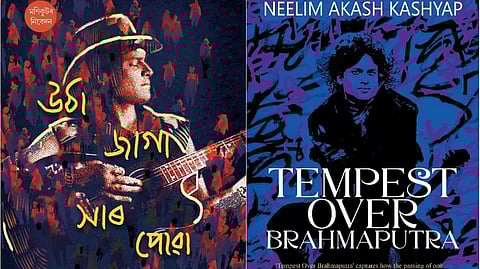
Published by Manikut Prakashan, ‘Utha-Jaaga-Xaaar Powa’ in Assamese and ‘Tempest Over Brahmaputra’ in English mark the first fictional works based on the life and legacy of the legendary singer. Both novels have been written by Neelim Akash Kashyap, a young novelist who approaches the subject not as a chronicler of events, but as a witness to a collective sense of loss. Together, the books represent a significant moment in contemporary Assamese literature, transforming a cultural icon into a literary presence.
‘Utha-Jaaga-Xaaar Powa,’ the first Assamese novel on Zubeen Garg, resists the structure of a conventional biography. Instead, it unfolds as a reflective narrative shaped by memory, music, and mourning. Zubeen Garg appears throughout the novel—not merely as a celebrated artiste, but as a living presence whose absence continues to define the emotional landscape of Assam. The narrative moves fluidly between his musical journey, the socio-cultural atmosphere of his times, and the silence that followed his departure.
The novel functions as a literary document of a Zubeen-less Assam. Familiar episodes from the singer’s life are interwoven with lesser-known and untold moments, allowing readers to encounter both the public figure and the private human being. Fiction becomes a tool to transform known facts into lived emotional experiences, giving depth to grief and resonance to memory.
One of the most striking aspects of ‘Utha-Jaaga-Xaaar Powa’ is the inclusion of the only short story ever written by Zubeen Garg himself—an almost unknown facet of his creative life. The novel also addresses deeply personal chapters, including the untimely death of his sister, Jonkey Borthakur. These moments are handled with sensitivity and restraint, adding emotional gravity without descending into sentimentality.
‘Tempest Over Brahmaputra,’ the English novel, extends this narrative beyond linguistic boundaries. Though rooted in the Assamese original, it is not a mechanical translation. Reworked by the author himself, the English version preserves the emotional core of the story while making its cultural context accessible to a wider readership. Through this novel, readers outside Assam are introduced not only to Zubeen Garg but also to the emotional world of a society shaped by his music.
Both novels share a common impulse: to document not just the life of an artist, but the collective mourning of a people. They explore how music becomes memory and how an artist’s voice continues to echo even in silence. Rather than mythologizing Zubeen Garg, the books choose to humanize him, allowing readers to feel his presence rather than merely understand his legacy.
Since their release, the novels have generated wide discussion among readers and literary circles, drawing attention to the possibilities of fiction as a means of preserving cultural memory. In bringing Zubeen Garg into the realm of the novel, Neelim Akash Kashyap does not attempt to define the legend. Instead, he listens—to songs remembered, to silences endured, and to the quiet grief flowing beneath Assam’s cultural consciousness.
In these pages, music turns into memory, and fiction becomes a space where an artist continues to live—not as an icon carved in stone, but as an enduring emotional presence.