
- Home
- Live Blog
- Breaking News
- Top Headlines
- Cities
- NE News
- Sentinel Media
- Sports
- Education
- Jobs
Dr. Mouchumi Dutta Khataniar
(Mouchumidutta78@gmail.com)
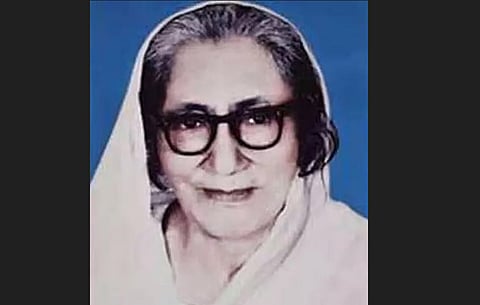
Padmashree Chandraprabha Saikiani took up a great challenge to lead the women of Assam in the first half of the 20th century and paved her name as a pioneer of women’s education and women’s empowerment in Assam. From her childhood, she was exceptional in her thought and action and keenly felt the importance of women’s education for the development of society. Saikiani worked for the womenfolk through Mahila Samiti so intensively and vigorously that she led the womenfolk to be independent first to make the nation independent.
By establishing Asom Pradeshik Mahila Samiti from a single women’s non-governmental organization to a significant huge women’s organization, Saikiani worked for all existing social issues. At that time (around 1917-1918) the only two major existing organizations of Assam were the Axam Xahitya Xabha and the Assam Association. For the students of whole Assam, the only organization that worked together was ‘Asom Chatra Sanmilan.’ These were the only three organizations that existed first in Assam. In the year 1918, a few women, namely Sri Juta Lakkshmiprava Chaliha and Chandrakanti Das, along with some girl students, had joined in Asom Chatra Sanmilan in the program where Chandraprabha Saikiani delivered her first public speech supporting the proposal of Amiya Kumar Das for the abolition of opium-eating. That was considered the first public speech by a woman in Assam.
The first Mahila Samiti was established in Dibrugarh by the initiative of Hemaprabha Das as the ‘Dibrugarh Mahila Samiti’ in 1915. The Samiti provides some light foods to the poor learners. Her elder sister Durgaprabha Bora was the first matriculate girl from Assam. Sudhalata Duara and Sukhalata Duara were the first higher-educated girls of Assam at that time. After that, in 1917, Nagaon Mahila Samiti was established under the initiatives of Chandraprabha Saikiani, where Khagendri Priya Baruani was the president and Swarnalata Barua was the secretary.
At that time, women were only allowed to go outside by walking and riding horses. Chandraprabha Saikiani was the eyewitness and initiator to open Tezpur Mahila Samiti in 1919 with the cooperation of Hirawati Gohaign Barua (wife of Padmanath Gohaign Barua), Kunjalata Devi (wife of Mahadev Sarma), and Kironmoyi Agarwala (mother of Jyotiprasad Agarwala). Kironmoyi Agarwala was the president, and Chandraprabha Saikiani was the secretary. The first resolution of Tezpur Mahila Samiti was to abolish the purdah system. They started to discuss and work on women’s education and women’s empowerment.
A historical event took place in Axam Xahitya Xabha, 1925, under the presidentship of Rajanikanta Bordoloi, which was held in Nagaon. The women in the meeting were segregated by a bamboo net, and ironically, the president’s speech was on women’s education. Chandraprabha Saikiani could not bear that and asked the women to break the barriers. Being encouraged by her epoch-making speech, the women broke the fences, and that was considered the first revolt in a public place by a large number of women in Assam. Chandraprabha Saikiani is the first woman who was able to lead and mold the women gathering in such a significant public meeting in Assam. Thousands of women gathered in the open field the next day and proposed to establish Asom Mahila Samiti. It is Chandraprabha Saikiani who enlightened the thought of womenfolk of Assam to get together and work together for the welfare of all women. In the 1926 Asam Xahitya Xabha session in Dhubri, the president, Benudhar Rajkhowa, proposed Chandraprabha Saikiani to form the Asom Mahila Samiti. Accordingly, women were gathered at Bijni Hall, and under the presidentship of Benudhar Rajkhowa, Asom Pradeshik Mahila Samiti was established, where Chandraprabha Saikiani became the secretary.
Within a very short time, Chandraprabha Saikiani established Mahila Samitis in different places. Sometimes she had to face teasing and unexpected behaviour from male figures, but Saikiani had deep knowledge of Shastras, and she overcame all those by her strong spiritual power. The first annual convocation of Asom Mahila Samiti was held in Goalpara under the presidentship of Durgaprabha Bora in 1927. Annada Das, Snehalata Bhattacharya, and Srimati Bharatpriya were present there along with Saikiani. The second annual convocation of Asom Mahila Samiti was held in Jorhat under the presidentship of Prafulla Bala Choudhury in 1928. The third annual convocation of Asom Mahila Samiti was held in Golaghat under the presidentship of Narayani Sandikoi. Most interestingly at that period, the only available cheapest communication was the Bullock Cart, and Golaghat town was filled up with the bullock carts that day because a large gathering of women hired those. Chandraprabha Saikiani worked hard for almost one month before each convocation to make it a grand success. They discussed women’s education and the problems and prospects of higher education for the women. After that, many primary schools upgraded to high schools. Almost 50,000 women became literate through the initiative process and hard work of Mahila Samiti. The ‘Maina Parijat’ program was started in 1951 after the convocation held in Jorhat, presided over by the late Mrs. Doulatram, wife of Governor Joyram Doulatram Dev.
The monthly magazine ‘Abhijatri’ was published from 1947 by the women writers of the samiti mainly. The magazine was continued for seven years, which included the major issues of society. But due to the readers’ crisis, Chandraprabha Saikiani herself managed Rs. 1,000, and the owner of the Assam Tribune, Radha Govinda Barua, had lost almost Rs. 2,000 at that time. Saikiani received financial aid from Bimala Prasad Chaliha, Gopinath Bordoloi, and Bishnuram Medhi. She set up the Harijan School, a weaving center for labor women with those aids. Saikiani conveyed her gratitude to Neera Dogra for granting different funds to the Mahila Samiti. Saikiani led the Mahila Samiti as the single women’s non-governmental organization of Assam.
Saikiani also wished to send women representatives to take part in the Legislative Assembly and Loka Sabha. As a result, Manjula Devi and Mafida Aahmed went to the Loka Sabha, and Usha Barthakur, Kamalkumari Barua, Padmakumari Gohaign, and Lily Sengupta went to the Legislative Assembly. Bedabati Buragohaign and Pushpalata Das became the members of Rajya Sabha. The Iron Lady of Assam, Padmashree Chandraprabha Saikiani,’s motto in life was to give dignity to a human being irrespective of sex and class, and she worked wholeheartedly throughout her entire life.
Most significantly, Padmashree Chandraprabha Saikiani passed away on her birthday, March 16th, having been born in 1901 and dying in 1972.
