
- Home
- Live Blog
- Breaking News
- Top Headlines
- Cities
- NE News
- Sentinel Media
- Sports
- Education
- Jobs
Chandan Kumar Nath
(chandankumarnath7236@gmail.com)
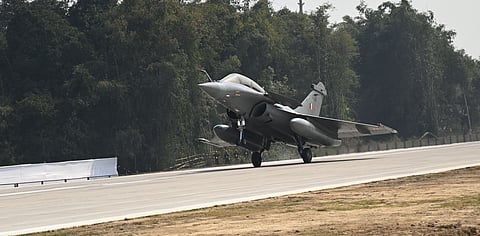
The skies over Assam’s Dibrugarh district reverberated with the unmistakable roar of aviation mastery on the morning of February 14, 2026. However, the theatre of this display was not a traditional military airbase but a stretch of civilian asphalt. When Prime Minister Narendra Modi’s Indian Air Force C-130J Hercules aircraft touched down on the newly minted Emergency Landing Facility (ELF) at the Moran Bypass, it marked a watershed moment in India’s infrastructure and defence narrative. This was not merely a ceremonial inauguration; it was a profound geopolitical statement. For geopolitical analysts and observers of India’s evolving “Act East” policy, the inauguration of the Northeast’s first highway-based airstrip is a historic milestone that inextricably links civilian infrastructure with frontline military readiness, permanently altering the region’s strategic calculus. Observing the trajectory of India’s frontier development, the events that unfolded in Moran offer a fascinating glimpse into a new paradigm of national security. The Prime Minister’s day-long itinerary, encompassing projects worth over Rs 5,450 crore, was a carefully orchestrated symphony of hard military power, civilian connectivity, and digital integration. Yet, it was the 4.2-kilometre reinforced concrete stretch on National Highway 127 that stole the global spotlight.
The visual of a transport leviathan like the C-130J making a flawless landing on a public highway is an engineering triumph and a masterclass in strategic signalling. Built at an estimated cost of Rs 100 crore, the Moran ELF represents a critical dual-use marvel. As the Prime Minister watched a 40-minute aerial display featuring the thunderous flypasts and touch-and-go manoeuvres of Sukhoi Su-30MKIs, Rafales, and indigenous Tejas fighters, the underlying message to the broader geopolitical arena was unmistakable. Geographically, Moran occupies a vital vantage point. Situated just a few hundred kilometres from the Line of Actual Control (LAC) with China and a mere 200 kilometres from the Myanmar border, this facility acts as a formidable forward operating base hidden in plain sight. In an era where border dynamics remain unpredictable and conventional airbases like Chabua or Dibrugarh Airport could theoretically be compromised during a conflict, the Moran ELF effectively transforms a national highway into a resilient alternative runway. Capable of handling fighter aircraft weighing up to 40 tonnes and massive transport planes up to 74 tonnes, this facility ensures that India’s aerial supply lines and combat readiness remain uninterrupted. Beyond the theatre of defence, this infrastructure holds immense humanitarian value. The Northeast is perennially vulnerable to severe seismic activities and devastating floods. In the immediate aftermath of a natural disaster, when conventional transport networks often collapse, this highway airstrip will serve as a lifeline, enabling the rapid and unhindered deployment of heavy rescue equipment, medical aid, and disaster response teams. It is a bulwark against both external aggression and internal calamity.
While the morning was dominated by the raw power of military aviation, the afternoon shifted focus to the arteries of civilian and economic life. The inauguration of the Kumar Bhaskar Varma Setu across the mighty Brahmaputra River stands as a testament to India’s growing infrastructural ambitions. This six-lane extradosed prestressed concrete (PSC) bridge, built at a staggering cost of approximately Rs 3,030 crore, fundamentally alters the geography of the State Capital Region.
By connecting Guwahati with North Guwahati, the bridge slashes travel time between the two banks to a mere seven minutes. However, the true marvel of the Kumar Bhaskar Varma Setu lies beneath its surface. Recognizing the high seismic vulnerability of the region, engineers incorporated cutting-edge base isolation technology utilizing friction pendulum bearings and high-performance stay cables. This ensures that the bridge is not only a conduit for daily economic activity but also a structure built to endure the restless tectonic forces of the Himalayan foothills. This is a clear indicator that the central government is no longer just building infrastructure in the Northeast; it is building resilient, future-proof infrastructure that matches global engineering standards. The true strength of a region, however, is not measured solely in concrete and asphalt but in its intellectual capital and digital prowess. The Prime Minister’s virtual inauguration of the temporary campus of the Indian Institute of Management (IIM) Guwahati from Lachit Ghat is a critical step in democratising top-tier higher education. By establishing premier management institutions in Assam, the government is ensuring that the youth of the Northeast are equipped to lead the economic integration of the region with Southeast Asia. Complementing this educational leap is the launch of the AI-enabled Hyperscale National Data Centre for the Northeastern Region at Amingaon. Developed by the National Informatics Centre (NIC) with a total sanctioned load of 8.5 MW, this state-of-the-art facility is the invisible bedrock of the region’s future. In an increasingly digitised global economy, secure and robust data infrastructure is non-negotiable. This data centre will not only host mission-critical applications for various government departments but will also function as a vital disaster recovery centre for other national data centres across India. It signifies that the Northeast is no longer just a consumer of digital services but a critical node in India’s broader digital nervous system.
Furthermore, the flag-off of electric buses under the PM-eBus Sewa Scheme, allocating 100 sustainable vehicles specifically for Guwahati, highlights a parallel commitment to green mobility and sustainable urban growth. It demonstrates an understanding that rapid urbanisation in the region must not come at the expense of its fragile ecological balance.
The climax of the visit, addressing nearly a lakh of BJP booth-level karyakartas at Khanapara, naturally underscored the political momentum ahead of the upcoming assembly elections. Yet, stepping back from the immediate political rhetoric, the broader analytical takeaway from February 14 is profound. The Rs 5,450 crore package delivered to Assam is not a disjointed collection of public works; it is a cohesive master plan. It elegantly weaves together the uncompromising demands of national security with the everyday necessities of public transport, digital connectivity, and higher education. The Moran Emergency Landing Facility, the engineering triumph of the Brahmaputra bridge, and the silent humming of servers at the new AI Data Centre all tell the same story. The image of a military transport plane touching down on a civilian highway will remain a lasting metaphor for this new era. It symbolizes a nation where everyday infrastructure can seamlessly pivot to shield its citizens in times of crisis. PM Modi’s historic visit confirms that the Northeast is no longer viewed through the antiquated lens of a peripheral, landlocked frontier. Instead, it has been rightfully positioned as the dynamic, heavily fortified, and economically vibrant centre of India’s resurgent ambitions on the global stage.