
- Home
- Live Blog
- Breaking News
- Top Headlines
- Cities
- NE News
- Sentinel Media
- Sports
- Education
- Jobs
Bhaben Ghimire
I’ve stood before mountains, oceans, and temples older than memory—but nothing prepared me for the moment I walked into the hall at ICAR–CMFRI, Kochi, and found myself standing beneath the skeleton of a whale.
On the quiet morning of October 2023, at Vellayil Beach in Calicut, people gathered not out of curiosity but out of concern.
A Bryde’s whale—built to roam thousands of kilometres of open ocean—lay still on the sand. There was no drama, no spectacle – just the weight of an enormous life that ended far too close to land.
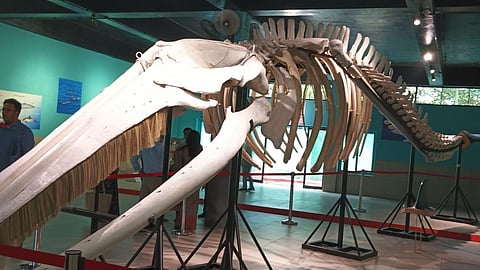
Photographs never prepare you for scale. The ribs alone were taller than me, arching like the ribs of a cathedral. The vertebrae—massive, weathered, deliberate—ran the length of the hall, telling a story of strength and motion now paused forever.
For most passers-by, it was a moment of shock. But for scientists and conservationists, it was a moment of responsibility.
The whale could not be saved. What its story could be?
In October 2023, with official permissions, the whale was buried right there at the beach. This wasn’t neglect—it was respect. Time, soil, and microorganisms would do what no machine could: return the body to nature while preserving the bones that carried its life’s blueprint.
For months, the whale remained unseen, slowly transforming beneath the sand.
Then, in June 2024, approval came from the Ministry of Environment, Forest and Climate Change to recover the skeleton. By August, a team carefully excavated the remains and transported them to ICAR–CMFRI, Kochi.
What followed was not swift work. It was patient, meticulous, human work.
The Quiet Labour behind the Science
Every bone had a history. Some were cracked. Some were incomplete. Some were heavy enough to require several people to lift together. The team cleaned, dried, treated, and preserved each piece by hand—often repeating the same process again and again.
There were no shortcuts.
Under the guidance of marine scientists and wildlife artist Mr Jiji Sam, the skeleton slowly began to take shape. Vertebrae aligned. Ribs curved back into place. The flippers—so clearly echoing ancient land-dwelling ancestors—were carefully mounted.
This wasn’t about display. It was about accuracy, dignity, and learning.
By September 2025, the whale stood whole again—not as a living animal, but as knowledge made visible.
From Loss to Learning
In February 2026, the Bryde’s whale skeleton was unveiled for public viewing at the ICAR–CMFRI Museum, Kochi. This journalist was part of a team from his fraternity that had the opportunity to witness the unveiling, thanks to PIB, which transported the group of journalists from Assam to Kochi.
The skeleton tells stories that no photograph can: how vast a whale’s lungs must be, how powerful its spine is, how closely it is related to terrestrial mammals, how fragile such magnificence becomes in a changing ocean, and the like.
This exhibit exists because a team chose to care beyond obligation. Their work, carried out under the Marine Mammal Project (PMMSY–MMSAI) of ICAR–CMFRI, turns a single stranding into a lasting lesson on marine conservation.
The whale no longer swims, but it still serves. It reminds us that oceans are not distant—they end at our shores. It reminds us that science is not cold, but deeply human. And that sometimes, the greatest acts of conservation begin after a life is lost.
Standing there, beneath bone and shadow, one thing becomes clear: the whale didn’t just come ashore. It came to be remembered—and to make us pause, learn, and care.
