
- Home
- Live Blog
- Breaking News
- Top Headlines
- Cities
- NE News
- Sentinel Media
- Sports
- Education
- Jobs
NEPAL FLOOD IS A CARBON CRIME
Dr. Lakshmi Niwas Kalwar
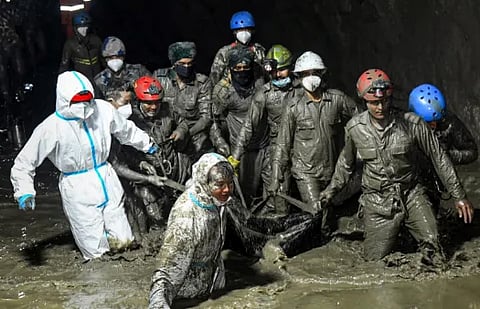
The flash flood that buried Rasuwa on 26th August 2026 was not caused by Nepal. Nepal emits 0.1% of global carbon. The flood was caused by us — by the world that emits 54 billion tonnes of CO2 every year — and the Himalayas are now collecting the bill.
When a glacier collapses in Tibet and 1,377 die in Nepal and 5,130 go missing, we call it a “natural disaster.” It is not. It is a predictable outcome of a 1.8-degree warming of the Hindu Kush Himalaya, which is warming twice as fast as the global average. This is climate injustice in its starkest form.
1. The science is clear; the victim is not the culprit
The Bhotekoshi flood was triggered by an ice-rock avalanche, a classic GLOF-like event amplified by permafrost thaw. ICIMOD has warned for a decade — there are 47 potentially dangerous glacial lakes in Nepal, Tibet and Bhutan. August’s temperature in the region was 3.2°C above normal. Permafrost that held mountains together for 10,000 years melted in a week.
Nepal’s contribution to global warming is negligible. Its annual per capita emission is 0.4 tonnes.
Compare:
USA: 14.9 tonnes per capita, 25% of all historical emissions since 1750
EU-27: 6.8 tonnes, 17% of historical emissions
China: 8.0 tonnes, 14% of historical emissions but now 32% of annual emissions
India: 1.9 tonnes, 3% historical
Nepal: 0.4 tonnes, 0.02% historical
The Himalayas store 75% of Asia’s freshwater. They are being destroyed by emissions made in Houston, Shenzhen, Berlin and Delhi — not in Rasuwa.
2. The accountability vacuum
We have a Paris Agreement that says ‘limit warming to 1.5°C.’ We are at 1.47°C already. We have a Loss and Damage Fund announced at COP28 with a pledge of $700 million — while the climate damage in 2024 alone was $2.8 trillion. Nepal’s current recovery need, as per IOM, is $20.5 million for just 43,000 people. The actual loss from this one flood is estimated at over $1.2 billion, including three hydropower plants (Rasuwa 111 MW, Trishuli 3A 60 MW, Chilime 111 MW).
Who is accountable? The UNFCCC principle is “Common but Differentiated Responsibilities and Respective Capabilities” (CBDR). It means those who polluted the most must pay the most. But the top 20 fossil fuel companies have made $52 trillion in profits since 1990 while contributing 48% of global emissions. The top 1% of global population emits more than the bottom 50%.
Yet Nepal must beg for aid. The family in Betrawati that lost 8 members will get NPR 200,000 (approx Rs. 1.2 lakh). Exxon Mobil made $36 billion profit last year.
This is not just unfair. It is unsustainable.
3. What drastic measures are needed — The Voice of the Day
If we do not want another Rasuwa, sympathy is not enough. Accountability must be fixed with legal teeth.
a) Make Carbon Accountability Legally Binding: The Loss and Damage Fund must be converted from charity to compensation. A 5% Climate Damage Tax on fossil fuel profits — as proposed by UN Secretary-General — can generate $900 billion annually. Nepal should be the first claimant, not the last applicant.
b) Himalayan Black Carbon and Glacial Audit: All infrastructure projects above 2,000 meters — hydropower tunnels, highways, ropeways — must undergo mandatory Glacial and Permafrost Risk Audit by ICIMOD, not just EIA. Nepal’s 900 missing hydropower workers are a warning: you cannot tunnel through a melting mountain.
c) Personal Carbon Accountability for Emitting Nations: Countries crossing 2 tonnes per capita must mandatorily cut 7% annually till 2030. No offset games. As a teacher, I teach my students — if you make the mess, you clean it.
d) An International Tribunal for Climate Crimes: The International Court of Justice’s advisory opinion on climate obligations in July 2025 opened the door. Nations whose policies knowingly cause transboundary glacial melt must be liable, just as they are for transboundary air pollution.
Nepal’s tragedy asks one question to The Hindu reader in Delhi, to the policymaker in Washington, to the factory owner in Guangzhou: Your carbon, their corpse — till when?
If we do not fix accountability today, tomorrow the Bhotekoshi will be the Brahmaputra, and the Rasuwa will be our own village.
(The author is a former Principal, recipient of the Assam State Best Teacher Award and Global Teacher’s Award. He works on zero-cost disaster education in 50 schools of Barak Valley.)
