
- Home
- Live Blog
- Breaking News
- Top Headlines
- Cities
- NE News
- Sentinel Media
- Sports
- Education
- Jobs
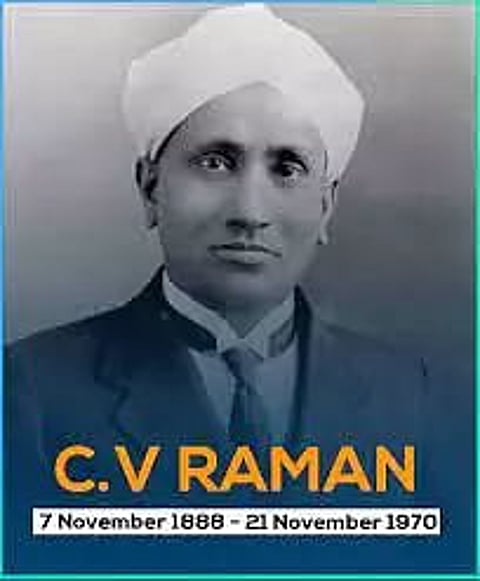
Born on 7 November 1888 in Thiruvanaikoil, Tiruchirappalli in Tamil Nadu, Sir Chandrasekhara Venkata Raman or C.V.Raman was a legendary Indian physicist known for his work in the field of light scattering. He went on to make significant contributions in the field of Science.
Born to a Tamilian brahmin family, he was intellectually very bright right from his childhood. At the early age of 11 and 13, he completed his secondary and higher secondary education from St Aloysius' Anglo-Indian High School.
At the age of 16, he was the topper in the bachelor's degree examination of the University of Madras with honours in physics from Presidency College. He completed his master's degree the following year.
At the age of 19, he joined the Indian Finance Service in Calcutta as Assistant Accountant General where he became acquainted with the Indian Association for the Cultivation of Science (IACS), the first research institute in India, which allowed him to do independent research and where he made his major contributions in acoustics and optics.
His most notable work was the Raman effect for which he received the Nobel Prize in Physics in 1930 thereby becoming the first Asian man to achieve this award in any branch of Science.
On 28 February 1928, the Raman effect was discovered. The Government of India celebrates this day annually as National Science Day. He also became the first Indian to have received the prestigious Bharat Ratna Award, the highest civilian award.
At the end of October 1970, Raman met with a cardiac arrest and collapsed in his laboratory. He was immediately rushed to the hospital where doctors diagnosed his condition and declared that his death is imminent and that it is unlikely for him to survive for more than four hours.
Surprisingly, he managed to survive for a few days and requested to stay in the gardens of his institute surrounded by his followers. He ultimately succumbed to his illnesses and passed away on the morning of 21 November 1970 at the age of 82.
He has left a long-lasting legacy in the field of science and his works continue to inspire science enthusiasts to this day.
Also watch: