
- Home
- Live Blog
- Breaking News
- Top Headlines
- Cities
- NE News
- Sentinel Media
- Sports
- Education
- Jobs
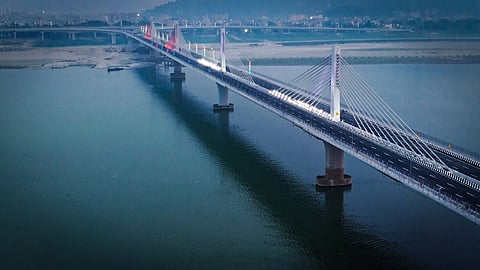
On 14 February 2026, Prime Minister Narendra Modi inaugurated the Kumar Bhaskar Varma Setu, a six‑lane extradosed bridge over the Brahmaputra that links Guwahati with North Guwahati.
Built at an estimated cost of around ₹3,000–3,300 crore, this prestressed concrete structure is the first extradosed bridge in the Northeast and a centrepiece of the BJP-led government’s infrastructure push in Assam.
By cutting travel time between the two banks from 45–60 minutes to just 7–10 minutes, it promises to reshape the city's daily commute, ease pressure on existing crossings like the Saraighat bridge, and lay the physical foundations for a genuine twin‑city model around the state capital.
Yet beyond engineering specifications and travel-time reductions, the bridge’s deeper resonance lies in its name. It honours Kumar Bhaskar Varman, the most distinguished ruler of the Varman dynasty of Kamarupa, a 7th-century monarch whose reign positioned Assam at the centre of eastern India’s political and civilisational map.
For much of the colonial period, the history of Kamarupa and its kings was framed through an external, often dismissive lens. British administrators tended to view Assam as a remote frontier, making it strategically important but culturally insignificant. The rich history of the Varman dynasty was suppressed, and the narrative of Kamarupa became a marginal border kingdom rather than a decisive player in the subcontinent’s story.
Later, many ideological currents in Indian historiography, including strong left‑leaning schools, focused overwhelmingly on a few “core” regions and empires of the Indo‑Gangetic plains. Assam and the Northeast, despite their rich inscriptions, copper‑plate grants, and references in texts like the Harshacharita and Xuanzang’s travelogue, often received only passing attention.
The result was a distorted picture in which Kumar Bhaskar Varman’s role as ally of Harsha, defender of the eastern frontier, and patron of learning and Dharma was drastically understated.
On this historic occasion, as the Kumar Bhaskar Varma Setu draws public attention to his name, revisiting his life is more than an academic exercise. It is a long‑overdue historical correction that re‑centres Kamrup in the story of India and invites younger generations to see themselves as inheritors of a legacy of statecraft, scholarship, and spiritual pluralism.
Kumar Bhaskar Varman (c. 600–650 CE) was the final and most illustrious ruler of the Varman dynasty. His reign marked both the culmination of an era and the establishment of Kamarupa as a structured, diplomatically active kingdom.
He inherited a state that had survived military pressures from Gauda and Magadha. What he achieved was not merely survival, but strategic repositioning. Let’s look at the highlights of Kumar Bhaskarvarman’s life and his kingdom.
At its height under Bhaskar Varman, Kamarupa extended:
From the Karatoya River in the west
Across the Brahmaputra Valley
To the Himalayan foothills and eastern hill frontiers
The kingdom was traditionally organised into four pithas: Kampeeth, Ratnapeeth, Saumarpeeth, and Suvarnapeeth. This indicates territorial segmentation and administrative clarity.
This was not an amorphous frontier region. It was a geographically defined and politically structured state.
One of Bhaskar Varman’s most consequential decisions was forging an alliance with Harshavardhana of Kanauj.
At a time when Shashanka of Gauda was expanding aggressively, Bhaskar Varman and Harsha formed a coordinated political axis that altered eastern India’s power balance. This alignment effectively pressured Gauda from two directions.
This strategic positioning demonstrates that Kamarupa functioned as a geopolitical pivot rather than a cultural margin.
One of the most valuable external testimonies of Bhaskar Varman’s reign comes from the Chinese monk Xuanzang, who visited Kamarupa around 643 CE. He described Kamarupa as:
A well-administered kingdom
A capital approximately 30 li (roughly 15 kilometers) in circumference
A disciplined and resilient population
A ruler intellectually inclined and generous
Few regions in eastern India during this period received such detailed foreign documentation. The fact that Kamarupa appears prominently in Xuanzang’s travelogue signals its recognised stature in 7th-century Asia.
Bhaskar Varman’s reign reflects strong patronage of Vedic learning and Sanskrit scholarship. His copper-plate grants document land endowments to Brahmins and religious institutions. His reign reflects:
Promotion of Vedic learning
Support for Sanskrit scholarship
Administrative patronage of religious establishments
While personally aligned with Brahmanical traditions, accounts suggest he maintained an environment of plural engagement, including respect for Buddhist institutions.
His self-identification with legendary figures such as Narakasura and Bhagadatta connected Kamarupa to epic and Puranic traditions, integrating Assam’s sacred geography, particularly the Nilachal–Kamakhya region, into the broader Indic narrative universe.
The Kumar Bhaskar Varma Setu forms part of a broader 8.4-km connectivity corridor designed to decongest central Guwahati and accelerate the evolution of a functional twin-city model with North Guwahati.
The bridge itself spans approximately 1,240 metres and has been executed under the EPC (Engineering, Procurement & Construction). Designed for a projected lifespan of nearly 100 years, it represents a high-specification intervention suited to the Brahmaputra’s demanding environment.
Advanced structural measures include:
Base-isolation using friction pendulum bearings to mitigate seismic shocks
High-performance stay cables for enhanced stability
A Bridge Health Monitoring System (BHMS) for continuous real-time structural assessment
Anti-carbon protective coatings suited to aggressive riverine conditions
Dynamic architectural lighting
A dedicated rescue station and grade-separated approaches
From an urban perspective, the bridge materially alters mobility patterns. The reduction in cross-river travel time affects commuter flows, freight logistics, emergency access, institutional connectivity, and long-term land value distribution. It reduces dependency on the ageing Saraighat crossing, which has borne heavy traffic loads for decades.
Historically, Guwahati’s growth has been concentrated along the south bank. The new crossing redistributes development pressure, encouraging institutional, residential, and commercial expansion in North Guwahati and subtly reshaping the metropolitan geometry of Assam’s capital region.
The Kumar Bhaskar Varma Setu is engineered for seismic resilience and designed for a 100-year life span. It reduces cross-river travel from nearly an hour to under 10 minutes and contributes to Guwahati’s transformation into a balanced twin city. Yet its most enduring dimension may be symbolic.
In the 7th century, Bhaskar Varman connected Kamarupa to the larger political currents of India through diplomacy, cultural patronage, and strategic foresight. In the 21st century, a bridge bearing his name connects two banks of the Brahmaputra while reconnecting Assam with an important chapter of its statecraft and civilisational history.
The structure stands in steel and concrete. The legacy it recalls stands in inscription, alliance, and memory.
