
- Home
- Live Blog
- Breaking News
- Top Headlines
- Cities
- NE News
- Sentinel Media
- Sports
- Education
- Jobs
Staff Reporter
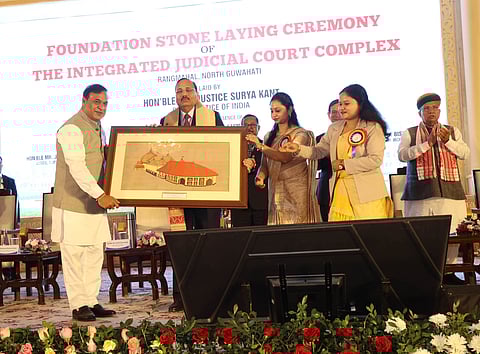
Guwahati: On Sunday, Chief Justice of India (CJI) Justice Surya Kant, in the presence of Chief Minister Dr Himanta Biswa Sarma, laid the foundation stone for the proposed Integrated Judicial Court Complex in Rangmahal, North Guwahati.
Delivering his speech on the occasion as the chief guest, Justice Surya Kant said, “Assam has always held a special place in India’s historical and constitutional imagination. This land has taught us that diversity is not a challenge to unity but its greatest strength. Shaped by the mighty Brahmaputra River and sustained by a rich mosaic of cultures, languages and traditions, this region embodies resilience, harmony with nature, and a deep sense of community. Standing here today, I’m reminded that justice, like this land, must progress steadily and inclusively, reaching everyone without obstruction or exclusion. Living amidst some of the most challenging terrains of this country has shaped how various communities understand protection and access. Assamese culture in particular reflects this through symbols like the Japi, the traditional conical hat that shelters all who wear it, asking nothing of status or background. Institutions here also must embody this quality, namely, accessible despite difficult geography and protective of everyone’s dignity.”
Expressing his delight on laying the foundation stone for the proposed integrated court complex, the Chief Justice of India observed, “It is in this spirit that we lay the foundation stone of the integrated court complex today, a comprehensive institution spanning hundreds of bighas, designed to house all facilities under one roof. And while laying the foundation stone, the CM has minutely explained all the modern-day facilities and a requirement that will probably be able to meet at least the next fifty years of requirements of the legal fraternity. All those issues have been rightly addressed in the proposed complex. I therefore believe that the ceremony that we have just completed represents far more than the commencement of a construction project. It is a reaffirmation of a constitutional guarantee, and the law must never appear remote, forbidding or out of reach. This commitment is fundamental and characterized by the region’s complex geography and social diversity.”
On the efficacy of the new integrated court complex, CJI Justice Surya Kant said, “In the context of reimagining justice delivery, I believe that the concept of an integrated court complex echoes a mature, contemporary and futuristic approach to how courts must serve. Dispute resolution is not confined to the courtroom or to the moment a judgement is delivered. It is a process that begins when someone brings a dispute to the court and continues until it is finally determined. This process of delivering justice involves judges, lawyers, consumers of justice, prosecutors, court staff, legal aid institutions and various other alternative dispute resolution mechanisms. When these components operate in isolation, the experience of delivery mechanisms becomes fragmented and exhausting. On the other hand, when they function together in tandem, justice becomes coherent, efficient and humane. Therefore, integration is not just an architectural concept; it is about how the system works as a whole. For litigants, the challenge often begins not in the courtroom but simply in how to reach there. I have seen how exhausting it is when litigants are required to move in courts across the city, from the high courts to the district courts and then to legal aid offices located somewhere else. The burden of travel and navigation drains the energy that would otherwise be spent on presenting their case.”
Expressing his opinion on the requirement for the new complex, he said, “I am personally so delighted that this integrated court complex will fundamentally change this experience for the consumer of justice. By bringing together the high court, the district judiciary of Kamrup Metro and all essential services in a single accessible location, it will enable people to focus on what truly matters, namely being heard and seeking justice rather than merely navigating the system. For members of the legal fraternity, I’m so happy that hundreds and hundreds of you have joined this historical occasion. For you, a fragmented infrastructure is not merely a matter of logistical inconvenience; it is a systemic barrier that stifles the evolution of a lawyer’s career. Today, our court complex is often seen as largely saturated with available space dominated by senior members who have leveraged their longevity. This leaves the rising generation of rising and brilliant lawyers, as my brother Ujjal also expressed his concern about it. The young and brilliant lawyers, especially the next generation of lawyers, those with a global vision, which is necessary for our future – if they are left without so much as a space to consult with their clients, what’s going to happen to them? Forced to commute between disparate forums, these new entrants in the profession face an impractical and unfair burden that limits their growth and preserves an unhealthy monopoly within the bar.”
Stating his intent to encourage the new generation, the CJI stated, “As the head of the Indian judiciary, my priority is to the development of future infrastructure that empowers those who are yet to find their way rather than catering to those who have already reaped the full harvest of their profession. They must also be given sufficient space, but my concern as the head of the institution is about the young lawyers, the future lawyers who are studying in law schools right now, and those who have a vision to join the bar. Their needs also we need to cater to well before time, particularly when we know after a time it will be difficult to have an open space for development of infrastructure near the cities and especially when we’re talking of a city which is the capital headquarters of a state.”
Regarding the Gauhati High Court Bar Association members that are protesting the shifting of the high court, the CJI said, “It came as a surprise when it was brought to my notice that some of the members of the bar association are opposing this infrastructure development. I believe either they are ill-informed or, unfortunately, they are not realizing the need and the necessity for the young members of the bar and of those who are in queue to join the profession. We hope, and I still firmly believe, that each one of them will realize that the personal vested interest, only because you might be having a good office near the old complex, should not be a valid or justified ground to hamper the development of a modern-day infrastructure which is a completely futuristic concept. In this backdrop, I earnestly appeal to the state government and the chief justice of the high court to ensure that every young lawyer, regardless of socio-economic background or professional seniority, be accommodated and be provided with adequate space to practise. I also propose a tiered approach while young entrants must be accommodated as a matter of right...”
He went on to add, “But in any case, I’m so happy to see the complex is so wide. The state government has decided to spend so liberally that it takes care of all the future, young, senior, and those who are already well established in practice that each one of you will respectfully accommodate it.”
Former Chief Justice of India, Ranjan Gogoi, attended the programme virtually. Supreme Court Judges Justices Ujjal Bhuyan, Sandeep Mehta, N. Kotiswar Singh and Vijay Bishnoi; several former judges of the Supreme Court; former Chief Justices of the Gauhati High Court; the current Chief Justice of the Gauhati High Court, Justice Ashutosh Kumar; Chief Justices of the High Courts of Tripura, Manipur and Meghalaya; and others were present. Union Minister of State (Independent Charge) for Law and Justice Arjun Ram Meghwal, Minister Ranjeet Kumar Dass, Chandra Mohan Patowary, the Registrar of the Gauhati High Court, the Advocate Generals of Assam, Nagaland and Arunachal Pradesh, representatives of the Bar Council, a large number of advocates and eminent members of the judicial fraternity, Chief Secretary Dr Ravi Kota, Director General of Police Harmeet Singh and other senior government officers and other dignitaries were present on the occasion.
Also Read: Between tradition and transformation: The great debate over shifting