
- Home
- Live Blog
- Breaking News
- Top Headlines
- Cities
- NE News
- Sentinel Media
- Sports
- Education
- Jobs
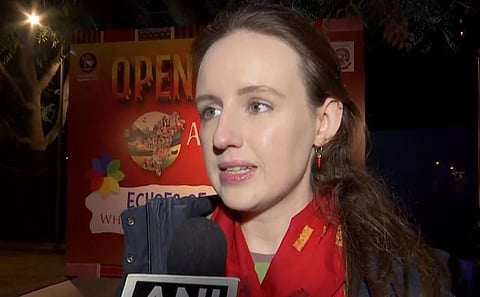
New Delhi: When Perrine Legoullon speaks about the Xatriya art form, her voice carries the conviction of someone who has not merely learnt a dance form, but entered a living tradition. A French national who has spent the last seven to eight years in India, Perrine's journey from Paris to understanding the Xatriya tradition of Assam reflects the growing global resonance of one of India's classical dance forms.
Perrine was first introduced to Xatriya far from its birthplace. Living in Paris at the time, she attended a performance by renowned Xatriya exponent Adhyapak Bhabananda Borbayan.
"I first saw the Xatriya performance when I was living in Paris. It was a performance by Adhyapak Bhabananda Borbayan. And that's when I first got exposed to Xatriya and got interested in learning about the art form," she recalls, talking to ANI. Already trained in Odissi, another Indian classical dance form, Perrine moved to India in 2018 after completing her Master's degree, determined to immerse herself further in Indian classical dance.
Delhi became her base, where she began formal training in Xatriya under Adhyapika Meenakshi Medhi.
"I moved to Delhi in 2018, and I started learning with Adhyapika Meenakshi Medhi and completed my Gunin with her," she says.
Explaining the essence of Xatriya, Perrine describes it as both classical and ritualistic.
"So, Xatriya is a classical dance form from Assam, which was the latest one to get that recognition in the year 2000. And it's a ritualistic art form that is still practised in the xatras (Vaishnavite monasteries) of Assam by Bhakats (followers of Xatriya tradition)," she explains.
Rooted in Bhakti, the art form retains its spiritual core. Rooted in the Bhakti movement initiated by Mahapurush Srimanta Sankardeva in the 15th-16th century, Xatriya combines dance, drama, music and devotion.
While the dance form originated within the xatras, Perrine notes that it has expanded beyond monastery walls in recent decades.
"In the past few decades, it has also come out, and thanks to several Adhyapaks that have come out of the xatras, more and more people got to learn Xatriya Nritya," she adds.
Although based in Delhi, Perrine makes a point of visiting Assam whenever possible.
"I'm living in Delhi. When I go to Assam, I visit the xatras. I don't stay there, but I stay nearby and keep going whenever I get the chance to," she shares, speaking to ANI.
As a foreign national practising an Indian art form, Perrine has observed growing global interest in Xatriya.
"I think slowly there are more and more foreigners who are getting to know about Xatriya and are learning it also," she says. She points to the expanding reach of the tradition, noting, "My Adhyapika also has another student who is in Chile, in South America."
Learning Xatriya, as expected, came with its own challenges.
"It's always (important) especially to understand the culture, the language, the meaning of the text, (and) all that takes time," Perrine admits.
While the physical aspect of training was manageable due to her dance background, the deeper cultural understanding required patience.
"It does take some time, especially with the language and understanding the meaning, and understanding the nature of Bhakti also in this specific tradition. It took some time, but now I would say I am more comfortable with it."
Contrary to frequent concerns about cultural disinterest among youth, Perrine believes young people are actively learning Xatriya dance and its traditions.
"Yes, they are practising. I feel that they are practising," she says. "There are a lot of youngsters who are learning Xatriya. Now, if you go to Assam, especially since recognition, it feels that every family has somebody who is learning Xatriya."
She, however, stresses the importance of encouragement through different festivals and scholarships.
Asked what her family's response was back in Paris when she made up her mind to immerse in the Indian art form, she says the family's reaction to her artistic path was one of support.
"Their reaction was very positive. They have always supported me," she says, adding that while her choice surprised them, "they've been nothing but supportive."
Looking ahead, Perrine hopes to take Xatriya to a broader European audience.
"We'd love to plan in the future to have workshops and performances across Europe to try to spread this art form as much as possible," she says, when asked if she would take this art form to the world. Her husband, Partha Pratim Hazarika, an Indian citizen, is also a Xatriya dancer and NSDian.
In Perrine Legoullon's journey, Xatriya finds not just a practitioner but a passionate cultural ambassador of the art form. (ANI)
