
- Home
- Live Blog
- Breaking News
- Top Headlines
- Cities
- NE News
- Sentinel Media
- Sports
- Education
- Jobs
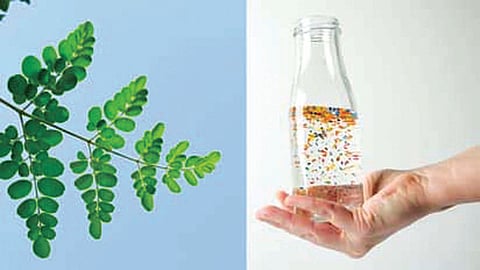
Scientists in Brazil have found that seeds from the moringa tree — a plant native to India and widely consumed across tropical regions for its nutritional value — can pull microplastics out of water with an effectiveness that rivals conventional chemical treatments.
The findings, published in ACS Omega, a journal of the American Chemical Society, come from researchers at the Institute of Science and Technology of São Paulo State University (ICT-UNESP) in São Jose dos Campos.
The key lies in a process called coagulation. Microplastics and other contaminants carry a negative electrical charge, which causes them to repel each other and resist capture during filtration.
Coagulants neutralise these charges, causing particles to clump together into larger clusters that are far easier to filter out. Moringa seed extract — which can be prepared at home using a saline solution — works through exactly this mechanism.
The research focused on in-line filtration, where water is treated with a coagulant and then passed through a sand filter — an approach suited to water with low turbidity that requires fewer preliminary treatment steps.
Also Read: Moringa Health Boost: Vitamins, Antioxidants, and More
The results were striking. Moringa seed extract performed comparably to aluminium sulfate, the chemical coagulant currently used in water treatment plants to remove microplastics.
"We showed that the saline extract from the seeds performs similarly to aluminum sulfate," said Gabrielle Batista, the study's first author. "In more alkaline waters, it performed even better than the chemical product."
Lead researcher Professor Adriano Goncalves dos Reis noted that aluminium sulfate does have a drawback — it increases dissolved organic matter in treated water, which can add cost to the overall process. Moringa, by contrast, is biodegradable and leaves no residual toxicity.
"On a small scale, such as on rural properties and in small communities, the method could be used cost-effectively and efficiently," he said.
To evaluate the method, the team added polyvinyl chloride (PVC) microplastics to tap water. PVC was selected because it is considered among the most harmful plastics for human health, carrying known mutagenic and carcinogenic properties, and because it commonly persists in water bodies even after conventional treatment.
The PVC was aged under ultraviolet radiation to better simulate real-world microplastic conditions. Results were then measured using scanning electron microscopy to count particles before and after treatment.
Both moringa extract and aluminium sulfate showed similar levels of microplastic removal.
The research team is now testing moringa seed extract on water from the Paraiba do Sul River, which supplies São Jose dos Campos. Early results suggest the method holds up in natural water conditions as well.
With regulatory scrutiny of aluminium- and iron-based coagulants increasing over concerns about biodegradability and long-term toxicity, researchers say the search for sustainable alternatives has never been more urgent — and moringa may be one of the more practical answers available.
